
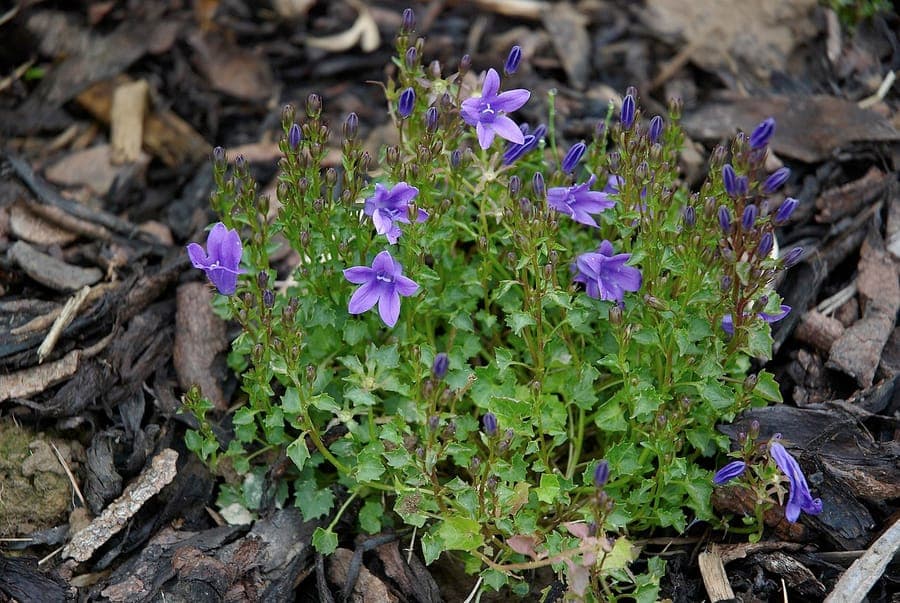
Wouter Hagens / CC BY-SA 3.0, via Wikimedia Commons
Adria bellflower: complete guide
Campanula portenschlagiana
Want to see Adria bellflower: complete guide in your garden?
1 minute, no credit card
Overview
Campanula portenschlagiana, better known as Adria bellflower, is a charming creeping perennial from the Campanulaceae family. Native to rocky crevices in Croatia and the former Yugoslavia, this hardy little plant has become a favourite among gardeners across temperate climates. It forms dense, cushion-like mats just 10 to 15 cm tall, spreading up to 30 cm wide, making it ideal for rock gardens, wall crevices, or front borders. Its long bloom period and minimal care needs make it a standout choice for low-maintenance spaces.
Adria bellflower thrives where other plants struggle – in poor soil, dry conditions, and tight spaces. On gardenworld.app, you can design a garden layout that highlights its cascading habit and integrates it with structural hardscaping.
Appearance & bloom cycle
The plant features small, dark green, oval leaves with slightly toothed edges, forming a dense evergreen carpet. From late June through August, it sends up stiff flowering stems topped with vivid blue, bell-shaped flowers about 2 cm long. Each bloom opens into a five-pointed star, creating a sea of blue when planted in groups. The flowering period is remarkably long, and with a light trim after blooming, you can encourage a second, lighter flush in early autumn.
Unlike some campanulas, it doesn't self-seed aggressively, so it stays where you plant it. Over time, the mat thickens, and older clumps may develop a slightly bare centre – a sign it's time for division.
Ideal location
Full sun to light shade is best. At least 5–6 hours of direct sunlight daily ensures the tightest growth and most abundant flowering. In heavy shade, stems stretch and flowering reduces. It excels in rock gardens, between paving stones, or spilling over low retaining walls.
Its natural habitat – limestone cracks and dry slopes – tells you exactly what it likes: sharp drainage and open exposure. It's perfect for gravel gardens, green roofs, or alpine beds. On gardenworld.app, visualise how Adria bellflower flows over stone steps or softens a stone path edge with natural texture.
Soil requirements
Well-drained, lean soil is key. Avoid heavy clay unless amended with grit, sand, or perlite. A pH between 6.0 and 7.5 is ideal. In containers, use a mix of potting soil and 30% horticultural grit to prevent waterlogging.
Don't enrich the soil with compost or manure – Adria bellflower prefers poor to moderately fertile conditions. Too much fertility leads to floppy growth and fewer flowers.
Free design
Want to see Adria bellflower: complete guide in your garden? Make a free design now.
Watering
Once established, this plant is highly drought-tolerant. Water regularly during the first few weeks after planting, especially if installed in spring or early summer. After that, rainfall is usually sufficient. Only water during prolonged dry spells (three weeks or more without rain), and always let the soil dry between waterings.
In pots, check the top 2–3 cm of soil weekly. Water only when dry. Never let it sit in saucers of water – root rot is the main risk.
Pruning
Deadhead spent flowers by cutting stems back to the leaf rosette after blooming. This tidies the plant and may trigger a second, lighter bloom. Use clean, sharp scissors and avoid cutting into old wood.
Every 3–4 years, lift and divide the plant in early spring or autumn. Discard the woody centre and replant the healthy outer sections. This keeps the mat lush and prevents dieback.
Maintenance calendar
- Jan: Check for frost damage; no action needed
- Feb: Leave undisturbed
- Mar: Remove debris, inspect for new growth
- Apr: Light feeding with slow-release granular fertiliser (optional)
- May: Monitor for drought stress, finalise spring planting
- Jun: Blooming begins; water if dry
- Jul: Peak bloom; deadhead regularly
- Aug: Trim after flowering, divide older clumps
- Sep: Allow new foliage to develop; reduce watering
- Oct: Stop fertilising, prepare containers for winter
- Nov: Leave foliage in place for winter protection
- Dec: Protect container-grown plants from freeze-thaw cycles
Winter hardiness
Adria bellflower is hardy to USDA zone 5 (–15°C). In garden borders, it survives most winters without protection. Foliage may bronze in cold weather but rebounds quickly in spring. Container plants are more vulnerable – insulate pots or move to a sheltered spot to prevent root damage from repeated freezing.
Avoid winter mulch directly over the crown, as it can trap moisture and encourage rot.
Companion plants
Pair it with drought-tolerant, sun-loving plants like Sedum rupestre, Thymus vulgaris, or Arabis caucasica. It contrasts beautifully with silver-foliaged plants like Artemisia schmidtiana or woolly thyme. Avoid vigorous spreaders like mint or Lamium, which can overwhelm it.
In a rock garden, combine with dwarf conifers, Sempervivum, or small ferns like Polypodium vulgare for layered texture.
Closing
Adria bellflower is a quiet achiever in the garden – it doesn't demand attention, but it delivers beauty year after year. It's reliable, long-blooming, and perfect for challenging spots. You'll find it at garden centres across the UK, including local independents and larger chains. Plant in groups of 5–7 per square metre for full coverage. With minimal effort, it creates a living carpet that softens hard edges and brings colour to overlooked spaces.
Want to see Adria bellflower: complete guide in your garden? Make a free design now.
Upload a photo, pick a style, and get a photorealistic design with plant list in under a minute.
No credit card required


Similar plants
Campanula alaskana: complete guide
Campanula alaskana
Discover Campanula alaskana, the delicate alpine bellflower from Alaska. Growing tips, hardy requirements, and design ideas for rock gardens and alpine troughs.
Campanula scouleri: complete guide
Campanula scouleri
Discover Campanula scouleri, the refined Pacific bellflower. Growing tips, care requirements, and design ideas for woodland and mountain gardens.
Doublehorn calicoflower: complete guide
Downingia bicornuta
All about Downingia bicornuta - the doublehorn calicoflower: sowing, location, bloom and care for this rare annual in your garden.