
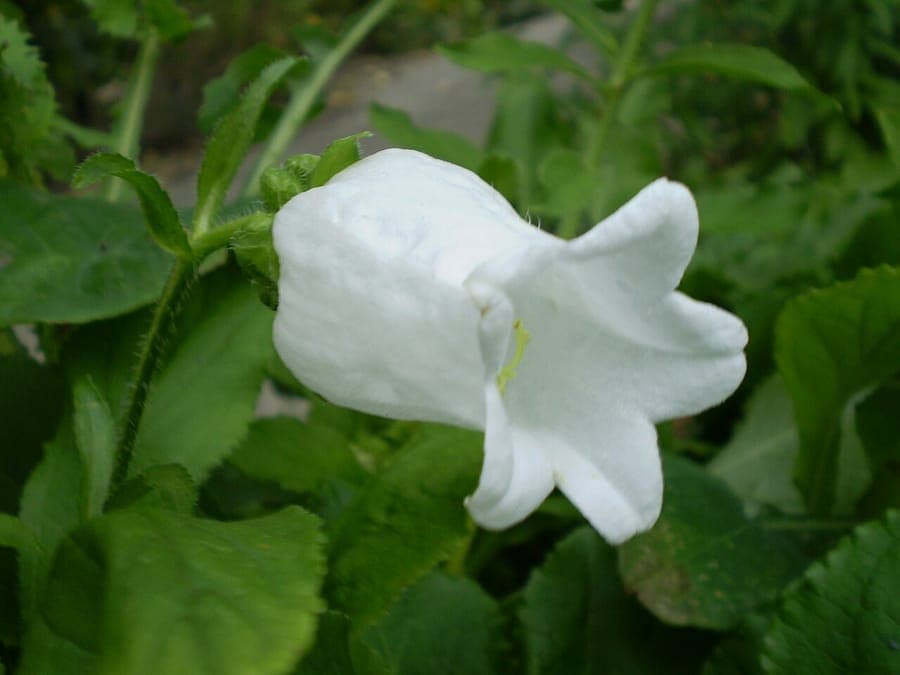
Rob Hille / Public domain, via Wikimedia Commons
Cup-and-saucer: complete guide
Campanula medium
Want to see Cup-and-saucer: complete guide in your garden?
1 minute, no credit card
Overview
Campanula medium, better known as Cup-and-saucer, is a cottage garden staple that brings old-world charm to modern plots. This biennial (sometimes short-lived perennial) forms a rosette in its first year and sends up tall, upright stems topped with clusters of bell-shaped blooms in its second. It typically reaches 60–90 cm in height and thrives in USDA zones 6–8. Though native to France and Italy, it's adapted well to temperate gardens across Europe and North America.
What sets Cup-and-saucer apart is its elegant two-tiered flower structure-each bloom looks like a cup resting on a saucer. The plant has a graceful, airy habit that works well in informal borders, woodland edges, or even large containers. If you're planning a layered planting scheme, gardenworld.app lets you visualise how Campanula medium fits into your garden's vertical structure and seasonal rhythm.
Appearance & bloom cycle
The flowers are the showstoppers-usually deep blue or lavender, though white and pink cultivars exist. They bloom from May through July, with peak flowering in June. Each stem carries multiple nodding bells, arranged in loose racemes. The foliage is coarse, dark green, and slightly hairy, forming a basal rosette in year one. In year two, flowering stems emerge, and the plant rarely survives beyond that unless it self-seeds.
Some gardeners treat it as a short-lived perennial by letting it reseed freely. The seedlings often pop up in spring, about 30 cm apart, creating a naturalised look. For a continuous display, stagger sowings in June and July so you have plants at different stages.
Ideal location
Cup-and-saucer prefers partial shade, scoring a 5 out of 10 on the light scale. Too much direct sun, especially afternoon heat, stresses the plant and shortens bloom time. A north- or east-facing border is ideal. It also grows well under light tree canopy or beside taller perennials that provide light shade.
Avoid hot, dry spots. It likes consistent moisture and shelter from strong winds. If your garden is exposed, consider planting near a low wall or shrub hedge. On gardenworld.app, you can simulate sun patterns across your garden to find the perfect microclimate for this plant.
Soil requirements
This Campanula likes well-drained, moderately fertile soil with a pH between 7.0 and 7.5. It tolerates chalky or limestone soils but struggles in acidic conditions below pH 6.5. If your soil is too acidic, lightly amend with ground limestone in autumn.
Heavy clay should be improved with grit and compost to prevent waterlogging. Sandy soils benefit from added organic matter to retain moisture. A mix of garden soil, compost, and horticultural grit works well in borders or containers.
Free design
Want to see Cup-and-saucer: complete guide in your garden? Make a free design now.
Watering
Water regularly during dry spells, especially in spring and early summer. Aim for deep, infrequent watering rather than daily sprinkles-this encourages deeper root development. Avoid wetting the foliage to reduce the risk of powdery mildew.
Plants in pots dry out faster, so check daily in warm weather. Use rainwater when possible; it's softer and helps maintain soil pH. Never let the plant sit in water-drainage holes in containers are essential.
Pruning
Deadhead spent flowers to encourage a second, lighter flush in late summer. Cut back flowering stems to just above a leaf node once blooming finishes. Leave the basal rosette intact over winter-it may survive mild winters and flower the following year.
If you want to collect seed, allow a few stems to mature and self-sow. Note that seedlings may vary in colour. Self-sown plants often appear in cracks in paths or at the edge of borders-this spontaneity is part of their charm.
Maintenance calendar
- March: Check overwintered rosettes. Remove any dead or damaged leaves.
- April: Begin light feeding. Keep soil evenly moist.
- May: Flowering begins. Water consistently. Avoid high-nitrogen fertilisers.
- June: Peak bloom month. Deadhead regularly.
- July: Final flowering phase. Cut back finished stems.
- August: Collect seed or let it self-seed. Watch for volunteer seedlings.
- September–November: Plants go dormant. Leave basal growth in place.
- December–February: Protect rosettes in harsh winters with a light mulch of straw or leaf mould.
Winter hardiness
Cup-and-saucer is hardy in zones 6–8 (down to -15°C). In zone 6, a light mulch helps prevent frost heave. In colder areas, the rosette may die back, but self-sown seedlings often replace it. Avoid heavy mulching-this can trap moisture and cause rot.
Container-grown plants are more vulnerable. Move pots to a sheltered spot or wrap them in hessian. Avoid using plastic covers, which encourage condensation and fungal issues.
Companion plants
Pair Campanula medium with other partial-shade lovers like Digitalis, Aquilegia, or Brunnera. The blue tones contrast beautifully with yellow or white flowers-try it with Euphorbia or white Geranium cultivars. It also blends well with ferns and hostas in woodland settings.
Avoid aggressive spreaders or heavy feeders that could overshadow or outcompete it. Plant in odd-numbered groups (3, 5, 7) for a natural look. You'll often find young plants or seed packets at garden centres like those in the UK, or online through trusted suppliers.
Closing
Cup-and-saucer is a no-fuss, high-reward plant that adds vertical interest and soft colour to the mid-border. It's not flashy, but it's dependable-blooming reliably when sited correctly and requiring minimal fuss. Let it self-seed, and you'll enjoy its presence year after year with little effort.
If you're unsure where to place it in your layout, try gardenworld.app. You can build a custom garden plan that accounts for bloom time, height, and spacing-ensuring your Cup-and-saucer shines without overcrowding.
Want to see Cup-and-saucer: complete guide in your garden? Make a free design now.
Upload a photo, pick a style, and get a photorealistic design with plant list in under a minute.
No credit card required


Similar plants
Campanula alaskana: complete guide
Campanula alaskana
Discover Campanula alaskana, the delicate alpine bellflower from Alaska. Growing tips, hardy requirements, and design ideas for rock gardens and alpine troughs.
Campanula scouleri: complete guide
Campanula scouleri
Discover Campanula scouleri, the refined Pacific bellflower. Growing tips, care requirements, and design ideas for woodland and mountain gardens.
Doublehorn calicoflower: complete guide
Downingia bicornuta
All about Downingia bicornuta - the doublehorn calicoflower: sowing, location, bloom and care for this rare annual in your garden.