
Kurt Stüber [1] / CC BY-SA 3.0, via Wikimedia Commons
Greater bellflower: complete guide
Campanula latifolia
Want to see Greater bellflower: complete guide in your garden?
1 minute, no credit card
Overview
Campanula latifolia, commonly known as greater bellflower, is a statuesque perennial that brings vertical interest and soft elegance to gardens from midsummer into early autumn. Native to forested areas across central and eastern Europe - including Austria, Finland, and the Baltic States - it thrives in the cooler, moist conditions typical of woodland margins. In the UK and northern Europe, it reaches heights of 80 to 120 cm, making it ideal for the middle or back of a border.
This plant isn't flashy or demanding, but it delivers consistent performance with minimal fuss. Once established, it returns reliably each year, forming sturdy clumps that slowly expand. On gardenworld.app, you can design a border layout that uses its height and bloom time to create rhythm and depth in your garden.
Appearance & bloom cycle
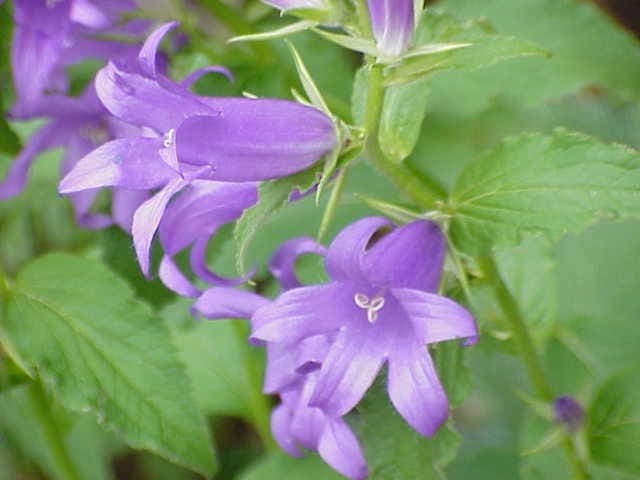
Greater bellflower features broad, heart-shaped basal leaves and upright, hairy stems lined with smaller, clasping foliage. From June through August, it produces drooping, bell-shaped flowers in a rich sky-blue - occasionally white or pale lavender in cultivated varieties. Each bloom is 3 to 5 cm long, facing downward along one side of the stem, giving the plant a graceful, arching habit.
It blooms for 6 to 8 weeks, peaking in July. The flowers attract bees and hoverflies, adding ecological value. While it may self-seed lightly, it's not invasive and seedlings are easy to remove or transplant.
Ideal location
Aim for partial shade (light level 5/10) - think dappled sun under light tree canopies, north-facing borders, or sheltered spots near shrubs. Full sun works only if the soil stays consistently moist. In dry, exposed areas, the plant will struggle, producing shorter stems and fewer flowers.
It's a natural fit for cottage gardens, wildlife borders, or shaded perennial beds. Pair it with plants that offer textural contrast, like ferns or hostas. On gardenworld.app, you can experiment with plant combinations to see how greater bellflower fits within your existing palette.
Soil requirements
This bellflower likes fertile, humus-rich soil with good drainage and a neutral to slightly alkaline pH (7.0–7.5). It grows well in loam or sandy loam but dislikes heavy clay unless amended with compost. Avoid acidic soils - it won't thrive below pH 6.5.
At planting, mix in well-rotted compost or manure to boost organic matter. Mulch annually in spring to retain moisture and suppress weeds.
Free design
Want to see Greater bellflower: complete guide in your garden? Make a free design now.
Watering
Water regularly during the first growing season to help roots establish. Once mature, it tolerates occasional dry spells but performs best with consistent moisture. During hot, dry summers, give a deep soak once a week, especially if planted in full sun or shallow soil.
Avoid overhead watering when possible - wet foliage can encourage fungal issues in humid conditions.
Pruning
Deadhead spent flowers to encourage a cleaner look and reduce self-seeding, or leave them for winter interest and seed-feeding birds. After flowering, cut stems back to 10–15 cm above ground to tidy the plant. In spring, remove any dead or damaged leaves before new growth emerges.
Don't cut back too early - the old foliage provides some winter protection and helps mark where the plant is.
Maintenance calendar
- Jan: check for rot in wet winters
- Feb: no action needed
- Mar: clear old foliage, lightly fork soil around base
- Apr: new growth appears; apply compost mulch
- May: watch for slugs; increase watering as growth accelerates
- Jun: flowering begins; monitor for drought stress
- Jul: peak bloom; ensure consistent moisture
- Aug: flowering continues; seed heads form
- Sep: cut back stems; collect seeds if desired
- Oct: tidy garden; leave some seed heads for wildlife
- Nov: mulch lightly; protect from waterlogged soil
- Dec: dormant period; avoid disturbing root zone
Winter hardiness
Campanula latifolia is hardy in USDA zones 4–8, surviving temperatures down to -30°C. In the UK and most of northern Europe (zones 7–8), it overwinters with no protection. The top growth dies back, but the crown remains alive underground.
Ensure good winter drainage - soggy soil is the main threat. In heavy clay areas, consider planting on a slight slope or raised bed.
Companion plants
Choose partners with similar moisture and light needs. Good companions include Geranium 'Johnson's Blue', Astrantia, Helleborus, and Digitalis. It also pairs beautifully with silver-foliaged plants like Artemisia or Stachys byzantina for contrast.
Avoid aggressive spreaders like mint or ground elder, which can overpower it.
Closing
Greater bellflower is a quiet achiever - not the loudest in the border, but one of the most dependable. Its tall, blue spires add elegance without dominating, and its care needs are minimal. It's perfect for gardeners who value structure, seasonal rhythm, and subtle beauty.
You can find Campanula latifolia at garden centres across the UK, or online with reputable suppliers. For design inspiration, use gardenworld.app to visualise how this plant layers with others in height, colour, and bloom time - especially useful when planning a low-maintenance, high-impact border.
Want to see Greater bellflower: complete guide in your garden? Make a free design now.
Upload a photo, pick a style, and get a photorealistic design with plant list in under a minute.
No credit card required


Similar plants
Campanula alaskana: complete guide
Campanula alaskana
Discover Campanula alaskana, the delicate alpine bellflower from Alaska. Growing tips, hardy requirements, and design ideas for rock gardens and alpine troughs.
Campanula scouleri: complete guide
Campanula scouleri
Discover Campanula scouleri, the refined Pacific bellflower. Growing tips, care requirements, and design ideas for woodland and mountain gardens.
Doublehorn calicoflower: complete guide
Downingia bicornuta
All about Downingia bicornuta - the doublehorn calicoflower: sowing, location, bloom and care for this rare annual in your garden.