
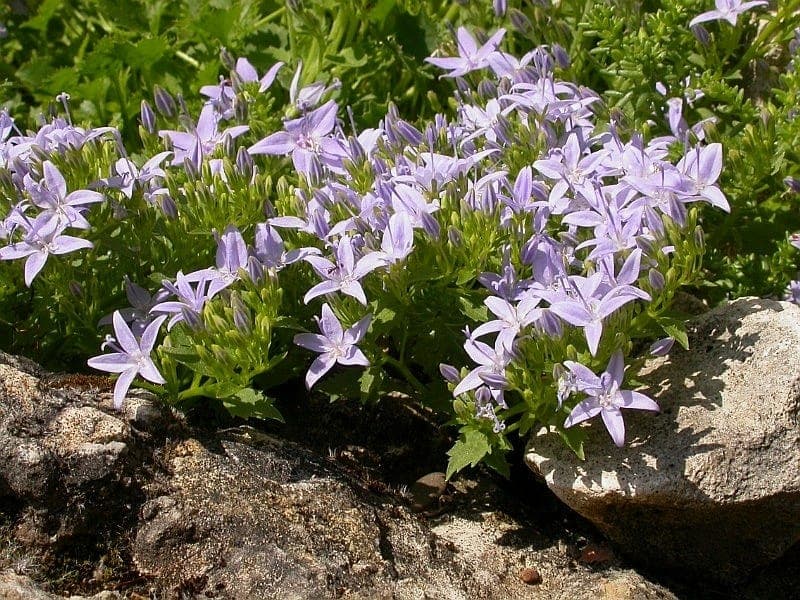
Jean-Jacques MILAN / CC BY-SA 3.0, via Wikimedia Commons
Adriatic bellflower: complete guide
Campanula garganica
Want to see Adriatic bellflower: complete guide in your garden?
1 minute, no credit card
Overview
Campanula garganica, commonly known as Adriatic bellflower, is a charming, low-growing perennial that brings delicate blue blooms and a relaxed, natural look to gardens. Native to rocky slopes in southern Italy and Greece, it's built for dry, sunny conditions and thrives in well-drained soils. In the UK and across northern Europe, it's a top choice for rock gardens, stone walls, and the front of sunny borders. It reaches just 10–15 cm in height and spreads slowly to form a neat 30 cm wide mat. It's not invasive, but it does self-mulch well, suppressing weeds while staying polite.
On gardenworld.app, you can design a planting scheme that highlights low-growers like this, pairing them with other drought-tolerant species for a low-maintenance look.
Appearance & bloom cycle
From June to August, Campanula garganica produces star-shaped, bright blue to pale violet flowers that hover just above the foliage. Each bloom is about 2–3 cm across, with five flared petals that give a cheerful, open face. The dark green, heart-shaped leaves stay tidy all season, forming a lush carpet even after flowering. If you trim back the plant lightly after the first flush, you'll often get a second, lighter bloom in early autumn.
In warmer microclimates, flowering can start as early as late May. In cooler areas, expect blooms from mid-June onward. While the flowering period isn't extremely long, the intensity and density of blooms make up for it.
Ideal location
This bellflower loves full sun to light shade. In full sun, it forms the densest mat and produces the most flowers. In heavy shade, it becomes leggy and sparse. The best spot is a dry, sunny area with good air circulation - think rockeries, crevices in stone walls, or the edge of a raised bed. Avoid damp, shaded corners where moisture lingers.
It's not a plant for wet feet, so keep it away from areas that collect water. Raised beds or sloped ground work best.
Soil requirements
Campanula garganica prefers sandy or gravelly soils with excellent drainage. A pH between 6.0 and 7.5 is ideal. Heavy clay soils are a problem unless amended with sharp sand and grit. If your soil is poor, that's actually fine - this plant doesn't need rich conditions. In fact, too much fertility leads to floppy growth and fewer flowers.
For containers or poor soils, mix in a handful of horticultural grit per plant. Avoid high-nitrogen composts - a lean mix is better.
Free design
Want to see Adriatic bellflower: complete guide in your garden? Make a free design now.
Watering
Once established, this plant is highly drought-tolerant. Water young plants regularly during their first growing season, especially in dry spells. After that, it rarely needs extra water, even in hot summers. When you do water, soak the root zone deeply but infrequently - about once a week during prolonged dry periods. Always let the soil dry out between waterings.
Avoid overhead watering to prevent fungal issues. Use a watering can with a long spout to target the base.
Pruning
After the main bloom in July, give the plant a light trim - cut back about one-third of the growth. This encourages fresh foliage and can trigger a second flush of flowers. Use sharp secateurs and avoid cutting into old wood. Deadheading isn't strictly necessary, but trimming helps maintain a tidy shape.
Maintenance calendar
- Jan: Check for frost heave; no action needed
- Feb: None
- Mar: Loosen topsoil gently; divide if overgrown
- Apr: Watch for slugs; protect young shoots
- May: Water if dry; monitor for mildew
- Jun: Peak bloom; avoid feeding
- Jul: Cut back after flowering
- Aug: Light watering if needed; check for re-bloom
- Sep: Optional light feed with low-nutrient compost
- Oct: Clear dead foliage; no mulch
- Nov: Ensure good drainage ahead of winter
- Dec: Protect from wet, not cold
Winter hardiness
Campanula garganica is hardy in USDA zones 5 to 8 (-20°C to -12°C). In the UK and most of northern Europe, it survives winter easily as long as the soil doesn't stay waterlogged. In wet winters, a light mulch of gravel or dry leaves can help keep the crown dry. Avoid organic mulches that hold moisture - they can rot the base.
In containers, move pots to a sheltered spot or wrap them to prevent freeze-thaw cycles.
On gardenworld.app, you can create a winter-resilient planting plan that includes tips for protecting borderline-hardy perennials like this one.
Companion plants
Pair Adriatic bellflower with other sun-loving, drought-tolerant plants. Good matches include Sedum spurium, Thymus praecox, Allium moly, and dwarf lavender. They share similar needs and create a natural, cottage-rockery look.
Avoid moisture-loving plants like hostas or astilbes - they'll demand conditions that could kill your Campanula.
Closing
Campanula garganica is a quiet achiever in the garden - not flashy, but utterly reliable. It asks little and rewards with months of cheerful blooms and a neat, weed-suppressing habit. With the right spot and minimal care, it'll thrive for years. Available at garden centres across the UK, and often found at independent nurseries. Look for healthy, compact plants in spring - and avoid overwatering once planted.
Want to see Adriatic bellflower: complete guide in your garden? Make a free design now.
Upload a photo, pick a style, and get a photorealistic design with plant list in under a minute.
No credit card required


Similar plants
Campanula alaskana: complete guide
Campanula alaskana
Discover Campanula alaskana, the delicate alpine bellflower from Alaska. Growing tips, hardy requirements, and design ideas for rock gardens and alpine troughs.
Campanula scouleri: complete guide
Campanula scouleri
Discover Campanula scouleri, the refined Pacific bellflower. Growing tips, care requirements, and design ideas for woodland and mountain gardens.
Doublehorn calicoflower: complete guide
Downingia bicornuta
All about Downingia bicornuta - the doublehorn calicoflower: sowing, location, bloom and care for this rare annual in your garden.