
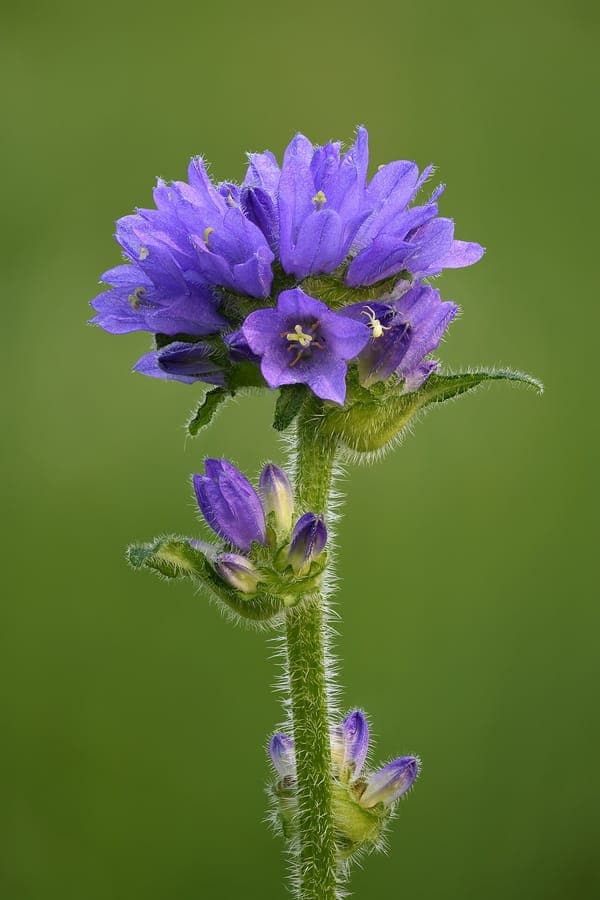
Ivar Leidus / CC BY-SA 4.0, via Wikimedia Commons
Bristly bellflower: complete guide
Campanula cervicaria
Want to see Bristly bellflower: complete guide in your garden?
1 minute, no credit card
Overview
Campanula cervicaria, commonly known as bristly bellflower, is a sturdy, clump-forming perennial that brings structure and cool blue tones to the summer garden. Native to central and eastern Europe - including Austria, the Baltic States, and parts of Russia - it thrives in open grasslands, rocky slopes, and dry meadows. In cultivation, it's a reliable performer in borders, cottage gardens, and wildlife-friendly plots across USDA zones 4 to 8.
The plant earns its name from the rough, bristly hairs on its stems and leaves - a tactile feature that deters some pests and adds textural interest. It's not the flashiest bellflower, but it's one of the most resilient, returning year after year with minimal fuss. On gardenworld.app, you can design a planting scheme that highlights its upright form and mid-summer bloom alongside complementary textures and colors.
Appearance & bloom cycle
Bristly bellflower grows 50 to 80 cm tall, with rigid, branching stems and narrow, lance-shaped leaves that are dark green and slightly rough to the touch. The lower leaves form a low rosette, while the upper foliage clusters around the flower heads.
From early July to late August, dense clusters of small, star-shaped blue flowers appear at the top of each stem. The blooms are typically sky-blue, though some cultivars may lean toward lilac. Each flower is about 1.5 cm across, with five pointed lobes that flare outward. The overall effect is a bold, rounded cap of color.
This is a pollinator favorite - especially for bees and hoverflies. The bloom period lasts 4 to 5 weeks. Deadheading can encourage a light secondary flush in September, though it's rarely as strong as the first.
Ideal location
Campanula cervicaria prefers full sun to light shade, scoring a 6 on the light scale (10 being full sun). At least 6 hours of direct sunlight ensures strong stems and abundant flowering. In too much shade, plants become leggy and flop over.
Plant in the middle to back of a border where its upright habit can shine. It works well in gravel gardens, on dry banks, or in naturalistic plantings. Space plants 30–40 cm apart to allow for air circulation and prevent overcrowding.
Using gardenworld.app, you can virtually place bristly bellflower in your garden layout to test spacing and companion combinations before planting.
Soil requirements
This bellflower demands well-drained, alkaline soil with a pH between 7.5 and 8.0. It thrives in chalky or limestone-based soils and tolerates poor fertility. Heavy clay or acidic, waterlogged soils will lead to root rot.
If your soil is too acidic, amend it with garden lime to raise the pH. For compacted soils, mix in grit or coarse sand to improve drainage. A light top-dressing of compost in spring supports growth, but avoid high-nitrogen fertilizers - they promote weak, floppy stems.
Free design
Want to see Bristly bellflower: complete guide in your garden? Make a free design now.
Watering
During the first growing season, water weekly with about 10 liters per square meter during dry spells. Once established, Campanula cervicaria is drought-tolerant and rarely needs supplemental watering, except in prolonged dry periods.
Overwatering is a bigger risk than underwatering. The plant hates sitting in wet soil. Use rainwater when possible, as tap water with high mineral content can affect sensitive roots over time.
Pruning
No pruning is needed to encourage flowering. However, cutting back spent flower stems to 10 cm above ground level after blooming may trigger a second, lighter flush.
In late autumn or early winter, cut all remaining stems down to the base. This tidies the garden and reduces overwintering pests. Alternatively, leave the stems standing through winter for structural interest and seed-eating birds.
Maintenance calendar
- Jan: Check for crown damage; leave stems for winter texture
- Feb: Remove any remaining debris
- Mar: Loosen soil around crowns; apply light compost
- Apr: Watch for slug damage on new shoots
- May: Monitor for aphids; water during dry spells
- Jun: Plant new specimens; ensure consistent moisture
- Jul: Peak bloom begins; check soil moisture weekly
- Aug: Continue blooming; deadhead for potential rebloom
- Sep: Stop fertilizing; allow seed heads to form
- Oct: Cut back or leave for winter; collect seeds if desired
- Nov: Trim foliage if not done in October
- Dec: Inspect for heaving in freeze-thaw cycles
Winter hardiness
Hardy to USDA zone 4 (-34°C), bristly bellflower handles cold winters with ease. The crown survives under snow cover, and new growth emerges in April or May.
In areas with wet winters, ensure excellent drainage to prevent crown rot. Mulching is not recommended - it can trap moisture. The plant's natural dormancy cycle doesn't require protection in most temperate climates.
Companion plants
Pair with sun-loving, drought-tolerant perennials that share its soil preferences:
- Salvia nemorosa (for vertical spikes and purple contrast)
- Echinops ritro (globe thistle, for architectural form)
- Geranium macrorrhizum (for ground cover and scent)
- Sedum 'Matrona' (for late-season color and pink stems)
- Stipa tenuissima (for airy texture and movement)
It also blends well in meadow-style plantings with grasses like Deschampsia cespitosa.
Closing
Campanula cervicaria is a no-nonsense perennial that delivers reliable color and structure with little input. It's perfect for gardeners who want beauty without constant upkeep. Its bristly texture, upright form, and pollinator appeal make it a standout in any sunny border.
You'll find it at garden centres across the UK and North America, often labeled as bristly or hairy bellflower. Try planting it in a sunny, dry spot where other perennials struggle - it'll thrive where many fail.
Want to see Bristly bellflower: complete guide in your garden? Make a free design now.
Upload a photo, pick a style, and get a photorealistic design with plant list in under a minute.
No credit card required


Similar plants
Campanula alaskana: complete guide
Campanula alaskana
Discover Campanula alaskana, the delicate alpine bellflower from Alaska. Growing tips, hardy requirements, and design ideas for rock gardens and alpine troughs.
Campanula scouleri: complete guide
Campanula scouleri
Discover Campanula scouleri, the refined Pacific bellflower. Growing tips, care requirements, and design ideas for woodland and mountain gardens.
Doublehorn calicoflower: complete guide
Downingia bicornuta
All about Downingia bicornuta - the doublehorn calicoflower: sowing, location, bloom and care for this rare annual in your garden.