
Kurt Stüber [1] / CC BY-SA 3.0, via Wikimedia Commons
Cornish bellflower: complete guide
Campanula alliariifolia
Want to see Cornish bellflower: complete guide in your garden?
1 minute, no credit card
Overview
Campanula alliariifolia, commonly known as Cornish bellflower, is a graceful yet underused perennial from the Campanulaceae family. Despite the name suggesting origins in Cornwall, this plant is native to the North Caucasus, Transcaucasus, and parts of Turkey. It thrives in the cool, shaded margins of woodlands and rocky slopes, making it a fantastic choice for gardeners looking to add subtle elegance to less sunny areas.
In cultivation, it reaches 40 to 60 cm in height and spreads slowly via underground rhizomes. Unlike more aggressive Campanula species, it doesn't dominate borders but instead forms neat, loose clumps over time. It's perfect for naturalistic planting schemes and works beautifully in cottage gardens, woodland edges, or shaded perennial beds.
This plant isn't flashy, but its charm lies in its restraint. On gardenworld.app, you can design a shade-friendly layout that highlights Campanula alliariifolia's understated beauty alongside complementary textures and foliage.
Appearance & bloom cycle
The foliage of Campanula alliariifolia is one of its standout features. The basal leaves are ovate to heart-shaped, dark green, and slightly hairy, resembling those of garlic mustard (Alliaria petiolata) – hence the species name. They grow up to 15 cm long and form a tidy rosette at the base. The flowering stems rise gracefully above the foliage, reaching 50–60 cm.
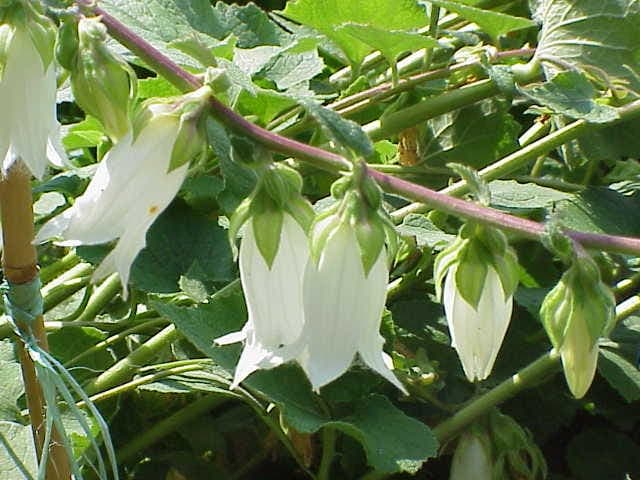
From June to July, nodding, bell-shaped flowers appear in loose panicles at the stem tips. Each bloom is 2–3 cm across, with a soft lavender-blue hue and five distinct lobes. The flowers hang delicately downward, giving the plant a gentle, swaying presence in the breeze. With deadheading, flowering can extend into late August.
Seed capsules form if flowers are left, but self-seeding is minimal in most garden settings. The plant dies back in late autumn, leaving behind dried stems that help protect the crown over winter.
Ideal location
This Campanula prefers partial to full shade. It performs best in dappled light, such as under deciduous trees or on the north or east side of a structure. Full sun is acceptable only in cooler climates or with consistent soil moisture, but in hot summers, leaves may scorch and stems become leggy.
An ideal spot receives morning sun and afternoon shade. Avoid deep, dry shade under dense evergreens. The plant benefits from sheltered locations where wind doesn't dry out the foliage too quickly. In urban gardens, it works well in courtyard beds with limited light or beneath small ornamental trees like Cornus alba.
Soil requirements
The soil should be rich, humusy, and well-draining. While the plant appreciates consistent moisture, it cannot tolerate waterlogged conditions. Heavy clay soils should be amended with compost or leaf mould to improve structure and aeration. A pH between 6.0 and 7.0 is optimal.
When planting, dig in a generous amount of compost (about 30% of the backfill). In containers, use a mix of loam-based compost, perlite, and composted bark. Plant the crown at soil level – not too deep, or rot may occur.
Free design
Want to see Cornish bellflower: complete guide in your garden? Make a free design now.
Watering
Keep the soil consistently moist, especially during the first growing season and in dry spells. Mulching with 5 cm of leaf mould or compost helps retain moisture and suppress weeds. Avoid overhead watering to reduce the risk of fungal issues like powdery mildew.
During flowering, consistent moisture prevents bud drop. In prolonged droughts, water deeply once or twice a week rather than frequent shallow sprinklings.
Pruning
Pruning is minimal. After flowering, cut back the spent flower stems to just above the basal rosette. This tidies the plant and may encourage a second, lighter flush of blooms. In autumn, leave the foliage intact until spring – it protects the crown and adds organic matter as it decomposes.
In early spring, remove any damaged or dead leaves before new growth emerges. Use clean, sharp snips to avoid tearing the tissue.
Maintenance calendar
- Jan: Check for frost heave. Keep mulch in place.
- Feb: Prepare tools. Remove any loose debris.
- Mar: Apply a thin layer of compost as a top-dressing.
- Apr: Watch for slug damage on new shoots.
- May: Growth accelerates. Water during dry spells.
- Jun: Bloom begins. Start deadheading.
- Jul: Peak flowering. Maintain even moisture.
- Aug: Final blooms. Reduce deadheading if self-seeding is desired.
- Sep: Growth slows. Gradually reduce watering.
- Oct: Let foliage die back naturally. Add compost.
- Nov: Mulch lightly for winter protection.
- Dec: Dormant. No action needed.
Winter hardiness
Campanula alliariifolia is hardy in USDA zones 5 to 8. It tolerates winter temperatures down to -20°C when well-mulched and planted in well-drained soil. In areas with repeated freeze-thaw cycles, the crowns may heave, so avoid disturbing the soil around the base in late autumn.
Leaving old foliage in place provides insulation. In wet winters, ensure the crown stays dry. If your garden has poor drainage, consider planting on a slight slope or raised bed. On gardenworld.app, you can generate a microclimate map of your garden to pinpoint the safest spots for moisture-sensitive perennials.
Companion plants
Pair Campanula alliariifolia with shade-loving perennials like Hosta, Brunnera, and Bleeding Heart (Dicentra). It also complements ferns such as Dryopteris or Athyrium, and early spring bulbs like Erythronium or Chionodoxa. For late-season interest, plant alongside Carex or Geranium phaeum.
Avoid invasive spreaders like mint or ground elder. Use low, spreading plants like Epimedium or barrenwort to fill gaps without overwhelming the Campanula.
Closing
Campanula alliariifolia is a quiet achiever in the garden. It doesn't shout for attention, but over time, it earns a special place in shaded borders. With minimal care and excellent winter hardiness, it's a reliable performer for gardeners who value subtlety and texture. Look for it at garden centres in spring, especially those specializing in woodland or shade plants. Young plants in 9–11 cm pots establish best and are often available from late March onward.
Want to see Cornish bellflower: complete guide in your garden? Make a free design now.
Upload a photo, pick a style, and get a photorealistic design with plant list in under a minute.
No credit card required


Similar plants
Campanula alaskana: complete guide
Campanula alaskana
Discover Campanula alaskana, the delicate alpine bellflower from Alaska. Growing tips, hardy requirements, and design ideas for rock gardens and alpine troughs.
Campanula scouleri: complete guide
Campanula scouleri
Discover Campanula scouleri, the refined Pacific bellflower. Growing tips, care requirements, and design ideas for woodland and mountain gardens.
Doublehorn calicoflower: complete guide
Downingia bicornuta
All about Downingia bicornuta - the doublehorn calicoflower: sowing, location, bloom and care for this rare annual in your garden.