
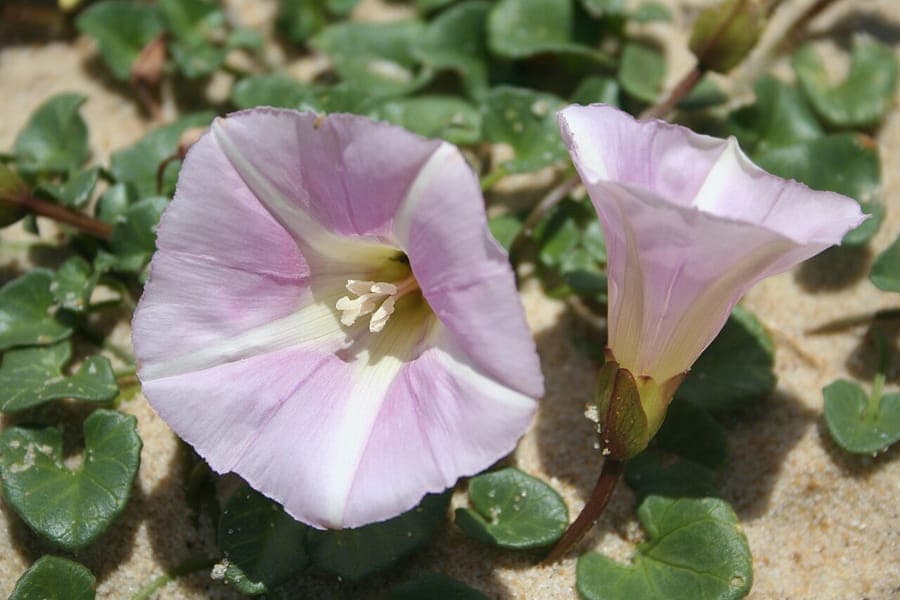
User:Strobilomyces / CC BY-SA 3.0, via Wikimedia Commons
Seashore false bindweed: complete guide
Calystegia soldanella
Want to see Seashore false bindweed: complete guide in your garden?
1 minute, no credit card
Overview
Calystegia soldanella, known as Seashore false bindweed, is a tough, creeping perennial that thrives in coastal environments. Native to sandy shores across Europe, North America, and parts of the Mediterranean, this plant is built for life in harsh, salty, and windy conditions. Unlike its aggressive relative, field bindweed, Seashore false bindweed spreads gently, forming low mats that stabilise loose sand without choking out neighbours. It's a brilliant choice for gardeners working with coastal plots, dry slopes, or sandy rock gardens.
This member of the Convolvulaceae family grows as a herbaceous vine, sending out long, trailing stems that root at the nodes. Once established, it requires almost no attention - perfect for low-maintenance landscapes. On gardenworld.app, you can design a coastal garden layout that highlights the natural spreading habit of this plant, pairing it with driftwood features and native grasses.
Appearance & bloom cycle
From May through October, Seashore false bindweed puts on a steady display of soft purple, funnel-shaped flowers. Each bloom measures 3–5 cm across, flaring open in full sun and closing at night or on overcast days. The flowers are held above glossy, thick, heart-shaped leaves that range from 3 to 5 cm wide. These leaves have a slightly waxy feel and are subtly hairy on the underside, helping to reduce water loss in exposed spots.
Stems can reach 1.5 metres in length but grow close to the ground, rarely climbing. They root as they spread, forming dense patches over time. This creeping habit makes it excellent for erosion control on sand dunes or sloped areas where soil retention is a challenge.
Ideal location
This plant demands full sun - a 9 out of 10 on the light scale. It needs at least 6–8 hours of direct sunlight daily to bloom well. Plant it in south- or west-facing beds, coastal terraces, or gravel gardens. Avoid shaded or damp corners; it won't thrive there.
In inland gardens, use it in rockeries, dry borders, or as ground cover in sandy areas. It's also ideal for modern xeriscaping or native plant schemes. Garden centres in the UK and Pacific Northwest sometimes stock it, especially those specialising in coastal or drought-tolerant plants. On gardenworld.app, explore how gardeners in similar climates use Seashore false bindweed in minimalist, naturalistic designs.
Soil requirements
Seashore false bindweed thrives in well-drained, sandy, or gravelly soils. It prefers a neutral to slightly alkaline pH, between 7.0 and 7.5. Heavy clay or water-retentive soils are unsuitable - they promote root rot. If planting in garden soil, amend with sharp sand or grit to improve drainage.
Fertility should be low to moderate. Rich soils encourage leggy growth and fewer flowers. Avoid compost-heavy mixes or nitrogen-rich fertilisers. This plant evolved in nutrient-poor dunes - it doesn't need feeding.
Free design
Want to see Seashore false bindweed: complete guide in your garden? Make a free design now.
Watering
During the first growing season, water weekly to help roots establish. After that, it's highly drought-tolerant and survives on rainfall alone in most coastal climates. In prolonged dry spells, especially in containers or sandy beds, give a deep soak every 10–14 days.
Never let the plant sit in soggy soil. Overwatering is the most common cause of failure. In pots, ensure drainage holes and use a gritty mix.
Pruning
Pruning isn't required for health, but you can trim back overgrown stems in late summer or early spring. Use clean shears to cut straggly growth and maintain a tidy appearance. The cuttings root easily in moist sand - a simple way to propagate new plants.
Don't cut it back hard in autumn; the remaining foliage helps protect the crown over winter.
Maintenance calendar
- Jan: Check for winter damage, remove debris
- Feb: Light inspection, no action needed
- Mar: Watch for new shoots, prepare for growth
- Apr: Water if dry, avoid fertiliser
- May: Blooms begin, monitor moisture
- Jun: Peak flowering, ensure sun exposure
- Jul: Continue bloom, check for pests (rare)
- Aug: Trim if needed, collect cuttings
- Sep: Final blooms, reduce watering
- Oct: Let stems die back naturally
- Nov: Clear dead foliage if desired, otherwise leave as mulch
- Dec: Dormant period, no care required
Winter hardiness
Seashore false bindweed is hardy in USDA zones 7–10 (-15°C to -1°C). In colder zones, a light mulch of straw or leaf litter in December helps protect the crown. Top growth may die back in winter, but the plant regrows from rootstock in spring.
In coastal areas, it often remains semi-evergreen, especially with wind protection.
Companion plants
Pair with other salt- and wind-tolerant species: Beach grass (Ammophila), Sea holly (Eryngium), Thrift (Armeria), or Sand pink (Sabulina verna). In garden settings, it combines well with Sedum, Artemisia, and low-growing ornamental grasses.
Avoid invasive spreaders like ivy or bindweed - they'll overpower this gentle creeper.
Closing
Calystegia soldanella isn't flashy, but it's dependable. It excels where few plants survive: in salt spray, drying winds, and poor sand. With minimal watering, no feeding, and only light pruning, it delivers months of bloom and excellent ground coverage. Look for it at garden centres in spring, especially those focusing on native or coastal species. Its quiet resilience makes it a smart, sustainable pick for modern gardens.
Want to see Seashore false bindweed: complete guide in your garden? Make a free design now.
Upload a photo, pick a style, and get a photorealistic design with plant list in under a minute.
No credit card required


Similar plants
Spreading alkaliweed: complete guide
Cressa truxillensis
Full growing guide for Cressa truxillensis, the salt-tolerant groundcover of alkaline flats: location, soil, watering, pruning and winter care.
Betony-leaved bindweed: complete guide
Convolvulus betonicifolius
Full guide to betony-leaved bindweed (Convolvulus betonicifolius): origin, appearance, ideal site, soil, watering and garden uses.
Ivyleaf morning glory: complete guide
Ipomoea hederacea
Everything about Ipomoea hederacea: location, soil and climbing care. A fast-growing annual vine with blue funnel flowers for sunny walls and pergolas.