
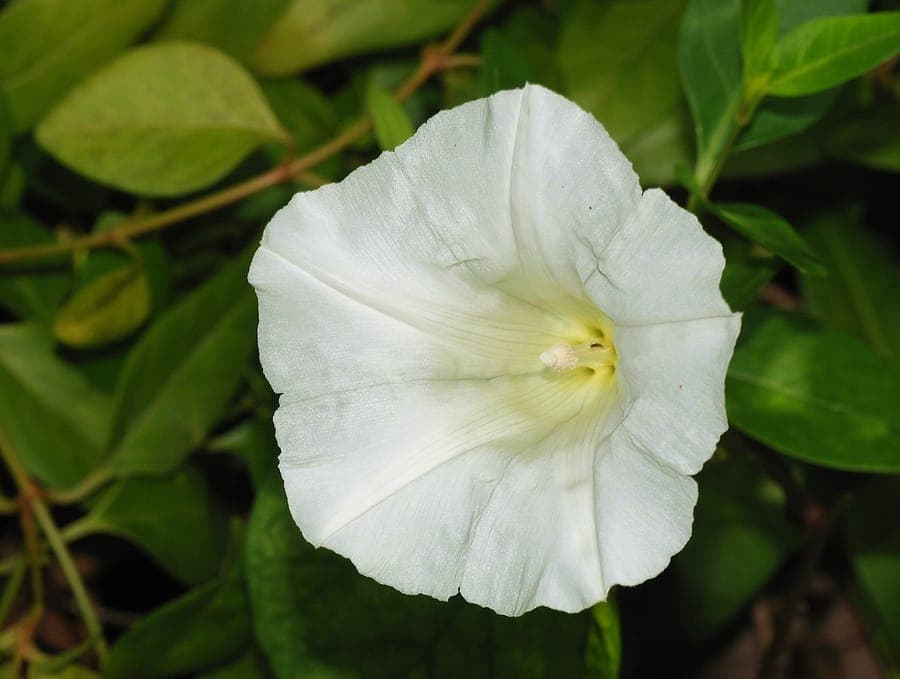
Alvesgaspar / CC BY-SA 3.0, via Wikimedia Commons
Bearbind: complete guide
Calystegia sepium
Want to see Bearbind: complete guide in your garden?
1 minute, no credit card
Overview
Bearbind, or Calystegia sepium, is a tenacious perennial vine in the Convolvulaceae family. Native across much of Europe, North America, and parts of Asia, it's often found scrambling through hedges, over fences, and up tree trunks. While its large, trumpet-shaped flowers are undeniably attractive, this plant comes with a warning: it spreads aggressively through underground rhizomes and can quickly dominate a garden if not managed.
On gardenworld.app, you can plan your planting layout to anticipate Bearbind's growth patterns, helping you stay ahead of its spread. This isn't a plant to toss into a border and forget - it demands awareness and regular intervention.
Appearance & bloom cycle
Bearbind is a high-climbing vine, capable of reaching 3 to 5 metres in a single season. Its leaves are heart-shaped to arrowhead-like, 3–7 cm long, with a smooth texture and medium green hue. From June through August, it produces showy white to pale pink flowers, 4–6 cm in diameter, with a distinct trumpet shape. Each flower opens in the morning and closes by late afternoon, lasting just one day.
Despite the short bloom span, the plant flowers continuously over several weeks, attracting bees and butterflies. After flowering, small capsules form containing seeds, but the primary method of spread is vegetative - via long, white rhizomes that can extend up to 3 metres annually and resprout from fragments as small as 2 cm.
Ideal location
Bearbind thrives in full sun to light shade. It performs best when given vertical support: wooden fences, trellises, or sturdy shrubs work well. Avoid planting it near delicate perennials or young trees - its twining stems can smother them within weeks.
This plant suits large, informal gardens or wild corners where its rampant growth can be contained spatially. It's not recommended for small urban plots or cottage-style beds. On gardenworld.app, you can simulate how Bearbind might interact with other plants in your space, helping you decide if it's a fit for your garden's balance.
Soil requirements
Bearbind is highly adaptable to soil types. It grows well in loam, sandy, or clay soils, as long as drainage is adequate. The ideal pH ranges from 5.5 to 7.5 - slightly acidic to neutral. It tolerates poor fertility and doesn't require rich soil or added fertiliser.
The one condition it can't handle is waterlogged ground. Prolonged wetness, especially in winter, leads to root rot. If your soil is heavy clay, consider raising the bed slightly or adding grit to improve drainage.
Free design
Want to see Bearbind: complete guide in your garden? Make a free design now.
Watering
During the first growing season, water weekly if rainfall is below 2.5 cm. Once established, Bearbind is drought-tolerant thanks to its deep rhizome system. In average UK or US summers, no supplemental watering is needed.
During extended dry spells (3+ weeks without rain), give a deep soak once every 10–14 days. Avoid frequent shallow watering - it encourages weak surface roots. Overhead watering isn't ideal, as wet foliage increases the risk of fungal issues.
Pruning
Pruning is essential to keep Bearbind in check. Start in early summer when new shoots emerge. Cut back stems that are straying into unwanted areas. Use sharp secateurs and cut close to the ground or at a main stem junction.
Never pull out vines by hand - this often leaves rhizome fragments behind. Instead, dig carefully with a fork to remove roots. For long-term control, consider installing a root barrier at least 60 cm deep around the planting zone.
Maintenance calendar
- March-April: Inspect for emerging shoots. Remove early growth if spreading beyond bounds.
- May: Begin monitoring for twining stems. Water if dry.
- June-August: Peak bloom. Prune regularly to control spread. Deadhead spent flowers if seed spread is a concern.
- September: Reduce watering. Trim back excessive foliage.
- October-November: Cut back dead stems. Leave some standing for winter structure, or clear for tidiness.
- December-February: Dormant period. No action needed unless digging out rhizomes.
Winter hardiness
Bearbind is hardy in USDA zones 4 to 8, surviving temperatures down to -30°C. In zone 7 and above, the top growth dies back in autumn, but the rhizomes remain viable underground. No mulch is required in mild winters, but a 10 cm layer of compost or leaf mould helps in colder zones.
Avoid piling mulch directly against old stems - this can trap moisture and promote rot.
Companion plants
Due to its aggressive nature, Bearbind has few ideal companions. Pair it only with strong, upright plants that can hold their ground, such as Yucca filamentosa, Phormium, or tall ornamental grasses like Miscanthus sinensis.
Avoid planting near low-growing perennials, groundcovers, or shrubs with fine foliage. These will be quickly overwhelmed. If you must grow Bearbind, isolate it in a dedicated area with physical boundaries.
Closing
Bearbind isn't a plant for the faint-hearted. It's beautiful in bloom but relentless in growth. If you value wild, naturalistic planting schemes, it might earn a spot - but only with strict management. Consider tamer alternatives like Clematis 'Jackmanii' or honeysuckle (Lonicera) for similar visual impact without the hassle.
You won't typically find Bearbind for sale at garden centres, as it's often classified as a weed. It usually appears uninvited via contaminated soil or compost. Keep an eye out for white, creeping roots. On gardenworld.app, you can track invasive tendencies and plan your garden to minimise future surprises.
Want to see Bearbind: complete guide in your garden? Make a free design now.
Upload a photo, pick a style, and get a photorealistic design with plant list in under a minute.
No credit card required


Similar plants
Spreading alkaliweed: complete guide
Cressa truxillensis
Full growing guide for Cressa truxillensis, the salt-tolerant groundcover of alkaline flats: location, soil, watering, pruning and winter care.
Betony-leaved bindweed: complete guide
Convolvulus betonicifolius
Full guide to betony-leaved bindweed (Convolvulus betonicifolius): origin, appearance, ideal site, soil, watering and garden uses.
Ivyleaf morning glory: complete guide
Ipomoea hederacea
Everything about Ipomoea hederacea: location, soil and climbing care. A fast-growing annual vine with blue funnel flowers for sunny walls and pergolas.