
Victor R. Ruiz from Arinaga, Canary Islands, Spain / CC BY-SA 2.0, via Wikimedia Commons
California incense-cedar: complete guide
Calocedrus decurrens
Want to see California incense-cedar: complete guide in your garden?
1 minute, no credit card
Overview
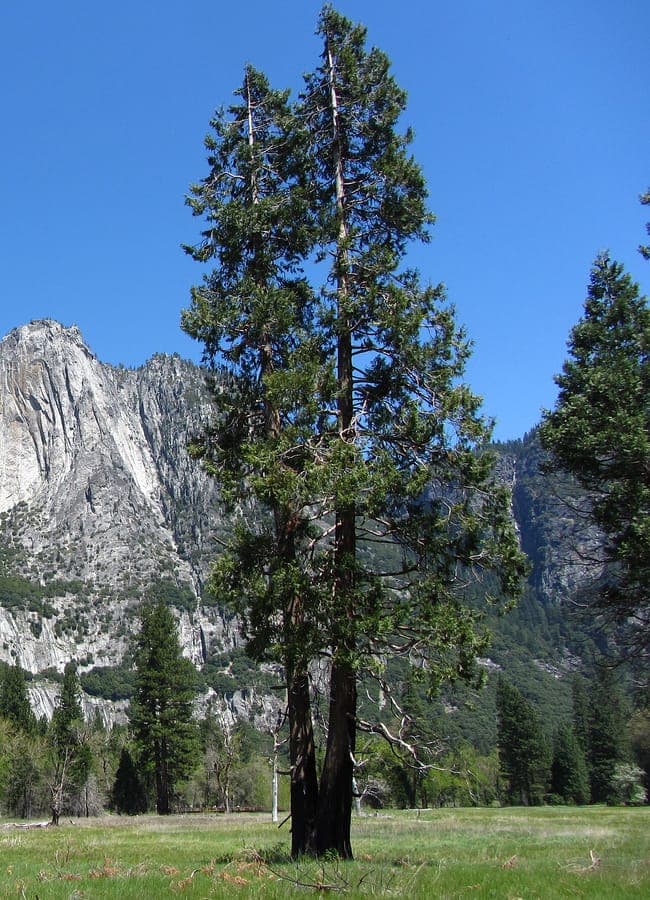
Calocedrus decurrens, commonly known as California incense-cedar, is a majestic evergreen tree native to the western United States-specifically California, southwestern Oregon, and northwestern Mexico. Belonging to the Cupressaceae family, this conifer is prized for its upright, columnar form, rich green foliage, and subtle vanilla-like fragrance when the foliage is crushed. In the UK and northern Europe, it's increasingly used as a specimen tree in large gardens, parks, or along driveways. While not fast-growing, it can reach heights of up to 30 meters with a spread of 6 to 8 meters when mature.
On gardenworld.app, you can design a garden layout that perfectly accommodates the California incense-cedar, whether you're aiming for a formal hedge or a naturalistic woodland setting. Its clean lines and dense texture make it a standout in structured designs, but it also works beautifully in wilder, more flowing garden styles-as long as it has space to grow.
Appearance & bloom cycle
The California incense-cedar grows in a narrow, pyramidal shape with horizontally layered branches. The foliage is scale-like, arranged in flattened sprays, and ranges from deep green to a slightly yellowish-green on newer growth. Each leaf is only 2–5 mm long and tightly packed, giving the tree a soft yet structured appearance. The bark is reddish-brown and deeply furrowed on mature trees, adding winter interest.
True to its family, this tree doesn't produce flowers. Instead, it forms small cones: male cones are yellow-brown and release pollen in spring, while female cones start green and ripen to a woody brown, reaching about 2 cm in length. These cones are not showy but are an important part of the tree's life cycle. A key identifier is the faint aromatic scent-reminiscent of incense or vanilla-released when you rub the foliage.
Ideal location
This cedar thrives in full sun to partial shade. At least 6 hours of direct sunlight daily is ideal for dense, even growth. In deep shade, the tree becomes leggy and loses its compact form. In exposed sites, especially in coastal or windy regions, young trees benefit from a windbreak or sheltered planting spot.
Plant it as a standalone feature on a lawn, in a mixed border, or as part of a screen. Due to its ultimate size, allow at least 5 meters of clearance from buildings or neighbouring properties. Use gardenworld.app to visualise how this tree fits into your existing landscape-helping you avoid future overcrowding.
Soil requirements
Well-drained, moist but not waterlogged soil is essential. Calocedrus decurrens tolerates a wide pH range from 4.6 to 7.1 (slightly acidic to neutral). Heavy clay soils should be amended with grit and organic matter to improve drainage. Sandy soils may require regular mulching and fertilisation to retain moisture and nutrients. Avoid planting in low-lying areas where water collects.
Free design
Want to see California incense-cedar: complete guide in your garden? Make a free design now.
Watering
Young trees need consistent watering during their first two growing seasons. Provide 10–15 litres per week during dry spells, focusing on deep watering to encourage root establishment. Once established, the tree is moderately drought-tolerant but performs best with occasional deep soakings during prolonged dry periods. Use a drip hose or soaker system to deliver water slowly to the root zone.
Pruning
Pruning is rarely needed unless you're training the tree into a hedge or topiary. If shaping is desired, prune lightly in late spring to early summer, after new growth has hardened. Avoid cutting into old wood, as it rarely produces new buds. Always use clean, sharp tools to prevent disease and ensure clean cuts.
Maintenance calendar
- January: Inspect for storm damage; remove any dead or broken branches
- February: Check root collar for signs of rot or girdling roots
- March: Apply a balanced slow-release fertiliser if growth is slow
- April: Monitor for pests like spider mites; water young trees if dry
- May: Light pruning if needed; refresh mulch layer
- June: Watch soil moisture; deep water young trees weekly if no rain
- July: Look for signs of heat stress-browning foliage may indicate drought
- August: Final light trim if shaping hedges
- September: Stop nitrogen fertiliser to prepare for dormancy
- October: Apply fresh organic mulch; keep it away from the trunk
- November: Protect young trunks from rodents with tree guards
- December: Final inspection for winter readiness; secure loose supports
Winter hardiness
California incense-cedar is hardy to USDA zone 6 (-23°C to -18°C). In the UK (zone 8), it grows well but may suffer from winter desiccation in exposed sites. Young trees can benefit from anti-desiccant sprays or burlap wraps in harsh winters. Mature trees are generally resilient, though prolonged freezing winds can cause foliage burn.
Companion plants
Pair this cedar with plants that contrast in texture and height. Try bold-leaved Rodgersia, tall ferns like Dryopteris, or ornamental grasses such as Calamagrostis. For ground cover, use non-invasive options like Carex or Vinca minor-avoid anything that climbs the trunk. Underplanting with snowdrops (Galanthus) or winter aconite (Eranthis) adds seasonal interest without competing for resources.
Closing
Calocedrus decurrens is a dignified, low-maintenance tree that brings year-round structure and subtle fragrance to the garden. With patience and proper placement, it develops into a striking focal point. Choose a sunny, well-drained site, give it room to grow, and you'll enjoy its presence for decades. Buy healthy specimens from reputable garden centres, where you can often find container-grown trees with strong root systems. And remember: on gardenworld.app, you can test different planting scenarios to see how this cedar enhances your garden's overall design.
Want to see California incense-cedar: complete guide in your garden? Make a free design now.
Upload a photo, pick a style, and get a photorealistic design with plant list in under a minute.
No credit card required


Similar plants
Cupressus macnabiana: complete guide
Cupressus macnabiana
The Fragrant Cypress offers elegant growth with fine, aromatic foliage. Perfect for temperate climates and as specimen trees in contemporary gardens.
Cupressus guadalupensis: complete guide
Cupressus guadalupensis
The Guadalupe cypress: an elegant conifer for gardens. Complete cultivation guide for this Mexican cypress. Information about care, location, form and maintenance.
Austrocedrus chilensis: complete guide
Austrocedrus chilensis
Discover Austrocedrus chilensis, the Chilean Cedar ornamental conifer. Elegant specimen with fine foliage and columnar form for permanent structure.