
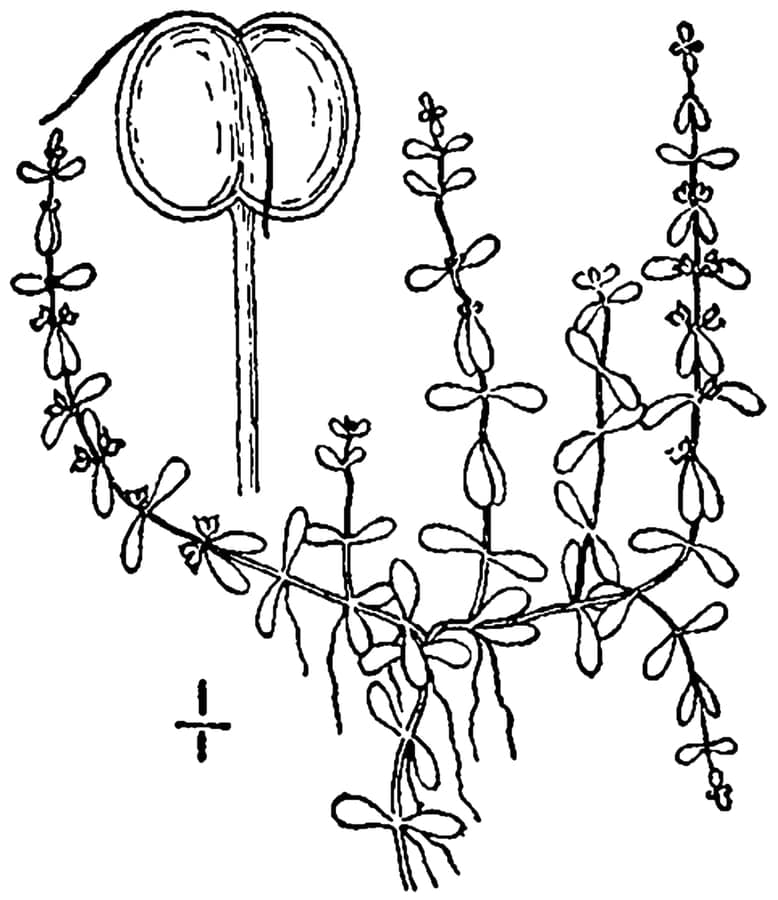
Britton, N.L., and A. Brown. 1913. An illustrated flora of the northern United States, Canada and the British Possessions. 3 vols. Charles Scribner's Sons, New York. Vol. 2: 477. Courtesy of Kentucky Native Plant Society. Scanned by Omnitek Inc. / Public domain, via Wikimedia Commons
Callitriche terrestris: complete guide
Callitriche terrestris
Want to see Callitriche terrestris: complete guide in your garden?
1 minute, no credit card
Overview
Callitriche terrestris, commonly known as Terrestrial water-starwort, is a fascinating small plant originating from southeastern Canada to the eastern and central USA. This species extends across much of Mexico to tropical America. Though small and unassuming, Callitriche terrestris plays an important ecological role in wetland habitats.
The species name terrestris points to the terrestrial character of this plant in contrast to fully aquatic species. This makes it a unique species capable of growing both in water and on moist soils. This adaptability makes it highly valuable for water-edge designs.
Appearance and Bloom
Callitriche terrestris grows as a delicate, finely-branched plant with extremely small leaves. The leaves are spoon-shaped to rounded and typically dark green in color. The plant body forms dense woven mats or small mounds when growing terrestrially.
The flowers are extremely small and inconspicuous, greenish-yellow in color. These subtle blooms are hidden within the fine foliage framework. The flowering period is usually summer through early autumn, but the flowers are so small they barely notice.
The plant typically reaches only 3-10 cm in height when fully mature, making it ideal for small wet spots and pond edges.
Ideal Location
Callitriche terrestris thrives best in moist to wet locations with at least average sunlight. The plant can tolerate both full sun positions and partial shade locations. In warmer climates, partial shade may be preferred to prevent excessive evaporation.
The plant grows ideally along pond edges, in marshes, in water ditches, and other moist terrains. It can also grow submerged in shallow water areas up to several centimeters deep.
Soil
Callitriche terrestris has no special soil requirements. It grows fine in normal garden soil as long as it remains moist. The plant is highly flexible and can grow in acidic, neutral, and alkaline soils.
The plant can, however, also grow without fixed soil, especially when fully submerged. In this case, it can grow free-floating or establish weak roots on substrate.
Free design
Want to see Callitriche terrestris: complete guide in your garden? Make a free design now.
Watering
Callitriche terrestris requires constantly moist conditions. It should never completely dry out. For terrestrial cultivation, the substrate must be kept continuously moist, though not waterlogged.
For aquatic cultivation, it grows fine in shallow water up to several centimeters deep. Water may be clear but can also be slightly turbid. Regular water changes promote healthier growth and prevent disease epidemics.
Pruning
Regular pruning promotes denser growth and compact form. Excessively long stems can be cut back to desired height. Dead or withered parts can be removed.
With rampant growth in ideal conditions, monthly pruning may be needed. This, however, promotes the attractive, finely-branched appearance.
Maintenance Calendar
Spring (March-May): Check moisture levels, regular pruning for shaping, inspect for pests.
Summer (June-August): Daily or twice-daily check moisture levels, regular pruning, water changes to prevent disease epidemics.
Autumn (September-October): Maintain moisture levels, prepare for winter dormancy.
Winter (November-February): Minimal growth, maintain moisture levels, minimal feeding.
Winter Hardiness
Callitriche terrestris is hardy in many temperate climates. In very cold areas, above-ground growth may die in winter, but plants can regenerate from rootstock in spring.
In zones where water freezes, the plant must have underwater protection to survive. Plants can grow in shallow pools if these don't freeze completely.
Companion Plants
Callitriche terrestris combines well with other moisture-loving and aquatic plants:
- Water pigmy (Samolus valerandi)
- Brooklime (Veronica beccabunga)
- Water mint (Mentha aquatica)
- Small duckweed
- Bittercress (Cardamine)
- Watercress (for aquatic cultivation)
Closing
Callitriche terrestris is a unique and valuable plant for water-edge designs, marsh gardens, and aquatic displays. Though small and modest in appearance, it offers many benefits: low maintenance requirements, ecological value, and versatility in growing conditions. The plant is excellent for small ponds, marsh cases, and moist landscape elements. Discover more water-edge plants at gardenworld.app.
Want to see Callitriche terrestris: complete guide in your garden? Make a free design now.
Upload a photo, pick a style, and get a photorealistic design with plant list in under a minute.
No credit card required


Similar plants
White Beardtongue: complete guide
Penstemon albidus
Discover white beardtongue (Penstemon albidus) - elegant perennial with white to cream flowers. Drought-resistant, perfect for prairie and dry gardens.
Longsepal Beardtongue: complete guide
Penstemon calycosus
Discover longsepal beardtongue (Penstemon calycosus) - beautiful perennial with lilac-blue flowers. For partial shade and moist soil. Ideal for naturalized.
Penstemon cusickii: complete guide
Penstemon cusickii
Discover Cusick's beardtongue, a compact alpine flowering plant with violet-pink blooms. Perfect choice for rock gardens and water-wise landscaping.