
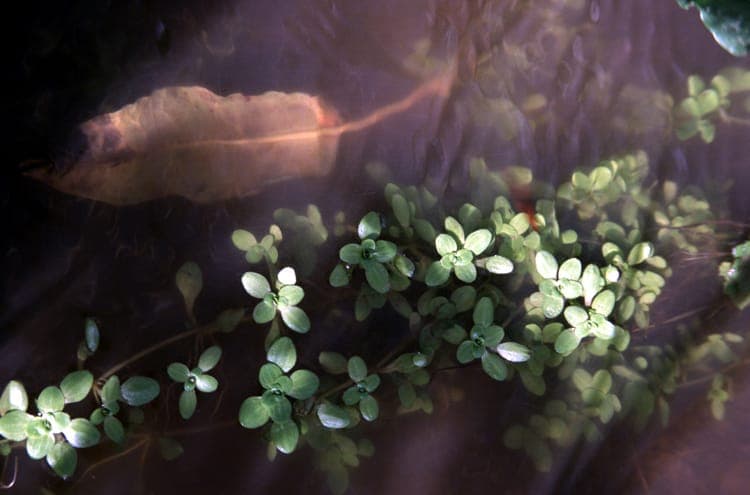
Gordon Leppig & Andrea J. Pickart / Public domain, via Wikimedia Commons
Starwort: complete guide
Callitriche stagnalis
Want to see Starwort: complete guide in your garden?
1 minute, no credit card
Overview
Starwort, or Callitriche stagnalis, is a subtle yet vital aquatic forb that thrives in shallow, still waters across temperate gardens. Native to much of Europe, including the UK and parts of Scandinavia, it's well-adapted to USDA hardiness zones 6 through 9. This low-growing, herbaceous plant spreads quietly along the bottom of ponds, ditches, and bog gardens, forming dense mats that support healthy aquatic ecosystems. Don't expect flashy blooms - its strength lies in resilience and ecological function.
Starwort is often overlooked, but experienced pond keepers know its value in oxygenating water and outcompeting nuisance algae. It's a perennial in milder winters, but may act as an annual if ice covers the pond for extended periods. If you're planning a natural pond layout, use gardenworld.app to design a space where Starwort can thrive alongside other marginal and submerged species.
Appearance & bloom cycle
Starwort gets its name from the star-shaped arrangement of its small, fleshy leaves. Each leaf is 3–8 mm long, oval to rounded, with a glossy dark green surface. They grow in whorls of 4 to 8 around short nodes, forming flat, carpet-like colonies just below or at the water surface.
Tiny greenish flowers appear from April to August, nestled between the leaf pairs. They're barely visible - less than 2 mm across - but they develop into small, segmented fruits that release seeds for natural propagation. The plant's real beauty is in its texture: a soft, velvety green layer that contrasts beautifully with open water and taller marginal plants.
Ideal location
Starwort prefers still or slow-moving water with moderate light - around 5 on a 1–10 scale. Full sun (7+) increases algae competition, while deep shade slows growth. A spot with dappled sunlight, like the edge of a pond shaded by shrubs or overhanging branches, works best.
Plant at depths between 5 and 30 cm. It won't survive strong currents or filter outflows, so avoid placing it near pumps or waterfalls. Choose a sheltered corner of your pond or a bog filter bed. Before installing, check your pond's conditions on gardenworld.app to ensure compatibility with Starwort's needs.
Soil requirements
This plant grows best in fine, nutrient-rich substrates with high organic content. A mix of clay, silt, and well-rotted pond loam works well. Avoid soils high in fertilizer or phosphate, as they encourage algal blooms.
Use a heavy, non-floating aquatic soil - available at most garden centres - to anchor the roots. Don't use regular potting compost; it's too light and will float away. The ideal pH range is 5.5 to 6.5. Test your water monthly during the growing season to keep pH stable.
Free design
Want to see Starwort: complete guide in your garden? Make a free design now.
Watering
As an aquatic species, Starwort must remain submerged at all times. While it tolerates temporary exposure during pond maintenance, prolonged drying (more than 48 hours) will kill the plant. Use rainwater or dechlorinated tap water to refill ponds, especially in summer.
Avoid sudden large water changes - they disrupt microbial balance. Instead, top up gradually. During hot, dry spells, monitor water levels daily. Add cool water slowly to prevent thermal shock to both plant and pond life.
Pruning
Pruning is rarely needed due to its low, creeping habit. However, if the mat becomes too dense, it can reduce oxygen exchange. In June or July, thin out patches by hand or with a fine net. This encourages new growth and prevents stagnation.
Dispose of removed plant material responsibly - don't compost near water, as fragments can re-root. Sterilize tools after use to prevent spreading invasive species or pathogens between ponds.
Maintenance calendar
- Jan: Check for overwintering growth; remove dead foliage
- Feb: Test pH and water hardness
- Mar: Replant divisions; top up water
- Apr: Watch for early flowering; monitor algae
- May: No intervention needed
- Jun: Thin if overcrowded
- Jul: Maintain water levels; avoid overheating
- Aug: Allow seed set; observe natural spread
- Sep: Stop thinning; let plants prepare for dormancy
- Oct: Remove excess biomass
- Nov: Plants die back in colder zones
- Dec: Ensure pond depth prevents full freeze
Winter hardiness
Starwort is hardy in zones 6–9. In zone 8 (UK average), it usually survives under ice if the pond is at least 40 cm deep. The top growth dies, but roots and seed bank persist. Prevent complete freezing with a pond heater or ice-free spot.
In shallow containers, bring a few clumps indoors in a bucket of pond water. Keep in a cool, dark place until spring. Return when water temperatures rise above 8°C.
Companion plants
Pair Starwort with other low-growing aquatics like Water Star-grass (Gentiana pneumonanthe), Bog Moss (Sphagnum spp.), or Creeping Jenny (Lysimachia nummularia). These share similar moisture and light needs. Avoid aggressive spreaders like Parrot's Feather or Hydrilla.
It also supports wildlife - newts, damselfly nymphs, and small fish use it for cover. Plant alongside emergent species like Iris laevigata or Marsh Marigold for visual contrast.
Closing
Starwort isn't a head-turner, but it's a workhorse in balanced pond systems. It improves water clarity, reduces algae, and supports biodiversity. Buy plants from reputable garden centres or propagate from existing stock. With minimal care, it returns reliably each year. And remember: gardenworld.app helps you plan a pond design where Starwort plays a quiet but essential role.
Want to see Starwort: complete guide in your garden? Make a free design now.
Upload a photo, pick a style, and get a photorealistic design with plant list in under a minute.
No credit card required


Similar plants
White Beardtongue: complete guide
Penstemon albidus
Discover white beardtongue (Penstemon albidus) - elegant perennial with white to cream flowers. Drought-resistant, perfect for prairie and dry gardens.
Longsepal Beardtongue: complete guide
Penstemon calycosus
Discover longsepal beardtongue (Penstemon calycosus) - beautiful perennial with lilac-blue flowers. For partial shade and moist soil. Ideal for naturalized.
Penstemon cusickii: complete guide
Penstemon cusickii
Discover Cusick's beardtongue, a compact alpine flowering plant with violet-pink blooms. Perfect choice for rock gardens and water-wise landscaping.