
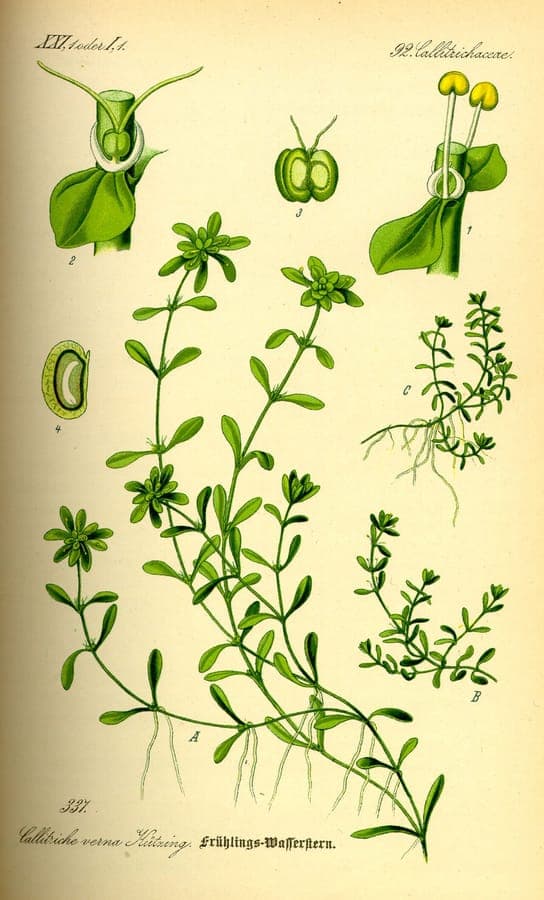
Wikimedia Commons / Public domain, via Wikimedia Commons
Narrow-fruit water-starwort: complete guide
Callitriche palustris
Want to see Narrow-fruit water-starwort: complete guide in your garden?
1 minute, no credit card
Overview
Narrow-fruit water-starwort (Callitriche palustris) is a quiet but valuable aquatic forb that slips under the radar in many garden designs. Found naturally in wet ditches, pond margins, and shallow marshes, this member of the Plantaginaceae family thrives in permanently moist to submerged conditions. It's not flashy, but it plays a key role in stabilizing wetland edges and supporting micro-ecosystems. As a low-growing perennial herb, it spreads slowly via creeping stems and forms dense mats in ideal conditions.
This plant prefers a light level of 7 out of 10, meaning it does best in full sun to partial shade. It's native across temperate regions including Alaska, Alberta, Austria, and the Baltic States, making it hardy and adaptable. In garden settings, it's ideal for wildlife ponds, bog gardens, or damp corners where other plants struggle. It's also a great choice if you're designing a low-input, ecologically balanced garden.
On gardenworld.app, you can design a garden layout that highlights wet zones perfect for narrow-fruit water-starwort, helping you make the most of underused soggy spots.
Appearance & bloom cycle
Callitriche palustris has narrow, lance-shaped leaves 5–15 mm long, arranged in opposite pairs along prostrate stems. The foliage is a fresh green, turning slightly darker in submerged growth. The plant typically reaches 2–5 cm in height but can spread 20–30 cm wide, forming soft, carpet-like patches. Both floating and emergent leaf forms may appear, depending on water depth.
Flowering occurs from March to June, with tiny greenish flowers nestled in leaf axils. These are less than 2 mm across and inconspicuous, but they develop into narrow, triangular fruits that give the plant its common name. While not showy, the bloom cycle supports early-emerging insects and aquatic invertebrates. The plant's real value lies in its ecological function rather than ornamental appeal.
Ideal location
Plant narrow-fruit water-starwort in shallow water (0–10 cm deep) or in soil that stays consistently wet. It performs best in full sun (5–7 hours daily) but tolerates light shade. Ideal spots include the shallow edges of ponds, bog gardens, or low-lying areas that collect spring runoff. Avoid locations that dry out in summer, as the plant will not survive prolonged drought.
If you're creating a rain garden or managing a damp border, this species can act as a ground cover. It's not suited for dry ornamental beds or containers unless they're water-retentive and regularly topped up.
Soil requirements
This plant prefers acidic to slightly acidic soils with a pH between 5.2 and 6.8. It grows best in humus-rich, moisture-retentive substrates like peaty loam or clay. Avoid sandy or nutrient-rich soils, as they drain too quickly or encourage algal competition. In pond planters, use a mix of garden soil and well-rotted compost-no synthetic fertilizers.
Callitriche palustris benefits from low-nutrient conditions, typical of natural wetlands. High fertility leads to algae overgrowth, which can smother the delicate mats. Keep the environment as natural as possible.
Free design
Want to see Narrow-fruit water-starwort: complete guide in your garden? Make a free design now.
Watering
Watering is critical-this plant must never dry out. In ponds, maintain a water depth of up to 10 cm. In bog gardens, ensure the soil remains saturated year-round. Use rainwater when possible, as tap water high in calcium can raise pH and harm growth.
During dry spells, especially in spring and early summer, check moisture levels daily. A thin crust on the soil surface means it's time to water. If the plant dries out completely, it may die back to seed, but recovery isn't guaranteed.
Pruning
Pruning is rarely needed. The plant grows slowly and self-manages in most settings. If it spreads too aggressively in a small pond, thin it by hand or with a pond net. Do not compost removed material-it may re-root. In autumn, leave the foliage intact to provide winter shelter for pond life.
In early spring (March), you can gently rake out dead debris if it's affecting water quality. Otherwise, let nature take its course.
Maintenance calendar
- January: Dormant. Ensure soil stays moist.
- February: Monitor moisture; no other action.
- March: Remove old debris. Plant new stock.
- April: Growth resumes. Check water levels.
- May: Blooming period. No feeding.
- June: Flowers fade. Watch for drying.
- July: Maintain moisture. Control algae.
- August: Slow growth. Check for overcrowding.
- September: Reduce activity. Prepare for dormancy.
- October: Leave plant intact.
- November: Protect from frost heave.
- December: Dormant. Ensure wet conditions.
Winter hardiness
Hardy in USDA zones 5–8 (down to -20°C). In zone 7, where most of the UK and northern US fall, it overwinters reliably as long as the soil or water doesn't freeze solid. In ponds, keep a small hole in ice to allow gas exchange. In bog gardens, mulch lightly with leaf litter to insulate roots.
The plant survives as creeping stems or seed. Top growth may die back in harsh winters, but it rebounds in spring.
Companion plants
Pair with moisture-loving species like Marsh marigold (Caltha palustris), Water forget-me-not (Myosotis scorpioides), or Soft rush (Juncus effusus). In pond margins, it works well with Yellow flag iris (Iris pseudacorus) or Brooklime (Veronica beccabunga).
For layered planting, place in the foreground with taller aquatics behind. Avoid aggressive spreaders like Water hyacinth unless contained.
On gardenworld.app, you can explore companion planting schemes for wetland gardens, complete with seasonal color previews and spacing guides.
Closing
Narrow-fruit water-starwort won't win prizes for beauty, but it's a workhorse in ecological gardening. It's perfect for wet spots that frustrate other plants, requires almost no care, and supports biodiversity. If you've got a soggy corner, this is your chance to turn it into a thriving habitat.
You can find Callitriche palustris at garden centres across the UK and US, often sold as part of native pond plant bundles. Look for responsibly propagated stock, not wild-collected plants.
Want to see Narrow-fruit water-starwort: complete guide in your garden? Make a free design now.
Upload a photo, pick a style, and get a photorealistic design with plant list in under a minute.
No credit card required


Similar plants
White Beardtongue: complete guide
Penstemon albidus
Discover white beardtongue (Penstemon albidus) - elegant perennial with white to cream flowers. Drought-resistant, perfect for prairie and dry gardens.
Longsepal Beardtongue: complete guide
Penstemon calycosus
Discover longsepal beardtongue (Penstemon calycosus) - beautiful perennial with lilac-blue flowers. For partial shade and moist soil. Ideal for naturalized.
Penstemon cusickii: complete guide
Penstemon cusickii
Discover Cusick's beardtongue, a compact alpine flowering plant with violet-pink blooms. Perfect choice for rock gardens and water-wise landscaping.