
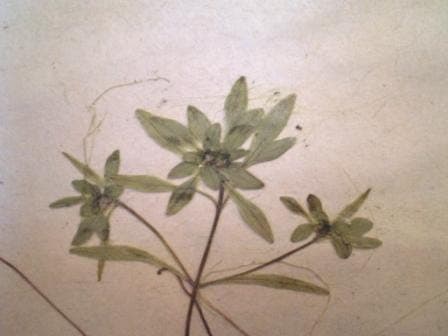
Jan Prančl (tzn. vlastní foto) / CC BY 3.0, via Wikimedia Commons
Narrowleaf water-starwort: complete guide
Callitriche hamulata
Want to see Narrowleaf water-starwort: complete guide in your garden?
1 minute, no credit card
Overview
Narrowleaf water-starwort (Callitriche hamulata) isn't the kind of plant that grabs attention with bold flowers or towering stems. Instead, it's a quiet performer - a submerged or floating herb that thrives in shallow, still to slow-moving waters. Native across much of Northern and Central Europe, it's commonly found in ditches, pond margins, and spring-fed streams. As a member of the Plantaginaceae family, it forms delicate mats beneath the surface, offering shelter for aquatic insects, tadpoles, and small fish. If you're building a balanced pond ecosystem, this plant deserves a spot.
On gardenworld.app you can design a pond layout that integrates narrowleaf water-starwort with other native species for a naturalistic water feature.
Appearance & bloom cycle
This plant has slender, opposite leaves that grow up to 2 cm long and just 1–2 mm wide. The foliage is bright green, slightly translucent, and often curves at the tip like a tiny hook - the origin of its scientific name hamulata. It grows primarily under water, but in very shallow areas, it may send creeping stems above the surface. Flowering occurs from June to July, though the blooms are barely visible - just tiny greenish dots nestled in leaf axils. The plant reproduces both by seed and vegetatively through runners, spreading slowly to form a soft, submerged carpet.
Growth starts in early spring (March–April) and continues through November. During peak season, it helps oxygenate water and suppresses algae by competing for nutrients.
Ideal location
Plant narrowleaf water-starwort in water between 5 and 30 cm deep. It prefers full sun to light shade. Avoid hot, stagnant water - temperatures above 25°C can slow growth. Choose calm, clear water with minimal current. It's ideal for the shallow shelf of a pond, bog garden, or rainwater basin. Keep it away from heavy fish traffic, especially koi, which may uproot or nibble the tender foliage.
Soil requirements
While it's an aquatic species, soil still matters. Use a firm, loamy or clay-based substrate with a pH from 6.5 to 8.0. The base should be rich in organic matter but not overly silty - too much silt leads to oxygen-poor conditions. A thin layer of aquatic soil (available at garden centres) works well. Avoid compost or manure-rich soils, as they fuel algal blooms and can cause rot.
Watering
Since it's fully submerged, "watering" isn't a daily chore. But water quality is critical. Maintain clean, slightly alkaline water using rainwater or dechlorinated tap water. Replace 10–15% of the pond volume weekly in summer to prevent nitrate buildup. If the water turns green, check for excess fish waste or overfeeding. This plant helps filter nutrients, but only if the balance is right.
Free design
Want to see Narrowleaf water-starwort: complete guide in your garden? Make a free design now.
Pruning
Pruning is rarely needed, but if clumps become too dense, trim back excess growth with scissors in spring (April–May) or early autumn (September). Don't remove large sections at once - that disrupts microhabitats. The cuttings can be replanted or composted. For natural ponds, minimal intervention is best.
Maintenance calendar
- January: Dormant. No action required.
- February: Check root anchoring and remove ice if present.
- March: Inspect for damage or snail activity.
- April: Clear dead material. Divide or replant if needed.
- May: Monitor for overgrowth. Light trim if necessary.
- June: Bloom period begins. Watch water clarity.
- July: Maintain water exchange. Prevent overheating.
- August: Provide shade in extreme heat.
- September: Trim lightly to prevent crowding.
- October: Leave dead foliage - it offers winter shelter.
- November: Growth slows. Reduce maintenance.
- December: Fully dormant. No care needed.
On gardenworld.app you can generate a seasonal maintenance schedule tailored to narrowleaf water-starwort and your pond's ecosystem.
Winter hardiness
This plant is hardy to USDA zone 5 (-20°C). In temperate climates like the UK and most of northern Europe, it survives winter easily if kept under at least 20 cm of water. Top growth may die back, but roots and stolons persist. In severe winters with thick ice, ensure part of the pond stays ice-free to allow gas exchange.
Companion plants
Pair narrowleaf water-starwort with other marginal and submerged plants like water mint (Mentha aquatica), dwarf sedge (Carex buxbaumii), or small water lilies (Nuphar pumila). It makes an excellent underlayer for taller emergents such as marsh marigold (Caltha palustris) or creeping willow (Salix repens). Avoid invasive species like Canadian waterweed (Elodea canadensis) that outcompete it. Plant in clusters of 5–7 sprigs per square foot for best coverage.
Closing
Narrowleaf water-starwort may not win any beauty contests, but it's a workhorse in a healthy pond. It stabilizes sediment, supports wildlife, and improves water quality with little effort. It's easy to grow, affordable, and widely available at garden centres. If you're aiming for a low-maintenance, ecologically sound water garden, this unassuming herb is a solid pick. Remember: balance is key. Too much of any one plant can throw off oxygen levels and light penetration. Plant thoughtfully, observe the results, and let nature do the rest.
Want to see Narrowleaf water-starwort: complete guide in your garden? Make a free design now.
Upload a photo, pick a style, and get a photorealistic design with plant list in under a minute.
No credit card required


Similar plants
White Beardtongue: complete guide
Penstemon albidus
Discover white beardtongue (Penstemon albidus) - elegant perennial with white to cream flowers. Drought-resistant, perfect for prairie and dry gardens.
Longsepal Beardtongue: complete guide
Penstemon calycosus
Discover longsepal beardtongue (Penstemon calycosus) - beautiful perennial with lilac-blue flowers. For partial shade and moist soil. Ideal for naturalized.
Penstemon cusickii: complete guide
Penstemon cusickii
Discover Cusick's beardtongue, a compact alpine flowering plant with violet-pink blooms. Perfect choice for rock gardens and water-wise landscaping.