
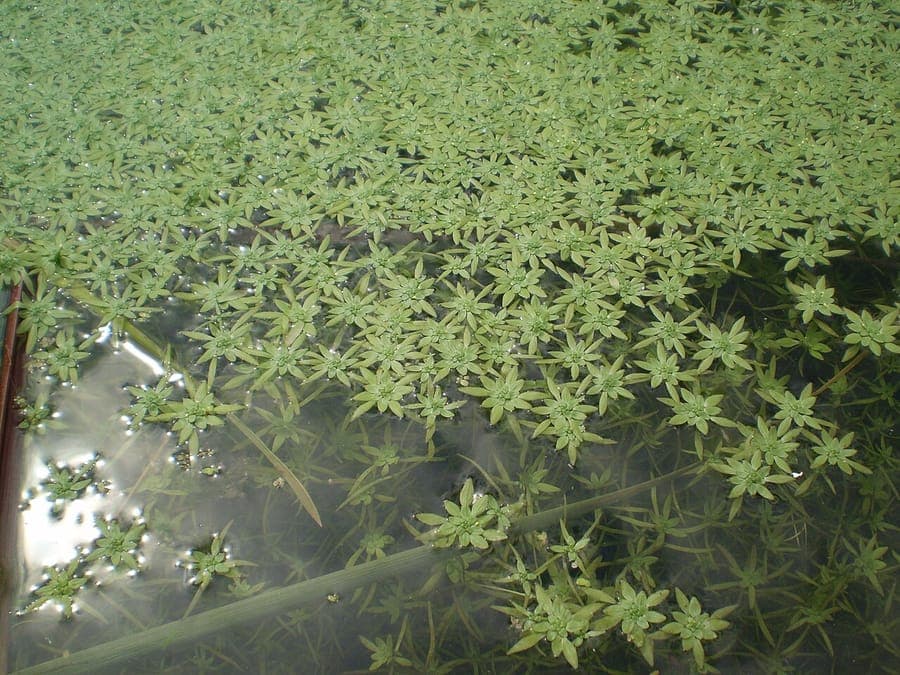
Jan Prančl / CC BY 3.0, via Wikimedia Commons
Callitriche cophocarpa: complete guide
Callitriche cophocarpa
Want to see Callitriche cophocarpa: complete guide in your garden?
1 minute, no credit card
Overview
Callitriche cophocarpa, commonly called blunt-fruited water-starwort, is a native aquatic plant belonging to the plantain family (Plantaginaceae). It grows naturally across Europe - from North Africa through central and eastern Europe to Siberia - in still and slow-moving water bodies such as ponds, ditches, marshes and shallow lakes. In the Netherlands the plant is now listed as locally extinct in the wild, making its presence in garden ponds particularly valuable for biodiversity. The name 'cophocarpa' refers to the blunt-angled fruits that distinguish this species from related water-starworts. In garden ponds, Callitriche cophocarpa is a practical and attractive plant: it grows submerged, absorbs nutrients from the water - helping to reduce algae growth - and provides cover and food for water insects, amphibians and small fish. On gardenworld.app you can explore garden designs featuring ponds and water features with native aquatic plants like this one at their heart.
Appearance and growth cycle
Callitriche cophocarpa is a slender, branching aquatic plant with thin stems that grow fully submerged or reach the water surface. Submerged leaves are narrow and linear, arranged in opposite pairs along the stem. At the water surface the plant forms small, distinctive rosettes of broader, elliptical leaves - it is these surface rosettes that give the genus Callitriche (meaning 'beautiful hair') its descriptive character and the common name 'starwort'. The flowers are tiny, green and barely visible to the naked eye, appearing in spring and early summer. The real ornamental value of the plant lies in the fresh emerald-green colour of the surface rosettes and the fine-leaved, dense submerged mass that keeps pond water clear and oxygenated. Growth is most vigorous from May through September. In warm water with plenty of nutrients, the plant can spread rapidly and form extensive mats that cover the pond surface.
Ideal location
Blunt-fruited water-starwort grows best in still or slow-moving water in a sunny to lightly shaded setting. The plant needs light for photosynthesis, though it can manage in partial shade with somewhat reduced growth. In a garden pond it thrives at water depths of 10 to 80 cm - too deep and insufficient light reaches the submerged portions of the plant. A calm, sheltered water body without strong wave action is ideal. The plant is also suitable for indoor aquaria, though it reaches its greatest ecological value outdoors in garden ponds and wildlife water features where it functions as a living component of a balanced water ecosystem.
Growing medium and substrate
In a garden pond, water-starwort does not strictly need to be planted in substrate - it can grow free-floating, anchoring itself with roots that grip the pond bottom, stones and leaf litter. If planting is preferred, a thin layer of pond mud or fine clay on the pond floor provides a suitable growing medium. Moderately nutrient-poor to moderately fertile conditions suit the plant best. In heavily eutrophic ponds where algae proliferate and cloud the water, the plant struggles because light cannot penetrate to its submerged leaves. Water with a pH in the range of 7 to 7.5 is optimal, in line with the species' recorded preferences. Clear, well-oxygenated water produces the healthiest and most attractive growth.
Water conditions and care
Callitriche cophocarpa is fully aquatic and must always have access to water. Drying out will kill the plant. However, the plant also functions as a natural water filter: it takes up dissolved nitrogen and phosphorus, reducing the nutrient levels that fuel algal blooms. This makes it genuinely useful in ponds prone to green water or excessive algae. Maintain a consistent water level to prevent drying out. During extended summer droughts when pond levels drop, the plant may partially die back, but it typically recovers quickly when water levels return to normal. Never add artificial fertilisers to pond water where water-starwort is growing - excess nutrients promote algae at the expense of submerged plants.
Free design
Want to see Callitriche cophocarpa: complete guide in your garden? Make a free design now.
Pruning and management
Water-starwort requires little active maintenance but can spread quickly in favourable conditions and dominate a small pond. In a garden pond it is sensible to thin out the plant periodically by removing portions of the mass with a pond net or rake. The best time to do this is late summer or early autumn when growth is slowing. Place the removed plant material on the pond bank for an hour before composting - this allows small aquatic creatures that were living in the plant mass to return to the water. In larger ponds and ditches, grazing by waterfowl, snails and other aquatic animals, together with shading from taller emergent plants, provides natural control without human intervention.
Maintenance calendar
March - April: The plant begins growing as water temperatures rise. Check for overwintering plant material from the previous year. Assess water clarity and quality.
May - June: Active growth phase. Dense green masses form in and on the water. The plant's water-filtering effect is most pronounced at this time. Thin out if growth becomes too dominant.
July - August: Peak growth. In warm water with high nutrient levels, spread can be vigorous. Thin out as needed to allow other aquatic plants sufficient light and space.
September - October: Growth slows. A good time to remove excess plant material before winter. Leave enough plant in the pond as shelter and food for overwintering aquatic invertebrates.
November - February: The visible above-water portion of the plant dies back in frost. Vegetative material and seeds survive at the pond bottom through winter. Do not drain the pond.
Winter hardiness
Callitriche cophocarpa is a native European species fully adapted to northwest European winters. It is completely winter hardy in the British Isles, northern France, the Netherlands and Belgium, surviving to USDA zone 6 and warmer. In winter the surface parts of the plant die back in frost, but roots, stems and seeds persist at the pond bottom and regenerate rapidly in spring as water temperatures rise. Ensure garden ponds do not freeze solid if fish are present - a pond pump or aerator keeps water moving and prevents complete freezing.
Companion plants and ecology
Blunt-fruited water-starwort combines well with other native aquatic and marginal plants. Water crowfoot (Ranunculus aquatilis) is a classic companion in ponds and ditches, with similar submerged habit and attractive white flowers. Pondweeds (Potamogeton species) provide complementary underwater structure and shade. At the pond margin, yellow flag iris (Iris pseudacorus), purple loosestrife (Lythrum salicaria) and marsh marigold (Caltha palustris) are natural companions. The plant itself supports a web of pond life: it shelters fish spawn, dragonfly larvae and frog tadpoles, and provides food for water snails and invertebrates. On gardenworld.app you can visualise what a naturalistic pond planting scheme would look like in your front garden before you start digging. Specialist aquatic plant nurseries and wildlife pond suppliers in the UK are the best sources for this species.
Closing
Blunt-fruited water-starwort is an understated but ecologically important aquatic plant that can play a meaningful role in any garden pond or water feature. It cleans the water, supports pond wildlife, and forms an attractive green surface layer. Easy to obtain from specialist aquatic nurseries and virtually maintenance-free once established, it deserves a place in any wildlife-friendly garden pond.
Want to see Callitriche cophocarpa: complete guide in your garden? Make a free design now.
Upload a photo, pick a style, and get a photorealistic design with plant list in under a minute.
10,000+ gardens designed already
No credit card required


Similar plants
White Beardtongue: complete guide
Penstemon albidus
Discover white beardtongue (Penstemon albidus) - elegant perennial with white to cream flowers. Drought-resistant, perfect for prairie and dry gardens.
Longsepal Beardtongue: complete guide
Penstemon calycosus
Discover longsepal beardtongue (Penstemon calycosus) - beautiful perennial with lilac-blue flowers. For partial shade and moist soil. Ideal for naturalized.
Penstemon cusickii: complete guide
Penstemon cusickii
Discover Cusick's beardtongue, a compact alpine flowering plant with violet-pink blooms. Perfect choice for rock gardens and water-wise landscaping.