
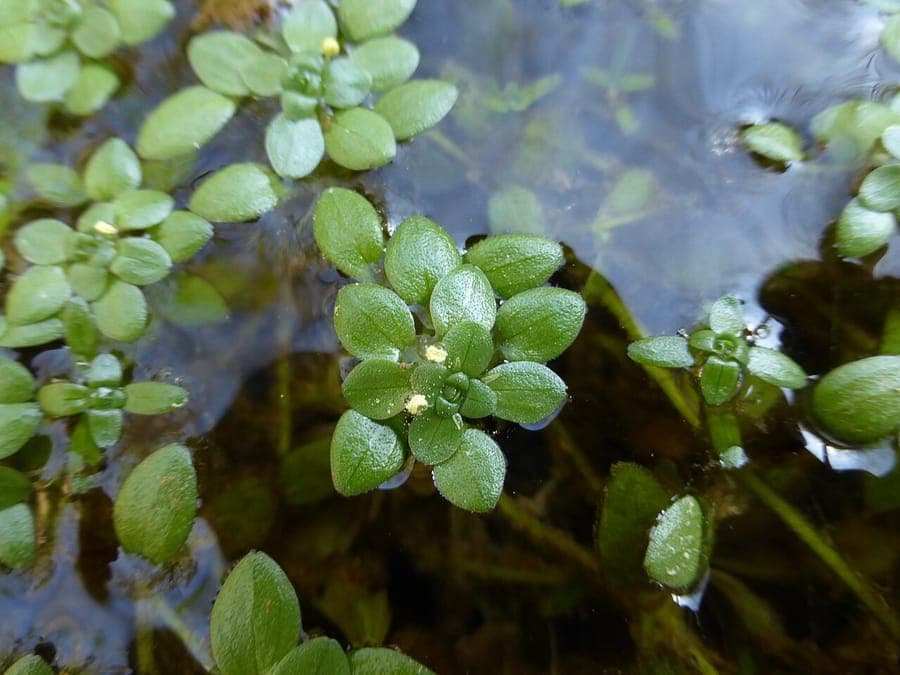
Jean-Pierre Lespinasse / CC BY-SA 2.0 fr, via Wikimedia Commons
Pedunculate water-starwort: complete guide
Callitriche brutia
Want to see Pedunculate water-starwort: complete guide in your garden?
1 minute, no credit card
Overview
Pedunculate water-starwort (Callitriche brutia) is a submerged aquatic perennial native to parts of Europe including France, Bulgaria, and the Faroe Islands. It belongs to the Plantaginaceae family, a surprising classification for a water-dwelling species. This plant thrives in calm, shallow water environments, typically no deeper than 15 cm. It spreads by creeping stems that root at nodes, forming dense, low mats along the pond floor.
If you're designing a water feature, gardenworld.app offers smart planning tools to incorporate plants like Pedunculate water-starwort into your layout. You can visualize depth zones and light exposure to ensure your aquatic ecosystem stays balanced and healthy.
Appearance & bloom cycle
The plant features small, linear to lanceolate leaves arranged in opposite pairs along slender stems. These leaves form a star-like pattern, giving rise to its common name. Individual leaves measure 0.5 to 1.5 cm long and remain a bright to medium green. Though technically flowering, blooms are tiny, inconspicuous, and often underwater. They appear from April to July but are rarely noticed.
Growth is steady under good light and stable water conditions. Peak density occurs between June and August. In winter, growth slows, and the plant may thin out slightly, but it generally remains evergreen in milder climates.
Ideal location
This species thrives in full sun to light shade with a light requirement of 8/10. It needs at least 6 hours of direct sunlight daily for optimal growth. Ideal placement is in shallow ponds, bog filters, or damp margins no deeper than 15 cm. Avoid locations with strong water movement - fountains or high-flow filters can dislodge its delicate stems.
Choose a quiet corner of your pond where fish are less likely to uproot it. It works well in wildlife ponds, rain gardens, or naturalistic water features. Avoid deep zones where light penetration is insufficient.
Soil requirements
While often seen floating freely, Callitriche brutia roots best in fine, nutrient-poor substrates. Use a mix of clay-based pond soil or aquatic compost topped with 2–3 cm of sand or fine gravel. Avoid rich soils or fertilizers, as they encourage algae.
The plant prefers neutral to slightly alkaline conditions, with a pH range of 7.0 to 7.5. Test your water monthly with a simple kit. Keep iron and trace elements low to prevent competition from filamentous algae. No additional feeding is required.
Free design
Want to see Pedunculate water-starwort: complete guide in your garden? Make a free design now.
Watering
As an aquatic plant, it must remain fully submerged year-round. Maintain a stable water level, especially during dry spells. Top up with rainwater or dechlorinated tap water - add it slowly to avoid temperature shock.
Evaporation is highest in summer (June to August), so check levels weekly. If your pond drops more than 5 cm in a week, consider reducing exposure to wind or adding a cover. Do not let the plant dry out - it will not survive emersion.
Pruning
Routine pruning is rarely needed, but if growth becomes too dense, thin it out to improve light and circulation. Use clean, sharp scissors to cut back overgrown patches. Remove cuttings from the pond to prevent decomposition and nutrient buildup.
You can propagate pruned sections by anchoring them to the substrate. They root quickly in warm, well-lit conditions. Avoid over-pruning - this plant recovers slowly from heavy disturbance.
Maintenance calendar
January: inspect for winter survival; remove dead material. February: clean debris; test pH. March: plant new cuttings; monitor for regrowth. April: growth begins; increase light exposure. May: spread accelerates; watch for algae. June–August: peak season; maintain water levels. September: growth slows; light trimming if needed. October: allow some leaf litter for microfauna. November: reduce maintenance. December: dormancy begins; minimal care.
Gardenworld.app lets you create a custom care calendar synced to your local climate. Get timely reminders for water testing, pruning, and seasonal adjustments - no guesswork needed.
Winter hardiness
Pedunculate water-starwort is hardy in USDA zones 6–9. It survives freezing temperatures as long as the pond doesn't freeze solid. Ensure at least 20 cm of liquid water remains below ice. In harsh winters, use a pond heater or de-icer to maintain an opening.
The plant may look ragged in late winter but typically rebounds in spring. Avoid disturbing it during cold months to protect overwintering aquatic life.
Companion plants
Pair with other submerged species like Hornwort (Ceratophyllum demersum) or Water moss (Fontinalis antipyretica). Marginal partners include Marsh marigold (Caltha palustris) and Water mint (Mentha aquatica).
Avoid invasive species like Canadian pondweed (Elodea canadensis), which outcompetes slower growers. Stick to native, low-competition plants for a harmonious setup.
Closing
Pedunculate water-starwort is a quiet achiever in the pond. It oxygenates water, provides shelter for tadpoles, and helps control algae by competing for nutrients. It's not flashy, but it's essential.
You can find this plant at garden centres across the UK. For reliable stock, check availability at local aquatic specialists. Plant it early in spring for best establishment. With the right conditions, it becomes a self-sustaining part of your water garden.
Want to see Pedunculate water-starwort: complete guide in your garden? Make a free design now.
Upload a photo, pick a style, and get a photorealistic design with plant list in under a minute.
No credit card required


Similar plants
White Beardtongue: complete guide
Penstemon albidus
Discover white beardtongue (Penstemon albidus) - elegant perennial with white to cream flowers. Drought-resistant, perfect for prairie and dry gardens.
Longsepal Beardtongue: complete guide
Penstemon calycosus
Discover longsepal beardtongue (Penstemon calycosus) - beautiful perennial with lilac-blue flowers. For partial shade and moist soil. Ideal for naturalized.
Penstemon cusickii: complete guide
Penstemon cusickii
Discover Cusick's beardtongue, a compact alpine flowering plant with violet-pink blooms. Perfect choice for rock gardens and water-wise landscaping.