
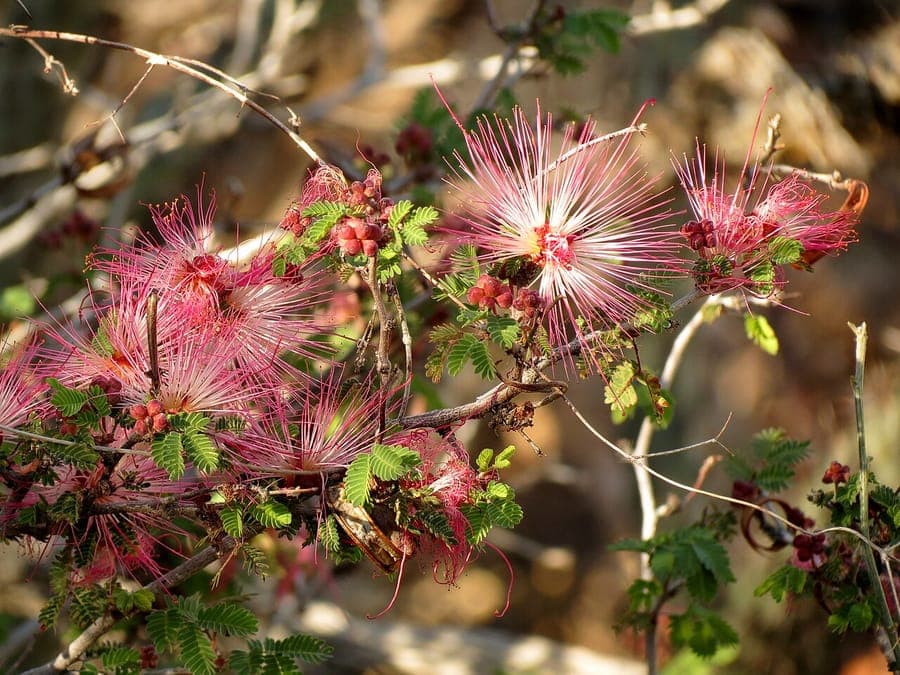
Katja Schulz from Washington, D. C., USA / CC BY 2.0, via Wikimedia Commons
Fairy duster: complete guide
Calliandra eriophylla
Want to see Fairy duster: complete guide in your garden?
1 minute, no credit card
Overview
Calliandra eriophylla, known by the evocative common name fairy duster, is a captivating desert shrub native to the arid Southwestern United States and much of Mexico. The botanical name is richly descriptive: Calliandra derives from Greek and translates as 'beautiful stamens', while the species epithet eriophylla means 'woolly-leaved'. Indeed, it is not petals but the long, thread-like stamens in vivid shades of pink to rose-purple that dominate the floral display - they give the blooms their characteristic soft, powder-puff appearance that inspired the plant's charming common name. A member of the legume family (Fabaceae) in the mimosa subfamily Mimosoideae, fairy duster is equally remarkable for its fine, bipinnate foliage and its exceptional ability to thrive with almost no supplemental water. Visit gardenworld.app for inspiration on designing a beautiful drought-tolerant garden featuring Mediterranean and desert shrubs like fairy duster.
Native to Arizona, California, New Mexico, Texas, and throughout Mexico from the Sonoran Desert to semi-arid scrub zones, this species grows naturally on poor, rocky soils in full sun, sometimes at elevations up to 1,500 metres. The plant typically reaches 30 to 90 cm in height with a similar spread, forming a dense, multi-stemmed mound of fine twigs. Its compact dimensions, spectacular flowering, and extraordinary drought tolerance make it an outstanding choice for small to medium Mediterranean gardens, rock gardens, and containers on a warm, sunny patio.
Appearance and bloom cycle
Fairy duster is a multi-stemmed subshrub with a moderate growth rate. The branches carry fine, doubly compound (bipinnate) leaves characteristic of the mimosa subfamily: each leaf is divided into many pairs of tiny leaflets that give the plant an airy, feathery texture. Like many mimosa relatives, the leaflets can fold together at night or when touched. The stems carry a fine covering of short hairs, especially on younger growth.
Flowering is the showstopper of the year. In its native range fairy duster blooms in two distinct flushes: the main spring bloom from February through April, and a secondary flush from August through September after summer monsoon rains. In cultivation the flowering pattern follows available moisture. The flower heads consist of a dense pom-pom of 20 to 30 long, thread-like stamens in vivid shades of pink to rose-purple with white bases. There are no conventional petals; it is entirely the stamens that provide the visual spectacle. The effect is genuinely extraordinary: clusters of soft, glowing pink powder puffs held above the finely feathered foliage. The flowers are highly attractive to butterflies, hummingbirds, native bees, and other pollinators. After flowering, flat brown seed pods of 5 to 10 cm develop and split explosively to disperse seeds.
Ideal location
As a resident of the Sonoran Desert and surrounding semi-arid scrub, Calliandra eriophylla has a strong preference for full sun. Less than six hours of direct sunlight daily results in fewer flowers and weaker growth. In its natural habitat it grows on open, rocky slopes and in dry washes, exposed to intense sunshine and low humidity. In the garden it performs best in a sunny, warm, well-ventilated position:
- Dry rock gardens and gravel borders
- Mediterranean terraces and patios in containers
- Against warm walls that absorb and radiate heat
- As a specimen plant in low-water xeriscape designs
The plant tolerates light partial shade but flowers less freely. Wind is generally not a problem; the compact, woody structure handles strong gusts well. In cooler climates, the warmest and most sheltered microclimate in the garden - ideally against a south-facing wall - gives the best results.
Soil
Calliandra eriophylla is the epitome of soil tolerance in the plant world. It thrives in poor, sharply drained soil with a pH of 7.0 to 8.5. Rocky, stony, or sandy soils that would frustrate most ornamental shrubs are exactly the conditions this desert native prefers. It also tolerates chalky, lime-rich soils well, making it suitable for gardens on calcareous substrates. The greatest threat comes from poorly drained, waterlogged clay soil - the roots are extremely sensitive to excess moisture and will succumb to root rot in persistently wet conditions. On heavy clay, improve drainage thoroughly by incorporating coarse grit, sharp sand, or perlite into the planting hole. No fertilising is needed; as a legume, fairy duster is capable of fixing atmospheric nitrogen through root nodule bacteria, allowing it to improve even nitrogen-poor soils over time.
Watering
Once established, fairy duster is among the most drought-tolerant ornamental shrubs you can grow in a temperate garden. In its Arizona homeland it survives on 250 to 400 mm of annual rainfall distributed across two rainy seasons. In the garden this means that after the establishment year you can largely leave it to the rain. During the first growing season after planting, weekly deep watering is necessary to help the roots develop properly. Allow the top 10 cm of soil to dry out completely before watering again. From the second year, rainfall in a temperate climate is generally sufficient, with supplemental water needed only during extended dry periods exceeding four weeks in summer. Overwatering is the primary killer of this plant in cultivation: the roots cannot withstand persistently moist soil and quickly rot. When in doubt, water less rather than more, and always ensure the soil has excellent drainage before planting.
Free design
Want to see Fairy duster: complete guide in your garden? Make a free design now.
Pruning
Fairy duster requires minimal pruning and naturally maintains a pleasing compact form. The best time for a light tidy-up is in early spring before the second bloom period begins, or after the summer flowering flush in September. Remove any dead, damaged, or crossing wood cleanly at the base. On older, oversized plants, light rejuvenation pruning - removing up to one-third of the oldest stems at the base - encourages fresh growth from within the mound. Avoid cutting deeply into old wood as this plant recovers poorly from drastic intervention and may lose its characteristic silhouette permanently. Removing spent seed pods is purely aesthetic and not strictly necessary. With this minimal care, fairy duster will maintain its charming, dense, mounded form for many years. Use sharp bypass secateurs and be aware that older branches may carry small spines.
Maintenance calendar
January: plant dormant; inspect for cold damage in cooler climates. February-April: first and most spectacular bloom period with soft pink powder-puff flowers. May-June: foliage develops; seed pods ripen; water only during dry spells exceeding three weeks. July: summer heat rest; the plant conserves energy for the monsoon bloom; minimal watering needed under normal conditions. August-September: second bloom flush after summer rains or irrigation; good time for light post-bloom tidying. October: gradual leaf thinning as cooler temperatures arrive; reduce watering further. November-December: protect from frost in borderline climates; bring container-grown plants under cover before temperatures drop below -5 degrees Celsius. Find design ideas for warm Mediterranean-style front gardens at gardenworld.app.
Winter hardiness
Winter hardiness is the critical consideration for gardeners in cooler climates. Calliandra eriophylla is rated for USDA hardiness zones 8 to 10, meaning it can tolerate brief dips to around -9 degrees Celsius. Prolonged cold below -5 degrees Celsius typically causes serious damage to the above-ground parts. In mild Mediterranean regions of Europe - the French and Italian Rivieras, coastal Spain and Portugal - it will overwinter outdoors provided frost episodes are brief and infrequent. In cool-temperate climates like those of the UK, the Netherlands, and Belgium, outdoor survival is only realistic in very sheltered, warm urban microclimates, ideally against a south-facing wall with a thick mulch over the root zone. In colder areas, growing the plant in a large container that can be moved under cover before the first frost is the most reliable approach. The plant recovers well from frost damage as long as the rootstock has survived. Check your microclimate carefully before committing to an outdoor planting in borderline zones.
Companion plants
Fairy duster combines beautifully with other drought-tolerant, sun-loving plants. In a Mediterranean or Southwestern US-inspired planting scheme it works superbly alongside century plant (Agave americana), ornamental sedums and echeverias, and Spanish lavender (Lavandula stoechas). The bold, architectural leaves of agave create a strong structural contrast with the airy, finely feathered foliage of calliandra. Rosemary (Salvia rosmarinus) shares the same preference for dry, lime-tolerant soils and adds year-round green texture. Other excellent companions include Mexican sage (Salvia leucantha), penstemon species, and low ornamental grasses adapted to dry conditions. Avoid water-demanding plants such as hostas, astilbes, or large hydrangeas in the same border; their requirements are fundamentally incompatible with those of this desert species. Visit gardenworld.app to explore complete planting schemes for dry, Mediterranean-style front gardens that incorporate fairy duster beautifully.
Ecological value and traditional uses
Calliandra eriophylla has significant ecological value in its native range. The flowers are major nectar sources for hummingbirds during winter and early spring when few other plants are in bloom, making the species a keystone for migratory hummingbird populations in Arizona and New Mexico. Native bees, butterflies, and other pollinators also make heavy use of the blooms. The seed pods are eaten by various seed-eating birds and small mammals. The plant has traditionally been used by indigenous peoples of the American Southwest: the roots contain saponins and were used for washing, and various plant parts appear in traditional medicine. The nitrogen-fixing ability of the roots improves soil quality over time, benefiting neighbouring plants.
Closing
Fairy duster is a plant that deserves a place in every warm, sunny Mediterranean-style garden. Its enchanting pink powder-puff blooms, the fine feathery foliage texture, and its remarkable drought tolerance make it one of the most distinctive ornamental shrubs available outside the mainstream garden centre range. In suitable climates it is low-maintenance and spectacularly beautiful. In cooler regions, growing it in a large decorative container that overwinters under cover brings the same rewards with minimal risk. Look for it at specialist Mediterranean plant nurseries or online importers; mainstream garden centres sometimes stock it in the exotic or heat-loving shrub section. Head to gardenworld.app for a complete front garden design featuring drought-tolerant shrubs and the expert guidance you need to create your perfect low-water garden.
Want to see Fairy duster: complete guide in your garden? Make a free design now.
Upload a photo, pick a style, and get a photorealistic design with plant list in under a minute.
10,000+ gardens designed already
No credit card required


Similar plants
Powderpuff Tree: complete guide
Calliandra haematocephala
The Powderpuff tree (Calliandra haematocephala) is an exotic flowering shrub with stunning red pom-pom blooms. Discover cultivation, care, and design possibilities.
White leadtree (Leucaena): complete guide
Leucaena leucocephala
White leadtree is a fast-growing, nitrogen-fixing tree from Central America. Learn how to cultivate this excellent shade tree for tropical and subtropical gardens.