
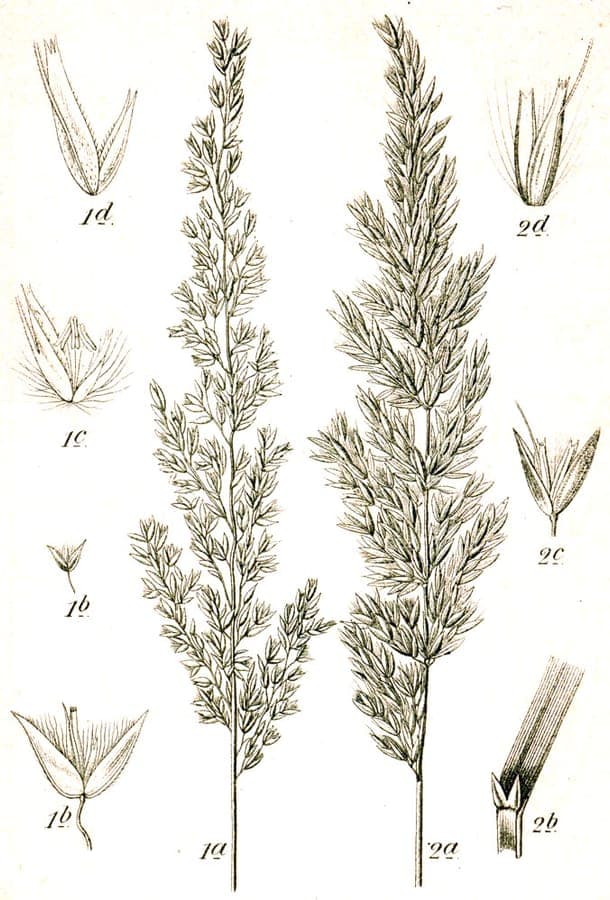
Johann Georg Sturm (Painter: Jacob Sturm) / Public domain, via Wikimedia Commons
Calamagrostis varia: complete guide
Calamagrostis varia
Want to see Calamagrostis varia: complete guide in your garden?
1 minute, no credit card
Overview
Calamagrostis varia, commonly found in alpine meadows across Central and Southern Europe, is a graceful, clump-forming grass that brings elegance and movement to the garden. Unlike its more cultivated cousins, this species thrives with minimal intervention, making it ideal for naturalistic planting schemes. Native to mountainous regions from Austria to Greece, it's adapted to well-drained slopes and calcareous soils. In garden settings, it reaches 80–120 cm in height and spreads slowly, forming tight, upright tufts that remain neat year-round.
On gardenworld.app, you can design a planting scheme that highlights the vertical rhythm of Calamagrostis varia alongside complementary perennials. It's not a showy plant in the traditional sense, but its subtle presence - especially when backlit by low sun - adds depth and texture. Perfect for borders, grassland mixes, or as a standalone feature in a modern garden.
Appearance & bloom cycle
The foliage is narrow, bright green, and reaches 40–60 cm before the flowering stems rise. From July to August, airy panicles emerge, standing 100–120 cm tall. The flowers are white to pale blue, with a soft, feathery texture that catches the breeze. Unlike some grasses that flop under rain, the inflorescences of C. varia stay upright and intact.
By September, the panicles fade to a warm beige, persisting well into winter. The plant retains its structure even under snow, offering visual interest during dormant months. It's not a long bloomer, but its seasonal arc - from fresh spring growth to winter silhouette - spans nearly the entire year.
Ideal location
This grass prefers full sun to light shade, scoring a 7 on the light scale (1–10). That means at least 5–6 hours of direct sunlight daily. It performs best in open, airy locations - south-facing slopes, raised beds, or the middle to back of a sunny border. Avoid heavily shaded corners or areas with constant tree root competition.
If you're unsure whether your garden gets enough light, gardenworld.app offers a sun exposure planner that maps daily sunlight patterns. Use it to find the perfect spot where Calamagrostis varia can thrive without getting smothered by denser perennials.
Soil requirements
Calamagrostis varia favors alkaline soils with a pH between 7.5 and 8.0. It grows naturally on limestone-rich substrates, so it does well in chalky, sandy, or gravelly loam. Avoid acidic or waterlogged soils - they can lead to chlorosis or root rot. If your soil is too acidic, amend it lightly with ground limestone, but don't overdo it, as this can harm acid-loving neighbours.
The plant doesn't need rich soil; in fact, overly fertile conditions encourage floppy growth. A lean, well-drained site is best. If planting in heavy clay, improve drainage by raising the bed and mixing in grit or gravel.
Free design
Want to see Calamagrostis varia: complete guide in your garden? Make a free design now.
Watering
Once established, this grass is drought-tolerant and rarely needs supplemental watering. During the first growing season, however, keep the soil evenly moist - water once a week during dry spells. Always water at the base to prevent fungal issues on the leaves.
Potted specimens dry out faster, so monitor them closely in summer. If a heatwave hits, move containers to partial shade until temperatures drop.
Pruning
Do not cut back in autumn. Leave the old foliage and flower spikes standing to provide winter structure and habitat for overwintering insects. The best time to prune is late February to early March, just before new growth emerges. Cut the entire clump down to about 15 cm using sharp shears or hedge trimmers.
Every 3–4 years, divide the clump in early spring to maintain vigour. This also gives you spare plants to share or relocate. Be careful not to damage the crown during division.
Maintenance calendar
- Jan: inspect for damage, leave standing
- Feb: prepare for cutting, remove loose debris
- Mar: cut back to 15 cm, divide if needed
- Apr: new shoots appear, no care required
- May: watch for slugs on young growth
- Jun: growth accelerates, no feeding
- Jul: flowering begins, peak visual impact
- Aug: full bloom, ideal for garden photography
- Sep: panicles fade, structure remains
- Oct: no action, let stand
- Nov: check for sogginess or collapse
- Dec: full winter display, leave uncut
Winter hardiness
Hardy to USDA zone 5 (-20°C to -29°C), Calamagrostis varia handles cold winters with ease. It remains evergreen in milder climates but dies back in harsher zones. The dried stems resist breaking and hold snow gracefully, adding sculptural interest. No winter protection is needed, even in exposed gardens.
Companion plants
Pair with late-summer bloomers like Echinacea, Rudbeckia, or Aster. The vertical lines of the grass contrast beautifully with the rounded forms of these flowers. You can also combine it with silver-foliage plants such as Artemisia or Stachys, which enhance its airy texture.
Avoid invasive groundcovers or aggressive grasses like Phalaris that might overwhelm it. In a meadow-style planting, it works well with Festuca ovina or small thymes that fill the gaps without competing.
Closing
Calamagrostis varia is a quiet achiever - not flashy, but deeply reliable. It asks for little and delivers structure, movement, and year-round presence. Plant it in sun on well-drained, alkaline soil, and prune at the right time. You'll be rewarded with a plant that moves with the wind and glows in the low light of dawn and dusk.
Find Calamagrostis varia at independent garden centres, especially those specialising in ornamental grasses. Check availability in spring and early summer. Use gardenworld.app to simulate how it will look in your border over the seasons, and plan combinations that balance form and foliage.
Want to see Calamagrostis varia: complete guide in your garden? Make a free design now.
Upload a photo, pick a style, and get a photorealistic design with plant list in under a minute.
No credit card required


Similar plants
Sporobolus pungens: complete guide
Sporobolus pungens
Sporobolus pungens is a stoloniferous Mediterranean coastal grass with outstanding salt and drought tolerance, perfect for seaside and dry gardens.
Mediterranean aegilops: complete guide
Aegilops biuncialis
Everything about Aegilops biuncialis, a Mediterranean annual grass with ornamental spikes and outstanding drought tolerance for dry gardens.
Silver bluestem: complete guide
Bothriochloa saccharoides
Full guide to Bothriochloa saccharoides (silver bluestem): site, soil, watering, winter hardiness, pruning, and garden companions.