
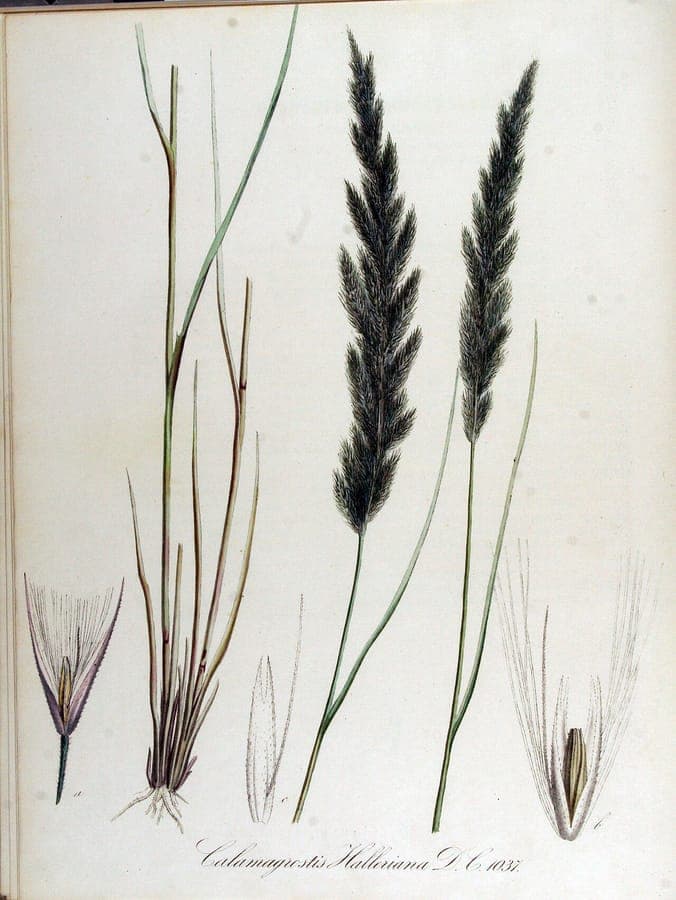
Jan Kops / Public domain, via Wikimedia Commons
Coastal small-reed: complete guide
Calamagrostis pseudophragmites
Want to see Coastal small-reed: complete guide in your garden?
1 minute, no credit card
Overview
Calamagrostis pseudophragmites, commonly known as Coastal small-reed, is a resilient, clump-forming grass native to riverbanks, marshes, and damp meadows across central and eastern Europe and parts of Asia. Standing between 100 and 180 cm tall, it thrives in consistently moist to wet soils and brings year-round structure to the garden. While not flashy, its subtle beauty and ecological value make it a standout for naturalistic planting schemes.
If you're designing a wet area in your garden, Coastal small-reed should be on your shortlist. On gardenworld.app, you can model a planting layout that integrates this grass seamlessly with other moisture-loving species, ensuring both visual harmony and soil stability.
Appearance & bloom cycle
This grass forms dense, upright tufts with narrow, bright green leaves 20–40 cm long and just 3–6 mm wide. In early summer, airy, silvery flower panicles emerge, rising above the foliage. These plumes mature from June through July, turning a soft tawny brown by late August and persisting well into winter. The flowering period runs from mid-June to September, depending on local climate.
The dried stems and seed heads add winter texture and movement, especially when lightly frosted or backlit by low winter sun. Unlike many ornamental grasses, it doesn't collapse under its own weight, maintaining an elegant silhouette even in wet, windy conditions.
Ideal location
Full sun is best for dense growth and strong flowering. It tolerates light shade, but in heavier shade, stems may flop. Plant it where water collects - along pond margins, in rain gardens, or in low-lying areas that stay damp. It handles periodic flooding up to 10 cm deep without issue.
Avoid hot, dry borders. This is not a plant for gravel gardens or xeriscaping. Instead, think of it as a structural element in waterside plantings. Use it to soften hard edges or create a soft, waving screen between garden zones.
Soil requirements
It prefers moist, humus-rich loam with a pH between 5.5 and 7.0. While it tolerates occasional inundation, it won't survive in permanently waterlogged, anoxic soils. Add well-rotted compost at planting to improve moisture retention and nutrient content.
If your soil is sandy or fast-draining, consider planting in a sunken container or raised bog bed. Mix in clay or organic matter to help hold water. Avoid lime-heavy soils - this grass dislikes high alkalinity.
Free design
Want to see Coastal small-reed: complete guide in your garden? Make a free design now.
Watering
Keep the soil consistently moist during the first growing season. Water deeply once a week during dry spells. Once established, it's more resilient but still performs best with regular moisture. In prolonged droughts, it may go dormant, but will rebound with rain.
Use rainwater when possible - tap water with high calcium content can build up over time and affect soil pH. Water at the base to prevent fungal issues on the foliage.
Pruning
Cut back hard in late winter or early spring (February to March) before new growth emerges. Trim old stems to 10–15 cm above ground level. This encourages fresh, upright growth and prevents the center of the clump from becoming woody and bare.
Wear gloves and long sleeves - the leaf edges can be sharp. Use sharp shears or a hedge trimmer for larger clumps. Leave the cut material on-site for a few extra weeks if you're supporting overwintering insects; remove it by mid-spring.
Maintenance calendar
- January: Check for winter damage. Leave seed heads standing.
- February: Begin pruning as soon as severe frost passes.
- March: Complete cutback. Apply a thin layer of compost around the base.
- April: New shoots appear. Watch for slugs.
- May: No major care needed. Monitor soil moisture.
- June: Flowering begins. Water if dry.
- July–August: Peak bloom. Avoid cutting.
- September: Plumes fade. No maintenance.
- October–December: Dormant. Leave standing for winter interest.
Winter hardiness
Hardy in USDA zones 5 to 8 (-20°C to -10°C). It remains semi-evergreen in milder winters, with tan-colored stems providing structure. No mulch or protection is needed, even in harsh conditions. In zone 5, it may die back more completely but regrows reliably in spring.
Companion plants
Pair with moisture-loving perennials like Iris pseudacorus, Filipendula ulmaria, or Carex rostrata. For contrast, use drier-ground plants on raised mounds nearby - think Echinacea purpurea or Salvia nemorosa.
Plant in groups of 3–5 for impact. It spreads slowly via rhizomes but isn't invasive. Avoid planting near aggressive spreaders like Phragmites australis, which can overwhelm it.
Closing
Coastal small-reed is a quiet achiever in the garden. It doesn't shout for attention, but it delivers texture, movement, and habitat value year after year. It's ideal for gardeners looking to embrace wet conditions rather than fight them.
Available at most garden centres in 3L pots, especially those specializing in native or water plants. Look for reputable suppliers to avoid mislabelling with similar species.
On gardenworld.app, you can design a planting scheme that uses Coastal small-reed to stabilize damp soil and add rhythm to your borders. Whether you're restoring a natural edge or creating a low-maintenance wet garden, this grass is a dependable ally.
Want to see Coastal small-reed: complete guide in your garden? Make a free design now.
Upload a photo, pick a style, and get a photorealistic design with plant list in under a minute.
No credit card required


Similar plants
Sporobolus pungens: complete guide
Sporobolus pungens
Sporobolus pungens is a stoloniferous Mediterranean coastal grass with outstanding salt and drought tolerance, perfect for seaside and dry gardens.
Mediterranean aegilops: complete guide
Aegilops biuncialis
Everything about Aegilops biuncialis, a Mediterranean annual grass with ornamental spikes and outstanding drought tolerance for dry gardens.
Silver bluestem: complete guide
Bothriochloa saccharoides
Full guide to Bothriochloa saccharoides (silver bluestem): site, soil, watering, winter hardiness, pruning, and garden companions.