
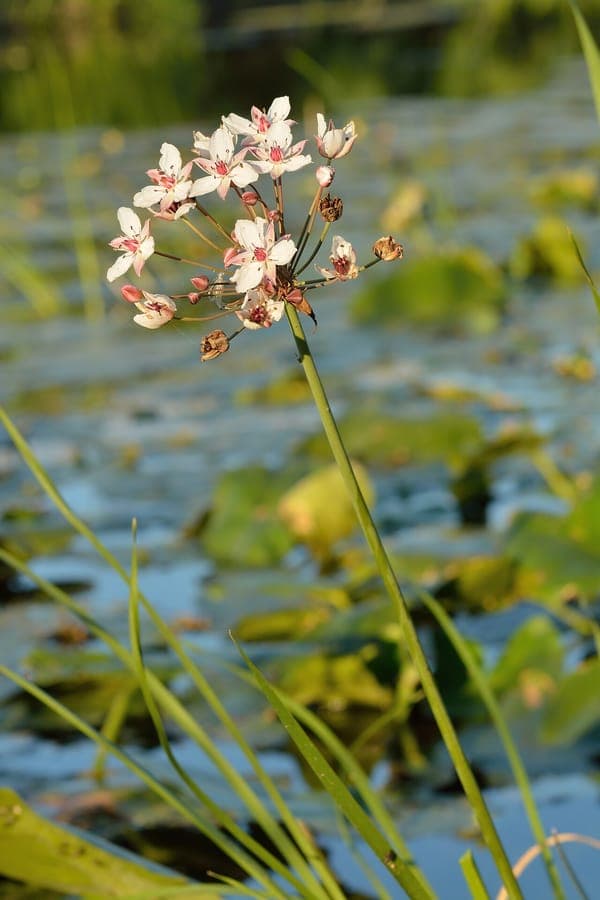
Ivar Leidus / CC BY-SA 3.0, via Wikimedia Commons
Water-gladiolus: complete guide
Butomus umbellatus
Want to see Water-gladiolus: complete guide in your garden?
1 minute, no credit card
Overview
Butomus umbellatus, commonly known as Water-gladiolus, is a striking aquatic perennial that brings vertical interest and bold colour to pond margins. Native to parts of Europe and Western Asia, it thrives in shallow water and moist soils, making it a favourite for naturalistic and formal water gardens. As a member of the Butomaceae family, it spreads slowly via rhizomes and forms upright clumps over time. The plant is hardy, long-lived, and particularly eye-catching when planted in groups of three or more.
On gardenworld.app, you can design a pond layout that perfectly accommodates Water-gladiolus, factoring in depth zones and companion species.
Appearance & bloom cycle
Water-gladiolus reaches 3 to 4 feet (90–120 cm) in height with a spread of about 16 inches (40 cm). Its sword-shaped leaves emerge from the base, growing upright and forming a dense clump. The foliage is bright green, slightly fleshy, and arranged in a fan-like pattern. From June through August, stiff, triangular flower stems rise above the leaves, topped with umbels of 20 to 50 small, star-shaped flowers. The blooms are a vivid pinkish-purple, with a delicate yellow spot at the base of each petal, adding subtle contrast. Each flower lasts several days, and the entire inflorescence can remain showy for 4 to 6 weeks.
Bees and butterflies frequently visit the flowers, making this plant a valuable addition to pollinator-friendly gardens. After blooming, seed pods form but are not particularly ornamental. Deadheading isn't essential but helps keep the plant tidy and can prevent self-seeding in ideal conditions.
Ideal location
Water-gladiolus performs best in full sun - aim for at least 6 to 8 hours daily (light level 7). It grows well in shallow water from 2 to 8 inches (5–20 cm) deep, making it ideal for planting baskets placed on pond shelves. It can also thrive in consistently moist soil at the edge of a bog garden or stream. Avoid deep water or heavily shaded areas, as both will lead to weak, leggy growth and poor flowering.
Still or slow-moving water is best. Strong currents may damage the flower stems. When planning your pond edge, use gardenworld.app to visualise how Water-gladiolus will integrate with other marginal plants and create seasonal impact.
Soil requirements
This plant prefers rich, loamy or clay-based substrates with a pH between 7.0 and 7.5. Avoid sandy soils unless amended with compost or aquatic soil mix. Use a heavy, nutrient-rich pond substrate - never standard potting soil, which floats and lacks structure. Plant rhizomes 2–3 inches (5–8 cm) deep in wide, shallow containers to allow room for spread. Top-dress with a thin layer of gravel to prevent soil disturbance.
Do not over-fertilise. A single slow-release aquatic fertiliser tablet at planting time is sufficient for the season.
Free design
Want to see Water-gladiolus: complete guide in your garden? Make a free design now.
Watering
In a pond, watering is self-regulated as long as the water level remains consistent. For plants grown in moist soil outside the water, regular irrigation is crucial - especially during dry spells in summer. The soil should never dry out completely. Use rainwater when possible, as tap water with high lime content can gradually raise pH.
If growing in a container outside a pond, place it in a saucer with water, but ensure the pot isn't sitting in stagnant water to avoid root rot.
Pruning
Pruning is minimal. Cut back spent flower stems to the base once blooming finishes. In late autumn or early winter, trim back dead foliage to about 4 inches (10 cm) above the crown. This keeps the plant neat and reduces the risk of rot during dormancy. Use clean, sharp shears to prevent disease spread.
Avoid cutting in early spring - old growth insulates the crown from late frosts and supports new shoots.
Maintenance calendar
- Jan: Check for crown damage; protect with straw if needed
- Feb: No action required
- Mar: Inspect for rot; remove dead material
- Apr: Trim old leaves; check planting depth
- May: Divide overcrowded clumps if needed
- Jun: Bloom begins; monitor water levels
- Jul: Peak bloom; watch for pollinators
- Aug: Continue deadheading; reduce feeding
- Sep: Prepare for dormancy; stop fertilising
- Oct: Cut foliage back to 10 cm
- Nov: Leave stubble for winter protection
- Dec: Dormant period; no feeding
Winter hardiness
Water-gladiolus is hardy in USDA zones 5 to 9. In zones 7 and above, it overwinters reliably in water or moist soil. In colder climates, ensure the crown stays submerged or mulch heavily. Potted plants are more vulnerable - sink them deeper into the pond or move to a protected, frost-free area. Avoid disturbing the plant in winter.
Companion plants
Pair Water-gladiolus with other marginal plants like Pickerelweed (Pontederia cordata), Sweet Flag (Acorus calamus), or Dwarf Cattail (Typha minima). For contrast, use white-flowered species such as Arrowhead (Sagittaria latifolia) or Lizard's Tail (Saururus cernuus). On land, combine with moisture-loving perennials like Astilbe or Joe-Pye Weed (Eutrochium).
Closing
Water-gladiolus is a low-effort, high-impact plant that adds structure and summer colour to wet areas. It's ideal for beginners and experienced gardeners alike. Purchase dormant rhizomes or container-grown plants in spring from garden centres or online retailers. Look for firm, healthy roots without signs of rot. Start small - this plant fills in fast. And remember: on gardenworld.app, you can map out your pond edge planting scheme and see how your Water-gladiolus will evolve over the seasons.
Want to see Water-gladiolus: complete guide in your garden? Make a free design now.
Upload a photo, pick a style, and get a photorealistic design with plant list in under a minute.
No credit card required


Similar plants
Acer pycnanthum: complete guide
Acer pycnanthum
Acer pycnanthum, the Japanese swamp maple, is a fast-growing tree with early red flowers and brilliant autumn color, ideal for damp garden settings.
Freeman maple: complete guide
Acer × freemanii
Everything about the Freeman maple (Acer x freemanii): a fast-growing shade tree with spectacular autumn colour for large gardens.
Silver vine: complete guide
Actinidia polygama
Discover silver vine (Actinidia polygama): a hardy climbing plant with silvery foliage, loved by gardeners and cats alike.