
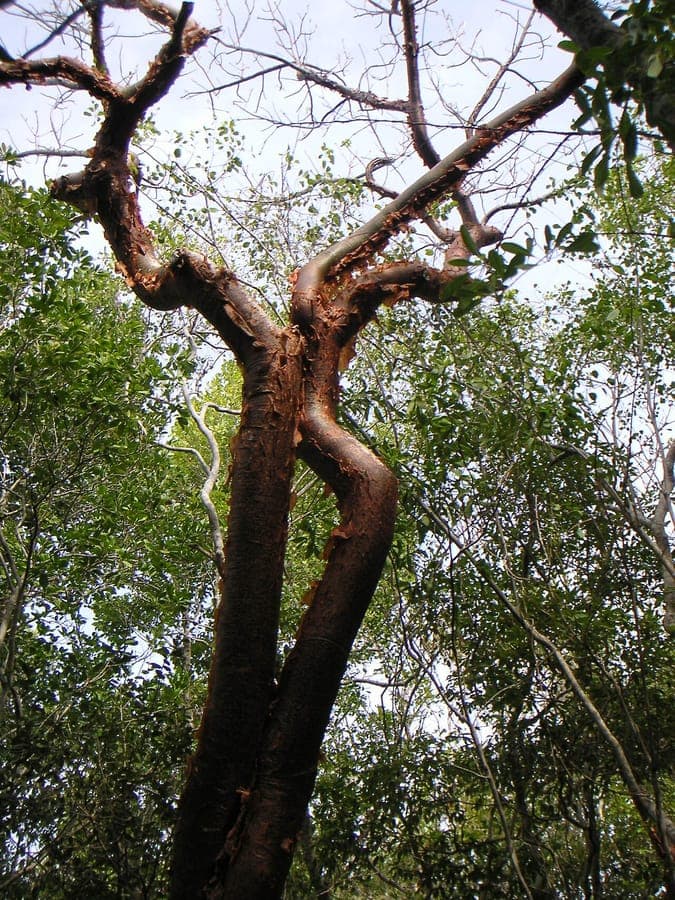
Louise Wolff (darina) / CC BY-SA 3.0, via Wikimedia Commons
West Indian-Birch: complete guide
Bursera simaruba
Want to see West Indian-Birch: complete guide in your garden?
1 minute, no credit card
Overview
Bursera simaruba, known by various names including Gumbo Limbo, West Indian-birch, and Tourist tree, is a fascinating tropical tree native to Mexico, the Caribbean, and South America. This tree is particularly renowned for its spectacular red and brown bark that somewhat resembles human skin, giving rise to the nickname "Tourist tree." In warm-climate gardens, it is a compelling choice due to its unique appearance and low maintenance requirements.
Appearance and Bloom
The Gumbo Limbo grows into a medium to large tree, typically 8 to 15 meters tall, though it can grow larger under optimal conditions. The most striking feature is undoubtedly its bark, which displays a gray, reddish-brown to bright red color and regularly exfoliates to reveal a smooth, almost mirror-like surface. This characteristic bark structure is particularly beautiful in winter months when foliage may drop.
The leaves are compound, pinnate, with numerous small, elliptical leaflets that give a fine, delicate texture. Flowers are small, inconspicuous yellow-greenish blooms appearing in small panicles. While not spectacular, these flowers attract beneficial pollinators.
Ideal Location
The Gumbo Limbo is a sun-lover and thrives best in locations with abundant sunlight. The tree tolerates shade but grows and flowers best in zones with at least six hours of direct sun daily. The tree is most comfortable in warm climates and cannot tolerate freezing well.
In seaside gardens, it is an excellent choice due to salt tolerance. The tree also tolerates windy conditions reasonably well. Ensure you plant it in a location where it can reach its full growth potential, as it develops a substantial crown.
Soil
The Gumbo Limbo is highly tolerant regarding soil conditions. It grows in sandy, clay, and loamy soils, provided they drain well. The tree tolerates acidic to neutral soils and can also grow in slightly saline soils. Well-drained soils are essential, however, as the tree performs poorly in permanently wet conditions.
During planting, supplementation with organic matter can be beneficial, though excessive fertilization can affect growth unnaturally. Once established, the tree typically requires no additional feeding.
Watering
Newly planted trees should receive regular water until well-established, typically over a period of several months to one year. Once established, the Gumbo Limbo is fairly drought-tolerant and may only need supplemental water during extreme dry spells.
In tropical regions with regular rainfall, supplemental irrigation is usually unnecessary. In drier climates, additional water can be beneficial, especially during dry seasons. Ensure water drains away properly.
Free design
Want to see West Indian-Birch: complete guide in your garden? Make a free design now.
Pruning
The Gumbo Limbo responds well to pruning and can be pruned for shape and size management. The best time to prune is after the growing season when the tree has reached its expansion phase. Remove deadwood and crossing branches to maintain a healthy structure.
Undergrowth or certain branches can also be removed to create clear views. Always work with sharp tools and keep cuts clean to prevent disease issues.
Maintenance Calendar
Spring: Plant new specimens for optimal growth during the growing season. Examine for damage from the previous winter.
Summer: Water regularly, especially in drier climates. Monitor for insect pests, though serious problems are unusual.
Autumn: Gradually reduce watering as growth slows. In some climates, the tree may shed foliage.
Winter: Minimal care needed. In tropical climates, the tree continues growing, but in subtropical areas, leaf drop may occur.
Winter Hardiness
The Gumbo Limbo is not cold-hardy against freezing. In areas where temperatures drop below freezing, it is unsuitable as permanent outdoor planting. However, in warm climates (USDA zones 10-11), it grows well as long-term landscape planting.
Actually, the tree sheds its leaves in response to drought and extended cold periods, a phenomenon known as deciduousness. This is actually a survival mechanism and not a sign of death. The tree will typically leaf out again in the next growing season.
Companion Plants
The Gumbo Limbo combines well with other tropical and subtropical trees such as mango, avocado, and palms. Ornamental trees like Delonix regia (Royal Poinciana) also form good visual partners. Underplanting with Heliconia or other tropical shrubs creates a full jungle-like garden.
Ground covers like Liriope also make good neighbors. For color contrast, try Ixora with its red flowers beside the red bark of the Gumbo Limbo.
Closing Thoughts
The Gumbo Limbo is a fascinating choice for warm, tropical gardens. With its incomparable red-brown bark, low maintenance requirements, and bird-friendly character, it offers much decorative value. Also known as the Tourist tree, this specimen invites visitors to admire its unique beauty. For inspiration on how to integrate this spectacular tree into your garden, visit gardenworld.app for more ideas. Discover numerous complementary tropical garden plants there.
Want to see West Indian-Birch: complete guide in your garden? Make a free design now.
Upload a photo, pick a style, and get a photorealistic design with plant list in under a minute.
No credit card required


Similar plants
Boswellia serrata: complete guide
Boswellia serrata
Explore the Indian frankincense tree: cultivation, care and applications. A unique plant with valuable properties for gardens and wellness.
Myrrh tree: complete guide
Commiphora myrrha
Discover the myrrh tree (Commiphora myrrha), valued for its aromatic resin. A drought-tolerant shrub for tropical and subtropical gardens. Cultivation and care guide.
Okoume: complete guide
Aucoumea klaineana
Aucoumea klaineana, the Okoume tree, is an African timber tree from West-Central Africa. Fast-growing with aromatic wood used in woodworking and rosin extraction.