
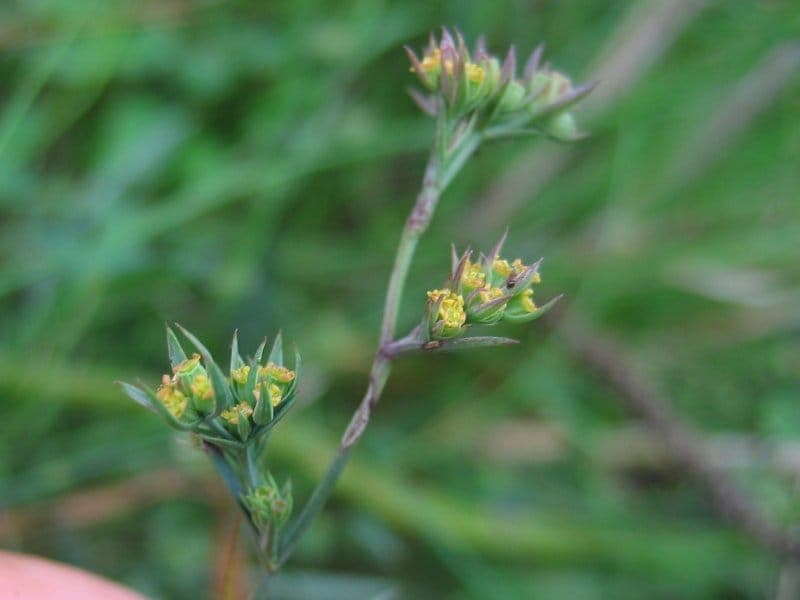
Kristian Peters -- Fabelfroh 08:34, 25 November 2006 (UTC) / CC BY-SA 3.0, via Wikimedia Commons
Slender hare's-ear: complete guide
Bupleurum tenuissimum
Want to see Slender hare's-ear: complete guide in your garden?
1 minute, no credit card
Overview
Slender hare's-ear, or Bupleurum tenuissimum, is a graceful, fine-textured annual or short-lived perennial in the Apiaceae family. Native to southern and central Europe - from Austria to Algeria - it thrives in dry, open habitats like rocky slopes, field margins, and grassy clearings. Though not native to the UK, it adapts well to cottage gardens, gravel beds, and naturalistic planting schemes. At 30 to 60 cm tall, it doesn't dominate, but adds a soft, shimmering layer to late-season borders. Its unassuming presence belies its value: a drought-tolerant, pollinator-friendly plant that bridges the gap between summer and autumn.
On gardenworld.app, you can design a border layout that highlights the airy texture of slender hare's-ear, especially when paired with bold-leaved or upright plants.
Appearance & bloom cycle
The plant features thread-like, linear foliage in a soft grey-green tone, giving it a feathery, almost translucent quality. From August through October, small yellow umbel flowers appear - classic of the carrot family. Each flower head is only 5–8 mm across, but collectively they create a glowing haze, particularly in late afternoon light. The bloom period is long, often lasting eight weeks or more in mild seasons. After flowering, tiny seed capsules form, which readily self-sow in well-drained soils. This makes it a reliable returner in the right conditions, though it may skip a year if the site is too wet or shaded.
Ideal location
Full sun is non-negotiable. Slender hare's-ear needs at least 6–8 hours of direct sunlight daily. It performs best in hot, dry spots: south-facing borders, gravel gardens, rockeries, or stone walls. It's excellent for xeriscaping or low-water gardens. Avoid shaded or damp areas - it will weaken and rot quickly. If your garden has partial shade, consider placing it near reflective surfaces like light-coloured paving to boost warmth. Use gardenworld.app to simulate sun exposure and check if your border gets enough light for this sun-loving species.
Soil requirements
Well-drained soil is essential. Heavy clay soils must be amended with grit, sand, or composted bark to improve porosity. Ideal conditions are sandy or loamy soils with low to moderate fertility. It tolerates a pH range of 6.0 to 7.8. Avoid rich, moisture-retentive soils - they encourage lush growth that flops and invites fungal disease. A lean soil actually promotes better flowering and structural integrity.
Free design
Want to see Slender hare's-ear: complete guide in your garden? Make a free design now.
Watering
Once established, slender hare's-ear needs no supplemental watering. During the first few weeks after planting or germination, keep the soil lightly moist if there's no rain. After that, rely on natural rainfall. Overwatering is the most common cause of failure. This plant is built for drought, not deluge. If you're using irrigation systems, exclude this species or set it on a minimal schedule.
Pruning
Deadheading isn't required, but cutting back spent flower stalks can encourage a second, lighter flush of blooms. If you want self-seeding, leave some stems intact into winter. Cut back all growth in late winter or early spring before new shoots emerge. Leaving it standing over winter also provides shelter for beneficial insects.
Maintenance calendar
- Jan: Check for early seedlings; clear debris if needed.
- Feb: No action.
- Mar: Watch for seedlings; remove excess if overcrowded.
- Apr: Apply a thin layer of compost if soil is poor.
- May: Monitor for slugs on young growth.
- Jun: Water only if prolonged drought; otherwise ignore.
- Jul: Plant reaches full size; no pruning.
- Aug: Blooms begin; check for aphids.
- Sep: Peak flowering; deadhead if desired.
- Oct: Allow seed set; stop watering.
- Nov: Cut back or leave for winter interest.
- Dec: Protect from waterlogged conditions; ensure good drainage.
Winter hardiness
Hardy in USDA zones 6–9 (-23°C to -1°C). In colder zones, it may behave as a biennial or annual. Self-seeding compensates for limited longevity. In wet winters, crown rot can occur - so drainage is key. Mulching is not recommended, as it can trap moisture. A light leaf litter layer is sufficient in exposed sites.
Companion plants
Pair with drought-tolerant perennials like Sedum 'Matrona', Eryngium planum, or Nepeta racemosa. It contrasts beautifully with bold foliage such as Phormium or Yucca. Good with grasses like Stipa tenuissima or Molinia caerulea for movement. Avoid aggressive spreaders like mint or goldenrod that could overwhelm it. Also works in pollinator mixes with verbena or echinacea.
Closing
Slender hare's-ear won't shout for attention, but it earns its place through resilience and quiet beauty. It's a low-fuss plant for gardeners who value texture and seasonal rhythm. You can find seeds or young plants at garden centres across the UK in late spring and summer. Retailers like Dobies or Sarah Raven often stock it, and local independents may carry it as part of native meadow mixes. It's not flashy, but in the right setting, it's unforgettable.
Want to see Slender hare's-ear: complete guide in your garden? Make a free design now.
Upload a photo, pick a style, and get a photorealistic design with plant list in under a minute.
No credit card required


Similar plants
Whorled carrot: complete guide
Daucus involucratus
Daucus involucratus is a Mediterranean umbellifer with white flower heads framed by lacy bracts. Growing this gravel garden gem.
Daucus muricatus: complete guide
Daucus muricatus
Daucus muricatus, the spiny wild carrot, grows wild on Mediterranean coasts. Discover sowing, June-July bloom, and wildflower meadow use.
Daucus pumilus: complete guide
Daucus pumilus
Daucus pumilus is a dwarf wild carrot relative with white lacy umbels, thriving on dunes and coastal rock in poor, fast-draining soil.