
Fornax / CC BY-SA 3.0, via Wikimedia Commons
Corn gromwell: complete guide
Buglossoides arvensis
Want to see Corn gromwell: complete guide in your garden?
1 minute, no credit card
Overview
Corn gromwell, or Buglossoides arvensis, is a resilient herbaceous plant often found along field margins, dry banks, and open woodland edges. Though native across much of Europe, including Austria, Albania, and the Baltic States, it's gaining recognition in garden design for its airy form and ecological benefits. It's a biennial or short-lived perennial, meaning it typically completes its life cycle in two years, but self-seeds reliably in suitable conditions. As part of the Boraginaceae family, it shares traits with borage and forget-me-nots - notably hairy stems and small, clustered flowers.
On gardenworld.app, you can plan a wildflower meadow or cottage border where Corn gromwell plays a supporting yet elegant role. It's not aggressive in its seeding, so it won't swamp neighboring plants. Because it grows naturally in disturbed soils, it adapts well to garden settings with minimal intervention.
Appearance & bloom cycle
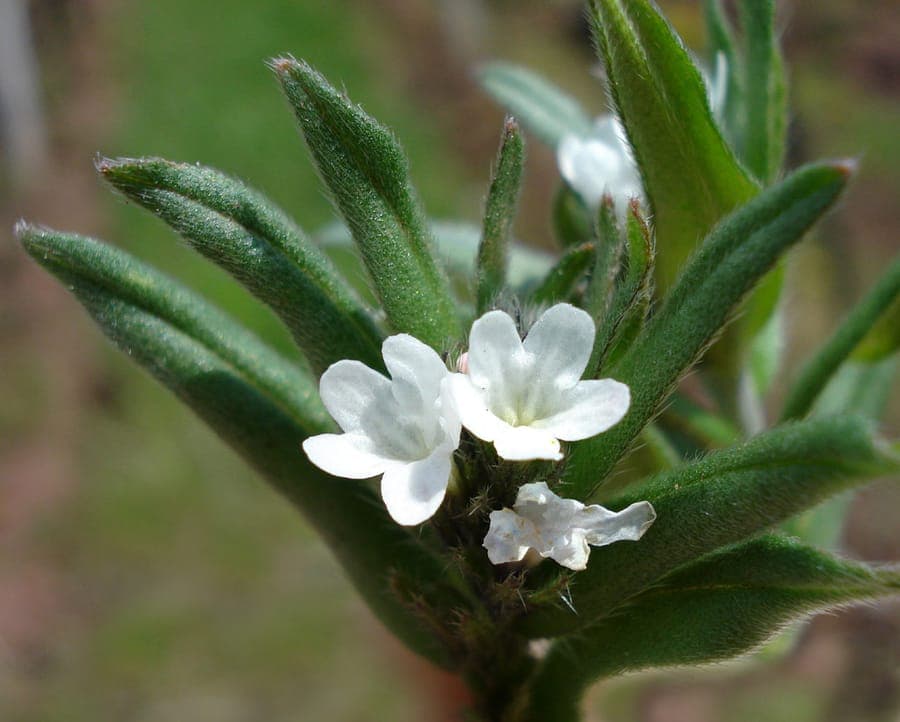
Corn gromwell reaches 30–60 cm in height, with upright, often branched stems and rough, lance-shaped leaves covered in fine hairs. The foliage has a grey-green tint and feels coarse to the touch. From April through September, it produces clusters of small white flowers, each about 5 mm across, arranged in elongated, one-sided racemes. The blooms have five notched petals that give them a slightly starry look.
The flowering period is impressively long, especially if you deadhead regularly. In a well-maintained border, you can expect peak bloom in May and June, with continued flowering through summer. It works well as a middle-layer plant, adding light texture behind bolder perennials like Echinacea or Verbena bonariensis. On gardenworld.app, you can visualize how Corn gromwell integrates with plants like Nepeta or Salvia for a balanced, pollinator-rich scheme.
Ideal location
This plant thrives in full sun, needing a light level of at least 7 out of 10. Aim for a south- or southwest-facing spot where it gets 6+ hours of direct sunlight daily. It tolerates light shade but blooms less freely. It's ideal for dry slopes, gravel gardens, or herbaceous borders with good air circulation. Avoid dense shade under large trees or near buildings that cast long shadows.
Corn gromwell is hardy in USDA zones 5–8, making it suitable for most of the UK, northern Europe, and the northern US. Use the climate zone tool on gardenworld.app to verify if it's a match for your region.
Soil requirements
It prefers well-drained, neutral to slightly alkaline soil with a pH of 7.0–7.5. Sandy or loamy soils work best. Avoid heavy clay unless amended with grit or compost to improve drainage. It does poorly in acidic or waterlogged conditions. If your soil is too acidic, incorporate garden lime in autumn to gradually raise the pH.
A calcareous substrate - such as old field edges or chalk grasslands - is ideal. Raised beds with a mix of sand, compost, and crushed limestone can mimic these conditions in garden settings.
Free design
Want to see Corn gromwell: complete guide in your garden? Make a free design now.
Watering
Once established, Corn gromwell is drought-tolerant. Water only during prolonged dry spells, especially in the first few weeks after sowing or transplanting. Give about 5 litres per square meter once a week if no rain falls. Avoid overhead watering - it can promote fungal diseases. Water at the base, early in the morning, to reduce evaporation and keep foliage dry.
Pruning
Deadheading spent flowers encourages repeat blooming and helps control self-seeding. Cut back flower stems to 10 cm above ground level after the main flush, around late August. This often triggers a second, lighter bloom in September. If you want it to reseed, leave a few stems intact until seeds turn brown and split open.
No other pruning is needed. In late winter, remove any dead foliage to make space for new growth.
Maintenance calendar
- Jan: Check for pests, remove old mulch if moldy
- Feb: Plan sowing, prep seed trays
- Mar: Start seeds indoors or in cold frames
- Apr: Sow directly or transplant seedlings, watch for frost
- May: Flowers open, monitor water needs
- Jun: Peak bloom, ensure good airflow
- Jul: Deadhead regularly, watch for mildew
- Aug: Cut back for second bloom, leave some seed heads
- Sep: Allow seeds to mature, collect or scatter
- Oct: Clear dead stems, prep soil for winter
- Nov: No action, check for overwintering insects
- Dec: Dormant period, inspect root zone
Winter hardiness
Corn gromwell survives down to -20°C (USDA zone 5). In colder regions, a light mulch of straw or leaf litter helps protect crowns from freeze-thaw cycles. Avoid thick, moisture-retaining mulches that could rot the base. In wet winters, ensure drainage is optimal to prevent root rot.
Companion plants
Pair Corn gromwell with drought-tolerant species like Achillea, Stachys, or Eryngium. It complements silvery foliage plants such as Artemisia or Santolina. Avoid moisture-loving plants like hostas or astilbes. It also works well beside upright grasses like Stipa tenuissima, which add movement without crowding.
On gardenworld.app, use the companion planting tool to test visual and ecological pairings with Corn gromwell in your layout.
Closing
Corn gromwell is a low-maintenance, high-reward plant for sunny, dry gardens. It supports pollinators, adds subtle beauty, and demands little in return. Buy seeds or young plants from garden centres like those stocking organic lines - look for reputable suppliers. Its long bloom season and self-sustaining nature make it a smart choice for sustainable planting. Plan your layout on gardenworld.app to see how Corn gromwell can enhance your garden's rhythm and texture.
Want to see Corn gromwell: complete guide in your garden? Make a free design now.
Upload a photo, pick a style, and get a photorealistic design with plant list in under a minute.
No credit card required


Similar plants
Western waterleaf: complete guide
Hydrophyllum occidentale
Full growing guide for western waterleaf (Hydrophyllum occidentale): shade tolerance, soil needs, watering, winter hardiness and naturalistic garden use.
Limestone phacelia (Phacelia affinis): complete guide
Phacelia affinis
Full guide to Phacelia affinis, the limestone phacelia: sowing tips, purple-blue bee flowers, drought tolerance and uses in dry or wildlife gardens.
Pyrenean viper's bugloss: complete guide
Echium asperrimum
Echium asperrimum is a striking biennial from the western Mediterranean with rough bristly stems and vivid blue flowers. A magnet for bees and a bold border plant.