
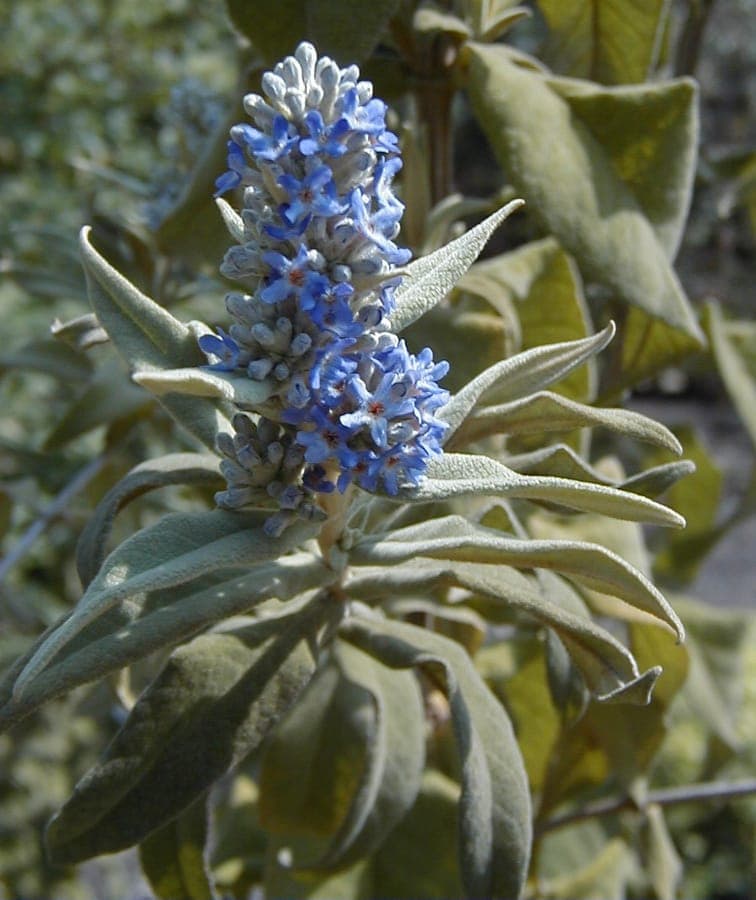
You may select the license of your choice. / CC BY-SA 4.0, via Wikimedia Commons
Wild sagewood: complete guide
Buddleja salviifolia
Want to see Wild sagewood: complete guide in your garden?
1 minute, no credit card
Overview
Buddleja salviifolia, also known as wild sagewood or sagewood, is a beautiful South African shrub distinguished by its elegant form and spectacular blooms. This semi-hardy to hardy shrub naturally grows in the dry woodlands of South Africa, making it ideally suited for gardens in areas with some drought.
Wild sagewood is an excellent choice for a low-maintenance garden because it is very drought-tolerant once established. Its yellow flowers and gray foliage also make it very attractive from an aesthetic standpoint.
Appearance and bloom
Wild sagewood grows into an elegant shrub about 2 to 3 meters tall and wide. The stems are thin and elegant, with gray-green lance-shaped leaves that provide nice texture. The foliage is somewhat rough and has a silver-gray tint, especially when the plant is younger.
The blooms are the highlight of this shrub. Yellow flower spikes appear abundantly during the summer season (June to September) and attract many butterflies and bees. The flowers have a pleasant aroma that is especially strong in the afternoon. The flowering period lasts long.
After flowering, small seed capsules form that are decorative.
Ideal location
Wild sagewood loves a location with plenty of sunlight. Plant it where it receives at least 6 hours of direct sunlight per day. The shrub also grows fairly well in partial shade, although flowering will be less abundant.
The plant grows better in open gardens where wind can circulate. This helps prevent mold problems. Shelter from strong winds is, however, welcome.
Wild sagewood is semi-hardy and suitable for USDA zones 8-10. In milder regions it can overwinter outdoors, but in more northern areas protection is needed.
Soil
Wild sagewood grows in virtually any soil type but prefers well-drained soils. The plant tolerates even poor soils, sand, and lean clay. The plant dislikes waterlogged soils.
The pH can be between 5.5 and 8.0. Adding sand or gravel to heavy clay soils significantly improves drainage.
Once established, no extra fertilizing is needed, although some compost helps.
Free design
Want to see Wild sagewood: complete guide in your garden? Make a free design now.
Watering and moisture
Young plants should be watered regularly until well established, usually during the first growing season. Water deeply during dry spells.
Once established (after about two growing seasons), wild sagewood is very drought-tolerant and can go long periods without water. In extremely dry conditions, regular watering in summer can help.
Mulching around the base helps retain moisture and suppress weeds.
Pruning
Wild sagewood responds well to pruning and can be cut back hard. The best time to prune is in late spring, just after flowering ends. This promotes a fuller growth pattern in the next season.
Remove dead or diseased branches as you encounter them. The plant may tend to grow tall and thin, so regular pruning helps maintain a more compact form.
Maintenance calendar
March-May: Pruning of previous season. New foliage emerges.
June-September: Flowering period. Water during drought.
October-November: Flowering ends. Seed formation visible.
December-February: Winter rest period. Minimal watering and feeding needs. Winter preparation in cold areas.
Winter hardiness
Wild sagewood is semi-hardy. In milder parts of temperate regions it can overwinter outdoors, but in more northern areas protection is needed. The plant can tolerate temperatures down to about minus 10 degrees Celsius.
In cold winters, it is better to keep the plant in a pot and bring it indoors. Or provide protection with straw or burlap.
Companion plants
Wild sagewood combines beautifully with:
- Cistus: For Mediterranean style
- Rosemary: For similar texture and drought tolerance
- Lavender: For purple color contrast
- Santolina: For silvery foliage
- Artemisia: For soft grey-green foliage
Closing thoughts
Wild sagewood is an elegant and drought-tolerant shrub perfectly suited for modern, low-maintenance gardens. With its yellow flowers, gray foliage, and drought tolerance, it's an excellent choice for sunny, well-drained locations.
Find wild sagewood at specialized nurseries and larger garden centers. On gardenworld.app you can find inspiration for designing your sunny garden with this beautiful South African shrub. With this guide, you have everything you need to successfully plant and maintain this elegant shrub in your garden. Enjoy!
Want to see Wild sagewood: complete guide in your garden? Make a free design now.
Upload a photo, pick a style, and get a photorealistic design with plant list in under a minute.
No credit card required


Similar plants
Naio: complete guide
Myoporum sandwicense
All about naio or bastard sandalwood (Myoporum sandwicense): a Hawaiian coastal tree, its uses, cultivation, and role as a tough windbreak in mild gardens.
Oriental Mullein: complete guide
Verbascum orientale
Complete guide to Oriental Mullein (Verbascum orientale): placement, soil, watering, pruning and garden design tips.
Buddleja marrubiifolia: complete guide
Buddleja marrubiifolia
Woolly butterfly-bush from Texas and Mexico. Shrub with soft, hairy leaves and orange-red flowers. Hardy to -5C. Blooms summer-fall. Drought-tolerant and low-maintenance plant.