
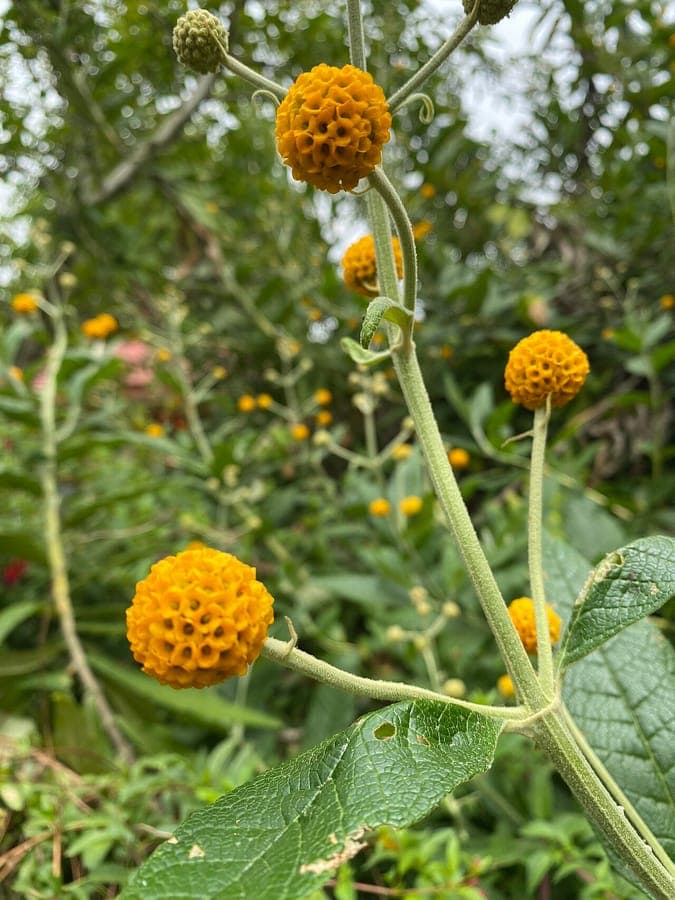
Corsario CL / CC BY-SA 4.0, via Wikimedia Commons
Orange-ball-tree: complete guide
Buddleja globosa
Want to see Orange-ball-tree: complete guide in your garden?
1 minute, no credit card
Overview
Buddleja globosa, commonly known as Orange-ball-tree, is a standout shrub for gardens that want structure and wildlife appeal without excessive upkeep. Native to the Andean regions of central and southern Chile and parts of Argentina, it's adapted to cooler, moist mountain climates-unlike its flashier cousin, B. davidii, which can turn invasive. In the garden, it reaches 6 to 10 feet tall and spreads 5 to 7 feet wide over time, forming an open, arching framework with softly felted foliage.
What makes this shrub special is its clusters of bright orange, globe-shaped flowers that bloom from early June through late August. They're rich in nectar and draw in butterflies, bees, and hummingbirds. The fragrance is warm and honeyed, noticeable on still summer evenings. If you're designing a wildlife-friendly space, this plant earns top marks. On gardenworld.app, you can design a pollinator corridor where Orange-ball-tree anchors the mid-back layer, pairing beautifully with grasses and late perennials.
It's semi-deciduous, meaning it may retain some leaves in mild winters but typically drops most by late autumn. Growth rate is moderate, so you won't be fighting it into submission every year. It's a shrub that fits well in both cottage and modern landscapes.
Appearance & bloom cycle
The leaves are lance-shaped, 4–6 inches long, dark green above, and covered in a fine greyish down underneath, giving them a soft, silvery look when the wind flips them. The real show starts in early summer when clusters of small, tubular flowers form tight, pom-pom-like spheres-each 2 to 3 inches across. These orange-yellow globes appear at the tips of last year's growth, which is crucial for pruning timing.
Bloom time runs from June to August, peaking in July. Unlike many shrubs that flower for just a few weeks, this one delivers over ten weeks of color and scent. Deadheading isn't necessary, though you can trim spent blooms to tidy up. The flowers don't set showy fruit, so there's no winter interest beyond the bare, twisting branches.
Young plants may bloom lightly in their second or third year. Full flowering usually kicks in by year four or five, so patience pays off.
Ideal location
Full sun is non-negotiable. Plant in a spot with at least 6 hours of direct sunlight daily. Less sun means fewer flowers and leggy growth. A south- or southwest-facing position works best. It tolerates light shade but expect reduced bloom and weaker structure.
Give it room to spread-don't tuck it too close to fences or walls unless you plan to prune annually. It's excellent as a specimen shrub, in shrub borders, or at the back of a mixed perennial bed. Avoid overly exposed, windy sites; while it's tough, strong gusts can damage the arching stems.
On gardenworld.app, you can map out a sun exposure plan for your garden and pinpoint the best microclimate for this shrub-especially if you're working with a small urban yard or a sloped site where drainage matters.
Free design
Want to see Orange-ball-tree: complete guide in your garden? Make a free design now.
Soil requirements
Well-drained soil is key. It tolerates a range of soil types-sandy loam, clay loam, even rocky soils-as long as water doesn't pool around the roots. Ideal pH is between 5.5 and 7.0 (slightly acidic to neutral). Heavy clay needs amending with grit or compost to improve drainage.
It doesn't require rich soil or fertiliser. In fact, too much nitrogen leads to lush foliage but fewer flowers. A light top dressing of compost in early spring is sufficient. Avoid lime unless your soil is extremely acidic.
Watering
Water young plants regularly during the first growing season-about 10 litres per week during dry spells from May to September. After that, it's moderately drought-tolerant, but performs better with occasional deep watering in prolonged dry periods. Always water at the base to prevent fungal issues.
Once established, mature shrubs rarely need supplemental watering except in extreme drought. Mulch with bark or wood chips in spring to conserve moisture and suppress weeds.
Pruning
Prune right after flowering ends, between late August and mid-September. Since it blooms on old wood, pruning in spring would remove the flower buds. Remove dead, damaged, or crossing branches. You can also cut back up to one-third of older stems to encourage renewal, especially on shrubs over five years old.
Avoid hard pruning unless necessary-this can delay blooming for a season. Use clean, sharp secateurs and disinfect between cuts if you notice any dieback.
Maintenance calendar
- Jan: Check for winter damage. No pruning.
- Feb: Prepare tools. No action needed.
- Mar: Apply light compost mulch.
- Apr: Monitor bud development. Water if dry.
- May: Water young plants weekly in dry weather.
- Jun: Bloom starts. Keep soil moist.
- Jul: Peak bloom. Watch for aphids.
- Aug: Flowers fade. Begin light pruning.
- Sep: Finish pruning. Avoid new growth.
- Oct: Leaves drop. Clean up debris.
- Nov: Protect young plants in zone 7.
- Dec: Dormant period. No watering.
Winter hardiness
Hardy in USDA zones 8–10 (10°F to −12°C). In zone 7 (0°F), it may die back to the ground but often re-sprouts from the base. Young plants benefit from a winter wrap of burlap in colder areas. Avoid wet, poorly drained sites in winter-standing water causes root rot.
In harsh winters, apply a dry mulch (like straw or shredded bark) around the base, but keep it away from the stem to prevent rot.
Companion plants
Pair with late-summer bloomers to extend visual interest: Echinacea, Verbena bonariensis, Salvia, and tall ornamental grasses like Miscanthus. Avoid invasive spreaders like mint or bamboo. Good groundcovers include Carex species or Thymus, which don't compete aggressively.
Avoid planting near heavy feeders or dense evergreens that create shade and root competition.
Closing
Buddleja globosa brings long-lasting color, fragrance, and wildlife value with minimal demands. It's not flashy like hydrangeas or finicky like rhododendrons-it earns its keep quietly. Buy from reputable garden centres, especially those that stock native-adapted species. Look for healthy, well-rooted young plants without signs of stress. With the right spot and a light hand with the pruners, this shrub will thrive for years. Use gardenworld.app to visualise how it fits into your garden's ecosystem-whether you're starting from scratch or refining an existing border.
Want to see Orange-ball-tree: complete guide in your garden? Make a free design now.
Upload a photo, pick a style, and get a photorealistic design with plant list in under a minute.
No credit card required


Similar plants
Naio: complete guide
Myoporum sandwicense
All about naio or bastard sandalwood (Myoporum sandwicense): a Hawaiian coastal tree, its uses, cultivation, and role as a tough windbreak in mild gardens.
Oriental Mullein: complete guide
Verbascum orientale
Complete guide to Oriental Mullein (Verbascum orientale): placement, soil, watering, pruning and garden design tips.
Buddleja marrubiifolia: complete guide
Buddleja marrubiifolia
Woolly butterfly-bush from Texas and Mexico. Shrub with soft, hairy leaves and orange-red flowers. Hardy to -5C. Blooms summer-fall. Drought-tolerant and low-maintenance plant.