
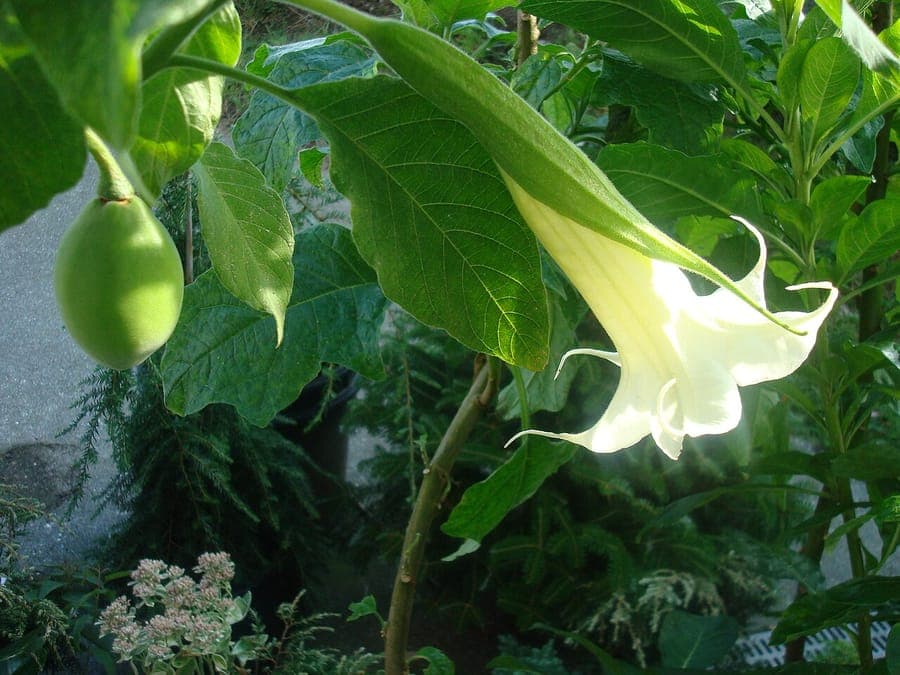
Tom Hulse / CC BY-SA 3.0, via Wikimedia Commons
Brugmansia arborea: complete guide
Brugmansia arborea
Want to see Brugmansia arborea: complete guide in your garden?
1 minute, no credit card
Overview
Brugmansia arborea, commonly known as white angel's trumpet or tree datura, is a spectacular flowering shrub native to mountain regions from Ecuador to northern Chile. This remarkable plant is celebrated for its gigantic, pendant trumpet flowers in pure white, combined with an intoxicating evening fragrance that enchants gardens across warm climates.
This is a plant for ambitious gardeners! With its enormous hanging blooms and exotic character, Brugmansia arborea transforms any garden into a tropical paradise. Although this plant demands intensive care and bears toxins, the rewards are unparalleled for dedicated enthusiasts.
Appearance and Growth
Brugmansia arborea distinguishes itself through robust, tree-like growth and enormous snow-white, pendant trumpet flowers. The plant develops a vigorous, heavily branched shrub with large, oval green foliage. Under ideal conditions, the plant reaches 2-4 meters in height.
The flowers represent the absolute highlight: trumpet blooms reaching 25-30 cm in length, pure white, with a pleasant and strong vanilla-like fragrance that intensifies in evening and night hours. Flowers appear throughout the growing season (May to October), with peak blooming during summer and autumn.
Following flowering, pear-shaped fruits develop, initially green then turning yellow. These fruits contain numerous seeds. The plant retains its foliage year-round in mild climates.
Ideal Location
Brugmansia arborea performs best in very sunny locations receiving at least 6-8 hours of direct sunlight daily. The plant tolerates some afternoon shade, especially in extremely hot climates. The site must be protected from strong winds that may damage heavy flowers.
The plant thrives in warm to moderately warm climates, ideally between 15 and 28 degrees Celsius. In cooler climates, the plant should be cultivated in containers that can be moved indoors for winter protection.
Soil
Brugmansia arborea thrives in nutrient-rich, well-draining soils. The plant has substantial nutritional demands and grows most luxuriously in soils generously enriched with compost or other organic matter. The species prefers neutral to slightly acidic soil (pH 6.5-7.0).
The plant accepts nearly any soil texture provided drainage is excellent. Waterlogging must be absolutely prevented as this leads to root diseases and plant collapse. Regular compost additions and slow-release fertilizer applications are essential for healthy growth.
Watering
Brugmansia arborea requires regular watering, especially during the growing season. The plant must never completely dry out but must also not remain in constant waterlogging. In warm, dry seasons, daily watering may be necessary.
The plant consumes substantial water due to rapid growth and large leaf surface area. Ensure the soil always feels moist but not waterlogged. In winter, watering can be substantially reduced, especially for plants grown indoors.
Free design
Want to see Brugmansia arborea: complete guide in your garden? Make a free design now.
Pruning
Brugmansia arborea responds well to pruning and can be substantially cut to maintain more compact form. Pruning should occur in early spring before the growing season begins. This stimulates additional branching and consequently more flowers.
Deadheading can also be performed to maintain plant tidiness. Dead or damaged stems can be removed throughout the year. Always use clean, sharp pruning tools to avoid damaging plant tissues.
Maintenance Calendar
Spring: Prune in early spring. Begin regular watering and fertilizer applications as temperatures rise. Monitor for pests. Summer: Continuous watering and fertilizer application. The plant flowers abundantly now. Ensure adequate sun intensity. Autumn: Gradually reduce watering and fertilizer as temperatures drop. Blooming remains excellent. Winter: Minimal watering and no feeding. Protect against frost in temperate climates. Much dormancy occurs.
Winter Hardiness
Brugmansia arborea is only moderately winter hardy, susceptible to frost damage at temperatures below 5 degrees Celsius. In temperate to warm climates, the plant can overwinter outdoors if protected with extra mulch or wrapping.
In cooler climates, the plant must be dug from the ground in autumn and moved indoors. The plant can be cultivated in a cool, bright location where temperature does not fall below 0 degrees Celsius. Minimal watering is required in winter.
Companion Plants
Brugmansia arborea combines beautifully with other heat-loving plants such as hibiscus (Hibiscus), bougainvillea (Bouganvillea) and other tropical flowering shrubs. These combinations create lush, blooming, tropical effects.
It can also be cultivated in containers with other potted plants such as passion flower (Passiflora) and other climbing flowering vines. This creates a spectacular container garden composition.
Closing Thoughts
Brugmansia arborea represents a spectacular flowering shrub for ambitious gardeners! With its gigantic, fragrant trumpet flowers and exotic character, it offers unparalleled visual impact. The plant demands intensive care and must be handled carefully due to its toxicity, but the rewards are unparalleled.
On gardenworld.app, you can integrate this exotic plant into your front yard design, especially if you have a warm, protected microclimate. The plant transforms your garden into a tropical paradise and brings enchantment and fragrance each year.
For UK and European sourcing: Check specialized plant nurseries for tropical species. With gardenworld.app's design tools, visualize exactly how this plant enhances your garden scheme. With proper care, this spectacular plant will deliver flowering pleasure for years.
Want to see Brugmansia arborea: complete guide in your garden? Make a free design now.
Upload a photo, pick a style, and get a photorealistic design with plant list in under a minute.
No credit card required


Similar plants
Solanum dolichosepalum: complete guide
Solanum dolichosepalum
Discover Solanum dolichosepalum, an Andean nightshade with striking long sepals. Growing tips, hardiness, and companion planting for your patio.
Solanum ripense: complete guide
Solanum ripense
Discover Solanum ripense, a moisture-loving Andean nightshade for pond edges and conservatories. Growing tips, hardiness, and companions.
Solanum tomentosum: complete guide
Solanum tomentosum
Discover Solanum tomentosum, a thorny South African nightshade with felted leaves. Growing tips, hardiness, and companion planting ideas.