
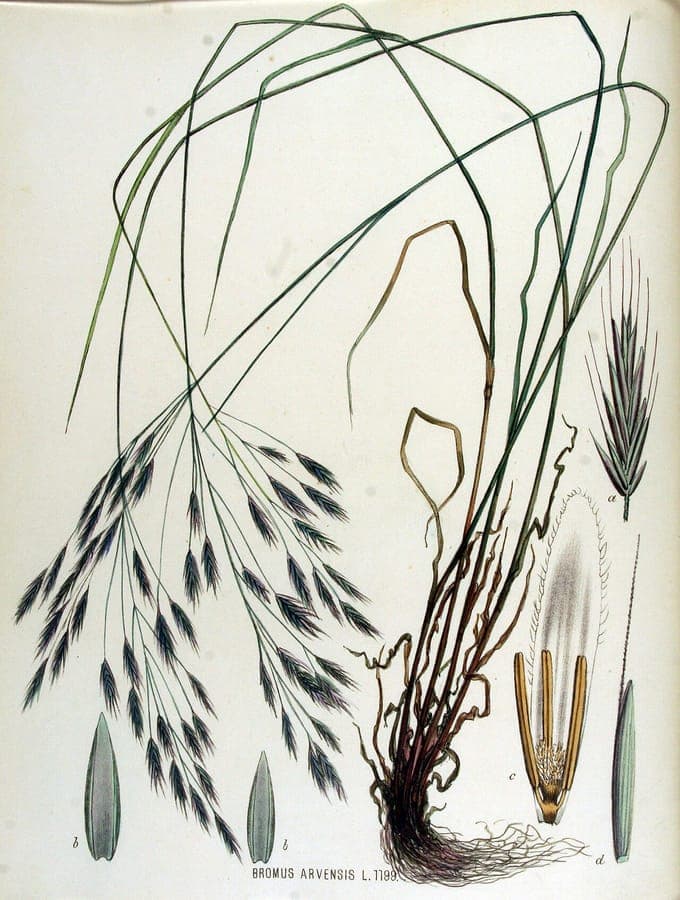
Jan Kops / Public domain, via Wikimedia Commons
Field brome: complete guide
Bromus arvensis
Want to see Field brome: complete guide in your garden?
1 minute, no credit card
Overview
Field brome (Bromus arvensis) is an annual grass species belonging to the Poaceae family, native to southern and eastern Europe, including regions like Greece, Italy, and Bulgaria. While often considered a weed in agricultural settings, it brings a wild, natural texture to informal garden designs. It's rarely sold as a standalone ornamental, but sometimes included in wildflower or meadow seed mixes. In home gardens, it works well as a temporary ground cover or pioneer plant in restoration projects. On gardenworld.app you can design a planting scheme that integrates Field brome seamlessly into a naturalistic garden layout.
Appearance & bloom cycle
Field brome grows 40 to 80 cm tall, forming loose, upright clumps with slender, pale green leaves that are slightly hairy to the touch. From May through late June, it produces open panicles - soft, drooping flower heads that start greenish-yellow and mature to a warm golden-brown. These seed heads remain ornamental well into autumn, adding movement and texture to the garden. As an annual, it completes its entire life cycle in one growing season: germination in spring, rapid growth, flowering, seed production, and death by late summer. It spreads readily by self-seeding if conditions allow, especially on bare soil.
Ideal location
Choose a full sun location - at least 6 hours of direct sunlight daily. Field brome thrives in open, unshaded areas with minimal competition. It's well-suited for vacant lots, roadside edges, or as a nurse crop in perennial beds. In garden designs, it fits naturally in wildflower meadows, cottage borders, or regenerative planting schemes. Avoid heavily shaded spots; in low light, the stems become weak and prone to lodging. Use gardenworld.app to assess your garden's sun exposure and determine if Field brome will thrive in your space.
Soil requirements
This grass is highly adaptable to soil types. It grows well in sandy, loamy, or light clay soils as long as drainage is adequate. It prefers moderately fertile to poor soils - overly rich soil leads to excessive foliage and weak stems. The ideal pH range is between 5.5 and 7.8. Poor drainage or waterlogged conditions should be avoided, especially during cooler months, though the plant doesn't overwinter. Compacted or heavily amended soils are less suitable.
Watering
Once established, Field brome is drought-tolerant and rarely needs supplemental watering. During germination and early growth (April to early May), consistent moisture helps seedlings establish. After that, natural rainfall is usually sufficient. In prolonged dry spells (over three weeks without rain), a light watering may prevent premature drying, but overwatering increases the risk of fungal diseases and lodging.
Free design
Want to see Field brome: complete guide in your garden? Make a free design now.
Pruning
No pruning is required. Since it's an annual, the plant dies back naturally after seed set. You can cut or mow the dead stems in late autumn or early winter for a tidier appearance. Leaving the seed heads intact through winter supports small birds like finches and sparrows, which feed on the seeds. If you want to limit self-seeding, cut the plants before seeds fully disperse - typically in late July.
Maintenance calendar
- Jan: Dormant period; no action needed
- Feb: Prepare soil if planning spring sowing
- Mar: Sow seeds when soil temperature reaches 10°C
- Apr: Seedlings emerge; keep soil lightly moist
- May: Rapid growth begins; flower spikes appear
- Jun: Full bloom; monitor for overcrowding
- Jul: Seeds mature; plants start to yellow
- Aug: Plants die back; seeds disperse
- Sep: Check for volunteer seedlings
- Oct: Mow or leave standing based on garden goals
- Nov: Leave residue for wildlife or clear for spring prep
- Dec: Fully dormant; assess next year's plan
Winter hardiness
Field brome is not winter-hardy as a mature plant. It's an annual and dies after setting seed. However, its seeds can survive winter in the soil and germinate the following spring when temperatures rise. It does not persist as living tissue through cold months. In USDA hardiness zones 5–9, the plant behaves as a spring-germinating annual. No winter protection is needed.
Companion plants
Pair Field brome with slow-establishing perennials like Echinacea, Rudbeckia, or native grasses such as Little Bluestem (Schizachyrium scoparium). It acts as a temporary cover, suppressing weeds while perennials develop. Avoid planting near low-growing ground covers that could be smothered. It also combines well with other annuals like Cornflower (Centaurea cyanus) or California Poppy (Eschscholzia californica) in meadow mixes. Be mindful of its self-seeding habit - it can become weedy in small, formal beds. Use sparingly in curated designs.
Closing
Field brome isn't a showy garden star, but it's a reliable, low-effort plant for naturalistic landscapes. It's easy to grow from seed, requires little maintenance, and supports local wildlife. Available at garden centres across the UK and US, often in wildflower seed blends, it's an affordable way to add movement and seasonal interest. While not long-lived, it plays a valuable role in transitional planting. Think of it as a temporary green scaffold. For inspiration on how to weave it into your garden layout, visit gardenworld.app, where you can visualize seasonal changes and planting combinations that include Field brome.
Want to see Field brome: complete guide in your garden? Make a free design now.
Upload a photo, pick a style, and get a photorealistic design with plant list in under a minute.
No credit card required


Similar plants
Sporobolus pungens: complete guide
Sporobolus pungens
Sporobolus pungens is a stoloniferous Mediterranean coastal grass with outstanding salt and drought tolerance, perfect for seaside and dry gardens.
Mediterranean aegilops: complete guide
Aegilops biuncialis
Everything about Aegilops biuncialis, a Mediterranean annual grass with ornamental spikes and outstanding drought tolerance for dry gardens.
Silver bluestem: complete guide
Bothriochloa saccharoides
Full guide to Bothriochloa saccharoides (silver bluestem): site, soil, watering, winter hardiness, pruning, and garden companions.