
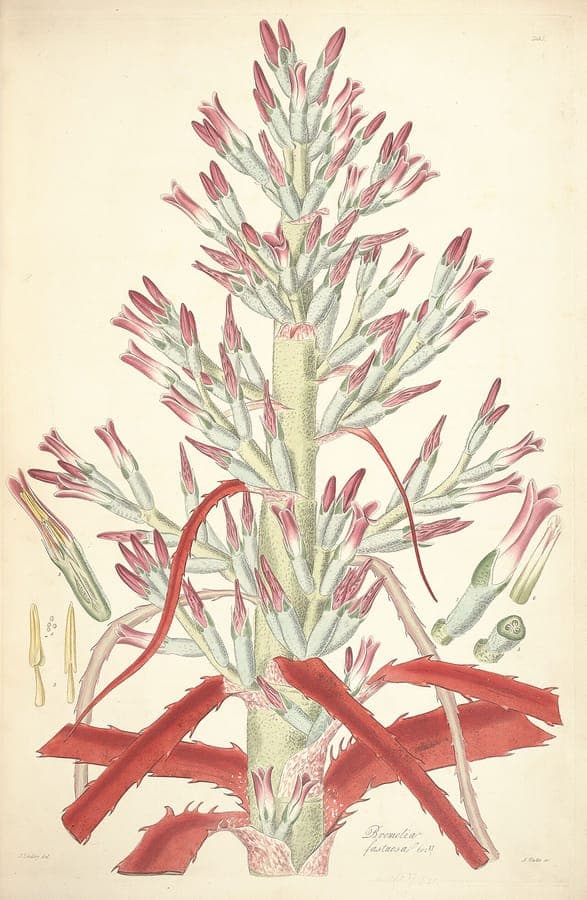
John Lindley (1799-1865) / Public domain, via Wikimedia Commons
Pinguin (Bromelia): complete guide
Bromelia pinguin
Want to see Pinguin (Bromelia): complete guide in your garden?
1 minute, no credit card
Overview
Pinguin (Bromelia pinguin), also called brown pineapple or wild pine, is an impressive bromeliad from the Bromeliaceae family, native from Mexico to tropical America. This semi-epiphytic plant forms a dense rosette of long, narrow, leathery leaves with sharp edges. The plant is especially prized for its bright red flowers that emerge strikingly from the heart center, followed by yellow fruits forming small, juicy berry clusters.
Appearance and Bloom
Bromelia pinguin builds slowly to a mature plant 60-120 cm wide, with deep green, grayish-tinged leaves radiating outward. Leaf edges bear fine spines, so handle with care. In spring through summer, a sturdy flower spike emerges from the heart center with red flowers that persist for several weeks. After flowering, small yellow fruits appear in clusters - technically edible but bitter unless ripened. The plant blooms only once in its lifetime (monocarpic) and slowly declines after fruiting.
Ideal Location
Bromelia pinguin thrives in very sunny positions: full sun for at least 5-6 hours daily. In temperate climates (UK, Belgium, Germany), this plant is grown as a houseplant or potted container plant because it cannot tolerate frost. Place the pot on a sunny windowsill, veranda, or warm patio. In subtropical climates (Southern France, Spain), it can winter outdoors. Avoid complete shade; the plant becomes weak and fails to flower.
Soil
Use free-draining potting mix, preferably bromeliad or orchid compost. Heavy clay soil is unsuitable as it causes waterlogging. Mix excellent drainage components: 40% tree bark, 30% perlite, 20% peat moss, 10% sand. For container culture, this is ideal. The plant also grows on tree bark as a semi-epiphyte naturally. Ensure the rosette cup (the heart center) retains slight moisture, which is natural and necessary.
Free design
Want to see Pinguin (Bromelia): complete guide in your garden? Make a free design now.
Watering
Here lies subtlety! Bromelia pinguin has a unique water system: the rosette heart forms a natural reservoir. Water regularly, but ensure the pot substrate dries slightly between waterings. The heart reservoir should always hold some water (approximately 1-2 cm), but never stagnate. During the growth period (March to September), water once to twice weekly, depending on temperature and humidity. Reduce to once every 10 days in winter. Use soft water (rainwater or distilled) because hard water causes white deposits in the heart.
Pruning
Pruning is unnecessary; the plant grows compact naturally. Remove only dead or damaged leaves at the base. Once the plant ages and declines after blooming and fruiting (after 2-3 years), small pups may appear at the base. These can be carefully separated and grown as individual plants. This is how the plant naturally propagates.
Maintenance Calendar
March-May: Growth begins. Water regularly and feed with dilute fertilizer. June-August: Peak flowering period. Plenty of sun and warmth. September: Flowering diminishes, fruit sets. October-February: Rest period. Reduced watering. Winter: Minimal care.
Winter Hardiness
Bromelia pinguin is extremely frost-sensitive and cannot overwinter outdoors in climates with temperatures below 10 degrees Celsius. Ideally, place the plant in a warm location (18-25 degrees) without drafts. Outdoor pots remain possible until October, then move indoors. In warm climates (zone 10+), it can stay outside year-round. No winter protection needed; simply bring inside.
Companion Plants
In an interior container setting, Bromelia pinguin pairs beautifully with other tropical plants: Anthurium, small Monsteras, Stromanthe, and Calathea. In pots outdoors on warm patios, combine well with other bromeliads (Tillandsia, Neoregelia) or small palms. Use contrasting green backgrounds; the red flowers stand out dramatically against them.
Closing
Bromelia pinguin suits anyone with a sunny window and patience. This isn't complicated gardening, but rather a Mediterranean summer plant for indoors. Red flowers and yellow fruit make it aesthetically valuable. Perfect choice for those seeking something exotic without orchid fussiness.
Want to see Pinguin (Bromelia): complete guide in your garden? Make a free design now.
Upload a photo, pick a style, and get a photorealistic design with plant list in under a minute.
No credit card required


Similar plants
Puya raimondii: complete guide
Puya raimondii
Discover the Queen of the Andes: care, cultivation, origin from Peru and Bolivia, and how this remarkable flower can thrive in your garden.
Spanish Moss (Tillandsia usneoides): complete guide
Tillandsia usneoides
Tillandsia usneoides, known as Spanish moss, is an epiphytic bromeliad without roots. Perfect for indoors or protected outdoor spots, this unusual plant offers magical, airy appeal.
Urnplant: complete guide
Aechmea fasciata
Discover the stunning Urnplant (Aechmea fasciata), an exotic bromeliad with striking silver-banded foliage and brilliant red inflorescences. An easy tropical houseplant.