
Sphl / CC BY-SA 3.0, via Wikimedia Commons
Lesser quaking grass: complete guide
Briza minor
Want to see Lesser quaking grass: complete guide in your garden?
1 minute, no credit card
Overview
Briza minor, commonly known as lesser quaking grass, is a delicate annual or short-lived perennial grass in the Poaceae family. Native to regions around the Mediterranean, including southern France, the Canary Islands, and parts of North Africa, it thrives in dry, open habitats with minimal competition. In garden settings, it brings movement and softness, making it a favorite for naturalistic planting schemes.
This grass typically reaches 30–45 cm in height, with slender, upright stems and fine-textured foliage. It self-seeds readily but isn't aggressive, making it easy to manage. Unlike its larger relative Briza maxima, Briza minor has a more refined, airy habit perfect for smaller gardens or precise design accents.
If you're planning a meadow-style border or a gravel garden, lesser quaking grass fits right in. On gardenworld.app, you can design a layout that highlights its gentle sway among boulders or between low-growing perennials.
Appearance & bloom cycle
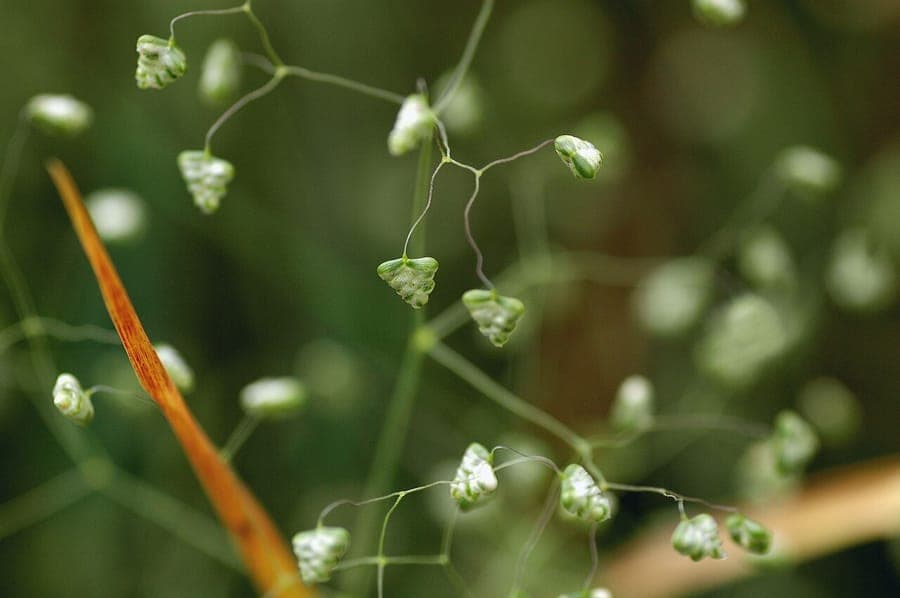
The standout feature of Briza minor is its bloom - not flashy, but mesmerizing. From late May through August, heart-shaped florets dangle from the tips of the stems. These aren't single flowers but clusters of tiny spikelets that shimmer and tremble in the slightest breeze, giving the plant its 'quaking' name.
The florets start green, mature to a soft golden hue, and persist long after flowering, adding interest into autumn and winter. The foliage is narrow, bright green, and forms a modest basal clump. As the plant matures, it takes on a see-through quality, allowing light and other plants to show through.
This extended visual appeal makes it a valuable plant for year-round garden structure, especially when combined with seed heads of Echinacea or Stipa species.
Ideal location
Full sun is essential - aim for at least 6 hours of direct sunlight daily. Briza minor tolerates partial shade, but plants will stretch, flop, and produce fewer flowers. Choose a spot with good air movement to enhance the quivering effect of the blooms.
It excels in challenging spots: rocky crevices, dry slopes, or gravel paths where moisture is scarce. It also works well in containers, provided the pot has drainage holes and isn't overwatered. Avoid placing it in rich, heavily amended beds where taller, more vigorous plants will quickly overshadow it.
Soil requirements
This grass loves poor, well-drained soils. Sandy, gravelly, or stony substrates are ideal. It doesn't need fertility - in fact, too much nitrogen leads to weak stems and sparse flowering. The pH range of 6.0 to 7.5 suits it best, but it's adaptable.
If your soil retains water, mix in sharp sand or small grit to improve drainage. Never use moisture-retentive composts or water-holding crystals. Raised beds or mounded soil help prevent root rot.
Free design
Want to see Lesser quaking grass: complete guide in your garden? Make a free design now.
Watering
Once established, Briza minor is drought-tolerant and rarely needs supplemental watering. Young plants and container-grown specimens may need watering once a week during dry spells in their first season. After that, rain is usually sufficient.
Overwatering is the fastest way to kill this plant. Soggy soil encourages fungal diseases and root decay. Always let the top layer of soil dry out between waterings.
Pruning
Pruning isn't necessary. The plant dies back naturally after setting seed. If you prefer a tidier look, cut back old flower stems in late autumn or early spring. Leave some seed heads intact if you want self-seeding or winter interest.
For controlled reseeding, collect the ripe seed heads in late summer before they scatter. Sow them directly where you want them the following spring.
Maintenance calendar
- January–February: Clear any remaining dead stems if desired. Check for early seedlings in mild areas.
- March–April: Prepare seedbeds in sunny, dry spots. Sow seeds directly; germination takes 10–14 days.
- May–August: Peak bloom time. No extra care needed.
- September–October: Monitor self-seeding. Thin out crowded seedlings.
- November–December: Minimal care. Protect potted plants from prolonged wet cold.
Winter hardiness
Briza minor is typically grown as an annual in cooler climates. It's not reliably perennial in USDA zones below 7b. However, it self-seeds reliably in zones 7–9, so even if the parent plant dies, new plants emerge in spring.
In colder zones, use it as a seasonal annual. In milder areas, it may behave as a short-lived perennial. Pots should be moved to sheltered spots or wrapped during extended freezes.
Companion plants
Pair Briza minor with plants that share its preference for sun and dry soil:
- Sedum 'Autumn Joy' – adds late-season color and structure
- Thymus serpyllum – low, fragrant, and drought-tolerant
- Eryngium yuccifolium – spiky blue accents
- Nepeta racemosa – soft purple spikes and long bloom time
The contrast between its dancing florets and bolder, structural plants creates a dynamic, layered effect.
Closing
Lesser quaking grass is a quiet achiever in the garden. It asks for little - sun, sharp drainage, and space to breathe - and rewards with months of movement and subtle beauty. It's perfect for gardeners who appreciate understated elegance and natural rhythms.
You can find Briza minor seeds or young plants at most garden centres in spring, including well-known retailers like B&Q, Wyevale, or local independents. Ensure you're getting the true Briza minor, not the larger Briza maxima.
Use gardenworld.app to sketch a planting plan where Briza minor drifts between stones or dances above creeping thyme - a design that captures its wild, effortless grace.
Want to see Lesser quaking grass: complete guide in your garden? Make a free design now.
Upload a photo, pick a style, and get a photorealistic design with plant list in under a minute.
No credit card required


Similar plants
Sporobolus pungens: complete guide
Sporobolus pungens
Sporobolus pungens is a stoloniferous Mediterranean coastal grass with outstanding salt and drought tolerance, perfect for seaside and dry gardens.
Mediterranean aegilops: complete guide
Aegilops biuncialis
Everything about Aegilops biuncialis, a Mediterranean annual grass with ornamental spikes and outstanding drought tolerance for dry gardens.
Silver bluestem: complete guide
Bothriochloa saccharoides
Full guide to Bothriochloa saccharoides (silver bluestem): site, soil, watering, winter hardiness, pruning, and garden companions.