
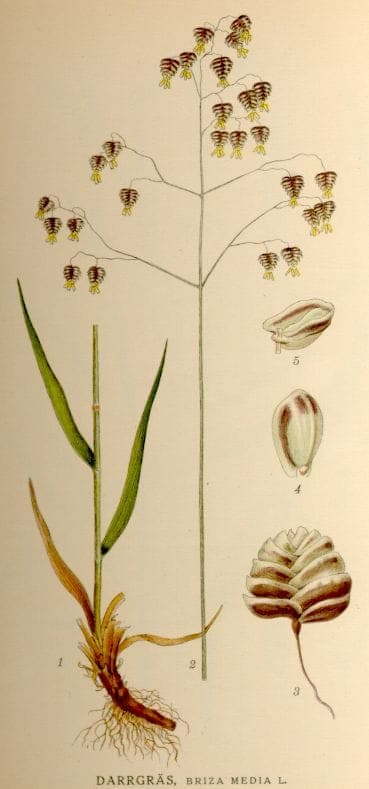
Carl Axel Magnus Lindman / Public domain, via Wikimedia Commons
Perennial quaking grass: complete guide
Briza media
Want to see Perennial quaking grass: complete guide in your garden?
1 minute, no credit card
Overview
Perennial quaking grass, known botanically as Briza media, is a graceful, clump-forming grass native to woodlands and grassy slopes across Europe, including the UK and Ireland. It earns its name from the way its seed heads tremble in the slightest breeze, like tiny lanterns swaying on slender stems. Reaching 50–70 cm in height with a spread of 30 cm, it's compact enough for smaller gardens but bold enough to make a textural statement.
This grass is semi-evergreen in milder climates, retaining some foliage through winter. It's a slow spreader, so it won't take over your borders, and it's fully hardy down to -20°C (USDA zone 5). That makes it a reliable performer year after year, especially in naturalistic planting schemes.
On gardenworld.app, you can design a planting plan that integrates quaking grass with other shade-tolerant perennials for a flowing, layered effect.
Appearance & bloom cycle
From June to September, Briza media produces its signature heart-shaped seed heads, which start green and mature to a soft, shimmering gold. These hang loosely from arching stems and catch the light beautifully, especially in morning or late afternoon sun. The fine, narrow leaves are blue-green, forming a tidy mound that supports the airy inflorescences.
Flowering begins in late spring, with seed heads fully developed by midsummer. They remain ornamental well into autumn, slowly fading to a pale beige or wheat colour. Even in winter, the dried stems provide structure and subtle movement, making this grass a true four-season plant.
Ideal location
Quaking grass thrives in partial shade – think dappled light under deciduous trees, woodland edges, or north-facing borders. It tolerates full sun if the soil stays reliably moist, but in hot, dry spots, the foliage may scorch and seed production diminish.
Avoid exposed, windy sites where strong gusts could flatten the delicate stems. A sheltered spot with morning sun and afternoon shade is ideal. This grass also works well in cottage-style gardens, wildflower meadows, or modern gravel beds with other fine-textured plants.
Use gardenworld.app to visualise how Briza media fits into a mixed border with plants like Epimedium, Dryopteris, or Astrantia.
Soil requirements
Well-drained but moisture-retentive soil is key. Briza media prefers neutral to slightly alkaline conditions (pH 7.0–7.5). It grows best in loamy or sandy loam soils rich in organic matter. Avoid heavy clay that stays waterlogged in winter, as this can lead to root rot.
If your soil is too acidic, amend with a little garden lime. No need for high fertility – in fact, overly rich soil encourages leafy growth at the expense of flowering. A light mulch of compost in spring is usually sufficient.
Free design
Want to see Perennial quaking grass: complete guide in your garden? Make a free design now.
Watering
Once established, perennial quaking grass is moderately drought-tolerant. However, during the first growing season, water weekly if rainfall is below 25 mm. Container-grown plants need more frequent watering, especially in summer.
Water deeply but infrequently to encourage deep root development. Never let the plant sit in soggy soil. Drought stress shows as browning leaf tips or stunted seed heads.
Pruning
Pruning is minimal. In late winter or early spring (February to March), cut back the previous year's growth to ground level before new shoots emerge. This keeps the plant looking fresh and prevents old stems from smothering new growth.
Leave the seed heads intact over winter if you enjoy their frost-dusted appearance. They also provide food and shelter for small insects and birds.
Maintenance calendar
- Jan: Dormant; leave old growth for winter interest
- Feb: Cut back old foliage
- Mar: New shoots appear; apply light compost mulch
- Apr: Water during dry spells
- May: Flower spikes begin forming
- Jun: Bloom starts; seed heads turn golden
- Jul–Aug: Peak display; minimal care needed
- Sep: Seeds mature; collect if desired
- Oct: Leave standing for winter texture
- Nov: No action required
- Dec: Decorative in frost and snow
Winter hardiness
Briza media is fully hardy in USDA zones 5–9. It survives UK and northern European winters without protection. The semi-evergreen foliage helps insulate the crown, and the dried stems trap snow, adding insulation.
In areas with prolonged wet winters, improve drainage with grit or compost to prevent crown rot.
Companion plants
Pair quaking grass with:
- Geranium phaeum (dusky cranesbill, shade-tolerant)
- Alchemilla mollis (lady's mantle, soft yellow blooms)
- Euphorbia characias (architectural evergreen)
- Carex elata 'Aurea' (golden sedge, bright contrast)
Avoid overly aggressive spreaders like mint or goldenrod, which can overwhelm its delicate form.
Closing
Perennial quaking grass is a quiet achiever in the garden – not loud, but always present, adding rhythm and movement. It's perfect for gardeners who appreciate subtlety, texture, and plants that work hard without demanding much.
You'll find Briza media at most garden centres in spring. Look for healthy, green clumps in 1-litre pots. Plant in autumn or early spring for the best establishment. Once settled, it asks for little and gives back all season long.
Want to see Perennial quaking grass: complete guide in your garden? Make a free design now.
Upload a photo, pick a style, and get a photorealistic design with plant list in under a minute.
No credit card required


Similar plants
Sporobolus pungens: complete guide
Sporobolus pungens
Sporobolus pungens is a stoloniferous Mediterranean coastal grass with outstanding salt and drought tolerance, perfect for seaside and dry gardens.
Mediterranean aegilops: complete guide
Aegilops biuncialis
Everything about Aegilops biuncialis, a Mediterranean annual grass with ornamental spikes and outstanding drought tolerance for dry gardens.
Silver bluestem: complete guide
Bothriochloa saccharoides
Full guide to Bothriochloa saccharoides (silver bluestem): site, soil, watering, winter hardiness, pruning, and garden companions.