
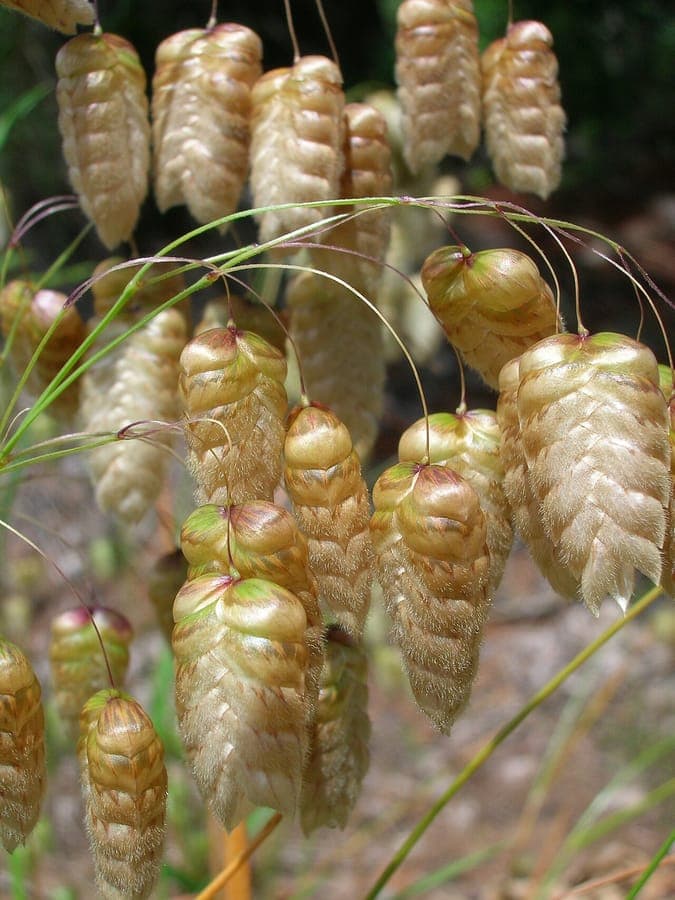
Forest & Kim Starr / CC BY 3.0, via Wikimedia Commons
Great quaking grass: complete guide
Briza maxima
Want to see Great quaking grass: complete guide in your garden?
1 minute, no credit card
Overview
Great quaking grass (Briza maxima) is an annual or short-lived perennial that brings graceful movement and texture to gardens with its unique, heart-shaped seed heads. Native to the Mediterranean basin, it thrives in warm, sunny spots with well-drained soil. In temperate climates like the UK and northern Europe, it's often grown as a summer annual, self-seeding readily if conditions allow. It's a standout in cottage gardens, gravel beds, and naturalistic plantings where its soft, dancing inflorescences catch the light and breeze.
On gardenworld.app, you can design a garden layout that highlights the airy elegance of Great quaking grass, especially when paired with other drought-tolerant perennials or in a meadow-style border.
Appearance & bloom cycle
Briza maxima reaches 30–60 cm in height and produces its signature nodding flower heads from late spring through summer (May to July). The flattened, silvery-green spikelets resemble tiny hearts or Chinese lanterns, and they tremble distinctly with the slightest wind-hence the name 'quaking grass'. The foliage is fine-textured and pale green, forming loose clumps that don't dominate space.
After blooming, the seed heads dry in place and remain decorative into autumn. They're excellent for dried flower arrangements. While the parent plant usually dies after flowering, it often self-seeds generously, especially in sunny, undisturbed spots. Seedlings typically emerge in early spring.
Ideal location
Plant Great quaking grass in full sun-at least 6 hours of direct sunlight daily. It needs sun to develop strong stems and abundant flowering. In shade, it becomes leggy and flops over. It's perfect for dry, exposed sites like rock gardens, raised beds, or the front of sunny borders. It also grows well in containers on patios or balconies with south or west exposure.
Avoid heavy wind tunnels, though-the delicate stems can snap in strong gusts. Position it behind low shrubs or sturdy companions for light shelter.
Soil requirements
This grass prefers poor to moderately fertile, well-drained soil. It dislikes heavy clay or waterlogged conditions, which lead to root rot. Improve drainage by mixing in sharp sand or grit, especially in heavier soils. A pH between 6.0 and 7.5 is ideal. In pots, use a mix of standard potting compost and 30% grit.
Avoid rich soils or high-nitrogen fertilisers-these promote weak, floppy growth. Lean conditions actually enhance its natural poise and resilience.
Free design
Want to see Great quaking grass: complete guide in your garden? Make a free design now.
Watering
Water sparingly. Keep soil moist until seedlings are established (about 2–3 weeks after sowing). Once settled, Briza maxima is highly drought-tolerant. Water only during prolonged dry spells, especially in containers. Overwatering causes weak stems and fungal issues.
Ensure pots have drainage holes and consider adding a base layer of gravel or perlite to prevent waterlogging.
Pruning
Pruning isn't necessary, but you can deadhead spent flower heads in late summer if you want to tidy up. Leave some to dry on the plant if you'd like it to self-seed. In spring, gently remove any old foliage to make space for new growth.
If self-seeding becomes too vigorous, pull out unwanted seedlings early in spring before they establish.
Maintenance calendar
- January: No action needed.
- February: Start seeds indoors or in a greenhouse if you want early plants.
- March: Sow directly outdoors in mild areas. Keep soil dry.
- April: Continue sowing. Remove any old debris.
- May: Rapid growth. First flower heads appear. Water only in drought.
- June: Peak bloom. Enjoy the swaying seed heads.
- July: Flowers fade. Cut back or leave for seed.
- August: Clear dead plants. Watch for new seedlings.
- September: Seedlings emerge. Protect from slugs.
- October: Leave seedlings to overwinter in mild zones.
- November – December: Dormant period.
Winter hardiness
Briza maxima is borderline hardy, surviving in USDA zones 8–10. In cooler zones (6–7), it's best treated as an annual. Young plants may survive mild, dry winters if self-sown in sheltered spots. To increase survival chances, sow in autumn in well-drained soil and cover seedlings with dry mulch in harsh weather.
In wet winters, seedlings often rot. For reliable returns, re-sow annually or let it self-seed in gravel or crevices where moisture drains quickly.
Companion plants
Pair Great quaking grass with sun-loving, drought-tolerant plants like lavender, sedum, Eryngium, or catmint. It blends beautifully with silver-foliaged plants such as Artemisia or Stachys. Use it as a light, floating layer in mixed borders or between boulders in a rock garden.
Avoid moisture-loving species like hostas or astilbes-they create too much competition and humidity.
Closing
Great quaking grass is a low-effort, high-reward plant that adds whimsy and motion to the garden. With minimal care, it delivers months of visual interest. Whether in drifts, containers, or naturalistic schemes, it's a charming choice for modern or traditional gardens.
On gardenworld.app, you can visualise how Great quaking grass fits into your garden design, including spacing, planting combos, and seasonal flow.
Want to see Great quaking grass: complete guide in your garden? Make a free design now.
Upload a photo, pick a style, and get a photorealistic design with plant list in under a minute.
No credit card required


Similar plants
Sporobolus pungens: complete guide
Sporobolus pungens
Sporobolus pungens is a stoloniferous Mediterranean coastal grass with outstanding salt and drought tolerance, perfect for seaside and dry gardens.
Mediterranean aegilops: complete guide
Aegilops biuncialis
Everything about Aegilops biuncialis, a Mediterranean annual grass with ornamental spikes and outstanding drought tolerance for dry gardens.
Silver bluestem: complete guide
Bothriochloa saccharoides
Full guide to Bothriochloa saccharoides (silver bluestem): site, soil, watering, winter hardiness, pruning, and garden companions.