
Carl Axel Magnus Lindman / Public domain, via Wikimedia Commons
Heath false brome: complete guide
Brachypodium pinnatum
Want to see Heath false brome: complete guide in your garden?
1 minute, no credit card
Overview
Brachypodium pinnatum, commonly known as Heath false brome, is a perennial grass in the Poaceae family native to dry, calcareous slopes across Europe and parts of Asia. It's not the flashiest plant in the border, but it brings subtle beauty and ecological value to naturalistic garden designs. If you're aiming for a low-input, wildlife-supporting garden with year-round structure, Heath false brome deserves a spot.
On gardenworld.app, you can design a planting scheme that integrates this grass seamlessly into meadow-style or woodland edge gardens. Its clumping habit and slow spread make it ideal for structured yet natural-looking layouts.
Appearance & bloom cycle
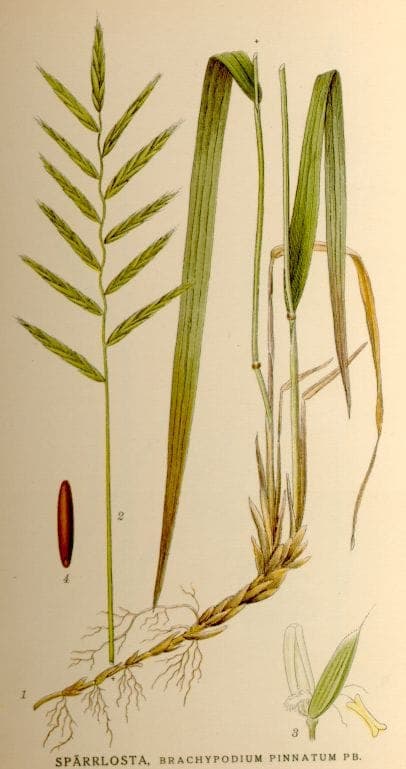
Heath false brome forms neat, upright tussocks with narrow, bright green leaves reaching up to 40 cm in length. From June to August, airy flower spikes rise to about 80 cm, carrying delicate, nodding panicles in pale purple-tinged green or beige tones. These mature into dry, wind-dispersed seeds by late summer.
The foliage turns warm golden-brown in autumn and holds its shape well into winter, providing visual interest when many perennials have faded. It doesn't collapse or flop, making it a reliable structural plant. The growth habit is tufted and non-invasive-spreads gently but never aggressively.
Ideal location
This grass thrives in light conditions rated 5 out of 10-meaning partial shade to light sun. It performs best in locations with morning sun and afternoon shade, such as woodland margins, under open-canopy trees, or on east- to southeast-facing slopes.
Avoid deep shade, which leads to leggy growth and poor flowering, and full, hot sun in dry soils, which can scorch leaf tips. For optimal placement, use gardenworld.app to map sunlight patterns in your garden and pinpoint the best microclimates for this species.
Soil requirements
Brachypodium pinnatum prefers well-drained, calcareous soils with a pH between 7.0 and 7.5. It tolerates sandy or loamy soils but struggles in heavy, waterlogged clay. Chalky or limestone-based substrates are ideal.
Do not enrich the soil with compost or manure-this grass thrives in low-fertility conditions. Excess nutrients encourage lush, weak growth and can cause the clump to disintegrate over time. Keep the ground lean, just as it would be in its natural habitat.
Watering
Once established, Heath false brome is drought tolerant and rarely needs supplemental watering. Young plants, however, benefit from weekly watering during their first summer, especially in dry spells. Apply 5–10 litres per plant, allowing the soil to dry between waterings.
Overwatering is more harmful than underwatering. Soggy soil promotes root rot and fungal issues. In average UK rainfall conditions, irrigation beyond year one is unnecessary.
Free design
Want to see Heath false brome: complete guide in your garden? Make a free design now.
Pruning
Pruning is minimal. Leave the plant standing over winter to provide shelter for overwintering insects and add textural interest to the dormant garden. In early March, cut back old foliage and flower stems to about 10 cm above ground level using sharp shears.
If clumps become too dense or start to die out in the centre, divide them in early spring. Use a spade or sharp knife to split the root ball into 2–3 sections, replanting at 30–40 cm spacing. This rejuvenates the plant and increases stock.
Maintenance calendar
- Jan: Check clumps for winter damage; leave standing
- Feb: No action needed; prepare for spring
- Mar: Cut back to 10 cm; divide if necessary
- Apr: Monitor for slugs; no feeding required
- May: Active growth begins; check for drought stress
- Jun: Flowering starts; no extra care needed
- Jul: Peak bloom; inspect for dry tips
- Aug: Seed heads form; thin if overcrowded
- Sep: Seeds disperse naturally; collect if desired
- Oct: No maintenance; plant enters dormancy
- Nov: Leave standing for winter
- Dec: Protect from waterlogging; no pruning
Winter hardiness
Hardy in USDA zones 5 to 8 (down to -20°C), Heath false brome handles cold winters with ease. In the UK and most of northern Europe, it survives without protection. The evergreen base insulates the crown, and standing foliage buffers frost penetration.
Even in harsh winters, recovery is quick in spring. No mulching or covering is required.
Companion plants
Pair Heath false brome with shade-tolerant, non-aggressive perennials. Good companions include wood anemone (Anemone nemorosa), wild ginger (Asarum europaeum), and bluebell (Hyacinthoides non-scripta). For drier, sunnier spots, combine with chalk milkwort (Polygala calcarea) or wild thyme (Thymus serpyllum).
Avoid vigorous spreaders like goldenrod or mint, which can overwhelm the grass. Also steer clear of heavy feeders that demand rich soil.
Closing
Heath false brome isn't a focal point, but it's a quietly essential player in ecological gardening. Its resilience, low needs, and seasonal texture make it a smart choice for naturalistic designs. You can find it at garden centres like those stocking native grasses-look for it in late spring at major retailers across the UK.
This grass fits perfectly in wildlife gardens, gravel schemes, or native meadow plantings. For layout ideas, visit gardenworld.app and explore designs where Brachypodium pinnatum complements other drought-tolerant, pollinator-friendly species.
Want to see Heath false brome: complete guide in your garden? Make a free design now.
Upload a photo, pick a style, and get a photorealistic design with plant list in under a minute.
No credit card required


Similar plants
Sporobolus pungens: complete guide
Sporobolus pungens
Sporobolus pungens is a stoloniferous Mediterranean coastal grass with outstanding salt and drought tolerance, perfect for seaside and dry gardens.
Mediterranean aegilops: complete guide
Aegilops biuncialis
Everything about Aegilops biuncialis, a Mediterranean annual grass with ornamental spikes and outstanding drought tolerance for dry gardens.
Silver bluestem: complete guide
Bothriochloa saccharoides
Full guide to Bothriochloa saccharoides (silver bluestem): site, soil, watering, winter hardiness, pruning, and garden companions.