
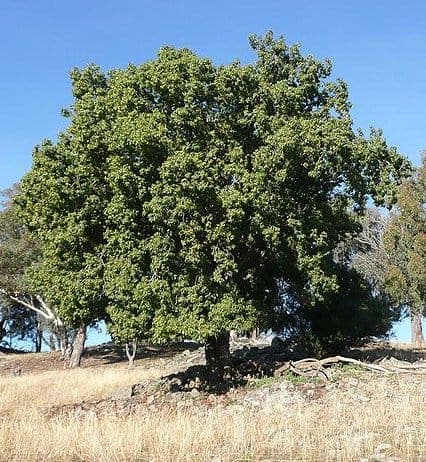
Wonx2150 / Public domain, via Wikimedia Commons
Kurrajong: complete guide
Brachychiton populneus
Want to see Kurrajong: complete guide in your garden?
1 minute, no credit card
Overview
The Kurrajong, scientifically known as Brachychiton populneus, is a spectacular tree from Australian rainforests in Queensland, New South Wales, and Victoria. This tree is renowned for its distinctive bottle-shaped trunk that stores water and nutrients during dry periods. With elegant foliage and white flowers, the Kurrajong symbolizes tropical sophistication and remarkable adaptability.
Appearance and bloom
The Kurrajong is a medium to large tree with a characteristic thickened trunk base that swells outward like a bottle. The common name 'bottletree' derives from this unique form. The foliage consists of fiddle-shaped leaves that remain green year-round. In spring, large creamy-white flowers with red undersides appear in dense clusters. These blooms attract bees and birds.
Ideal location
The Kurrajong thrives in sunny locations with 6-8 hours of direct sunlight daily. In temperate climates, partial shade during extreme summers can be beneficial. The tree works excellently for privacy screens, street planting, and as a specimen tree in large gardens. Its graceful form suits Mediterranean and tropical garden designs perfectly.
Soil
This tree performs best in very well-draining soil. Heavy clay soils must be amended with sand, perlite, and organic matter to prevent waterlogging. Neutral to slightly acidic soil (pH 6.0-7.5) is ideal. Well-draining sandy loams are perfect, as the plant naturally grows in such conditions in its native habitat.
Watering
After establishment, regular watering supports growth, especially during the growing season. Once mature, the Kurrajong is drought-tolerant thanks to its water-storing trunk. Water when the top 5 cm of soil feels dry. Excessive moisture can cause root rot. Reduce watering in winter. The tree is highly water-efficient and suitable for xeriscape landscapes.
Free design
Want to see Kurrajong: complete guide in your garden? Make a free design now.
Pruning
Pruning is important early on to develop strong structure. Cut branches to encourage branching. Mature trees need minimal maintenance. Remove dead wood and prune as needed. Best pruning occurs after flowering. A well-developed skeleton will naturally maintain an elegant silhouette without extensive pruning requirements.
Maintenance calendar
- Spring: Apply fertilizer, prune from previous year, check for pests
- Summer: Regular watering in dry periods, apply mulch
- Autumn: Add leaf-based fertilizer, prepare for dormancy
- Winter: Reduce watering, remove dead branches, protect in cold areas
Winter hardiness
The Kurrajong is frost-sensitive and grows best where winter temperatures don't drop below minus 5 degrees Celsius. In colder regions, the tree can suffer damage from extreme frost. In regions with regular freezing, plant near warm south-facing exposures, against walls, or with winter protection. Young trees are more vulnerable to frost than established specimens.
Companion plants
The Kurrajong pairs beautifully with other tropical trees like various Eucalyptus species, Ficus neriifolia, and Syzygium types. Shade-tolerant groundcovers like Ajuga repens and Vinca minor grow well beneath. Climbing vines add vertical dimension to the design.
Closing
The Kurrajong is a unique choice for designers seeking a joyful, strong-looking tree with botanical interest and drought tolerance. Its exotic appearance and Australian heritage make it an exceptional centerpiece for tropical and Mediterranean gardens. In the right location, this tree offers decades of beauty and character.
Find Kurrajong seedlings and young trees at Intratuin and Gamma for direct planting in your garden.
Want to see Kurrajong: complete guide in your garden? Make a free design now.
Upload a photo, pick a style, and get a photorealistic design with plant list in under a minute.
No credit card required


Similar plants
Crimean linden: complete guide
Tilia × euchlora
Crimean linden is an elegant, fast-growing shade tree ideal for large gardens. Discover cultivars, spacing, maintenance tips and winter hardiness.
California flannelbush: complete guide
Fremontodendron californicum
Everything about California flannelbush (Fremontodendron californicum): sunny placement, drainage, pruning and care for this spectacular yellow-flowering shrub.
Hairy rose mallow: complete guide
Hibiscus moscheutos subsp. lasiocarpos
Full growing guide for hairy rose mallow (Hibiscus moscheutos subsp. lasiocarpos): location, soil, watering, winter hardiness and garden design tips.