
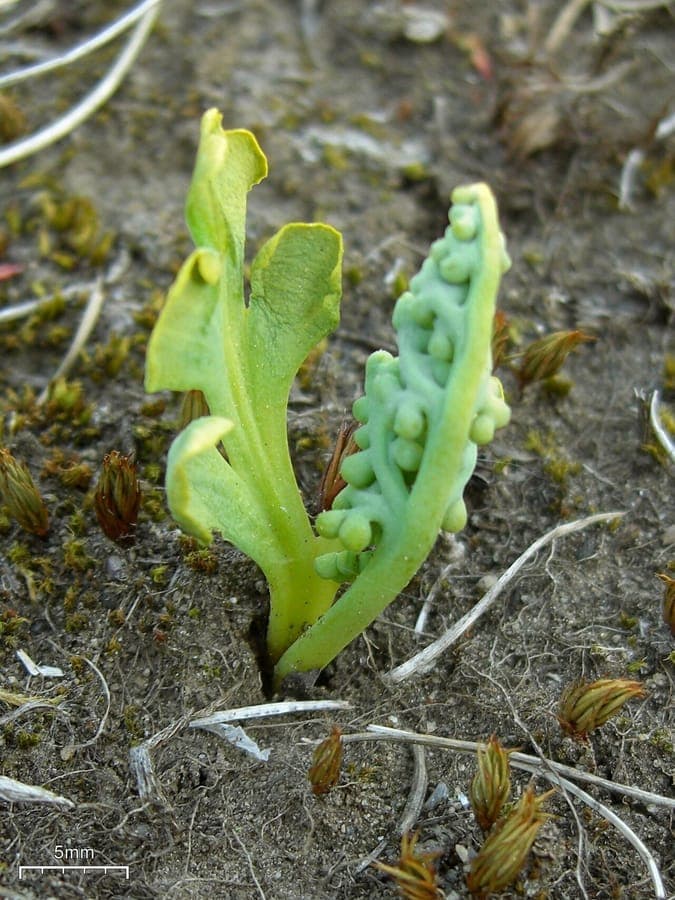
Jason Hollinger / CC BY 2.0, via Wikimedia Commons
Little grapefern: complete guide
Botrychium simplex
Want to see Little grapefern: complete guide in your garden?
1 minute, no credit card
Overview
Little grapefern (Botrychium simplex) is a modest, understated fern that thrives in cool, shaded, and acidic environments. Native to parts of North America and Europe, it's found in damp woodlands, peat meadows, and forest edges where competition is low and organic matter is abundant. If you're designing a naturalistic garden with native species, this fern adds quiet elegance and ecological value. On gardenworld.app, you can create a custom planting layout that accounts for the precise light and soil needs of Botrychium simplex.
Growing only 5–15 cm tall, it's a true ground-hugging plant, ideal for understory planting or tucked into rock crevices. It's a perennial geophyte, meaning it dies back fully in winter but returns from a small underground tuber each spring. It doesn't spread aggressively - in fact, it grows slowly - so it's perfect for controlled, thoughtful garden designs.
Appearance & bloom cycle
The plant produces a single, two-part frond: a green, fan-shaped sterile blade (trophophore) and a separate, upright fertile stalk (sporophore) that bears clusters of spore sacs resembling tiny grapes - hence the name 'grapefern'. The entire structure reaches 5–15 cm in height. Growth begins in early spring (April–May), with fronds fully developed by late May.
Spore production occurs from July to September. Unlike flowering plants, ferns reproduce via spores, not seeds. After spore release, the fronds wither and disappear above ground by late autumn. There's no floral display, but the structure of the sporophore adds subtle visual interest in summer.
Ideal location
Little grapefern needs dappled to full shade - aim for a light level of 6 on a 1–10 scale. It thrives under open-canopy deciduous trees like birch, beech, or alder, where sunlight filters through gently. Avoid hot, south-facing spots or exposed areas with drying winds.
In a garden, place it along woodland edges, beneath shrubs, or in shaded rock gardens. It's excellent for adding texture to low-light corners. Use gardenworld.app to simulate light patterns in your yard and identify microclimates suitable for this fern.
Soil requirements
This fern demands acidic soil with a pH between 3 and 4. It prefers humus-rich, well-drained, sandy loam or peaty substrates. The soil must be loose, airy, and rich in organic matter - never compacted or clay-heavy. Avoid limestone soils or any additions of lime, wood ash, or alkaline compost.
Mulch with pine needles or oak leaves to maintain acidity and moisture. Do not use standard garden compost, which may raise pH. A soil test before planting is highly recommended, especially in previously cultivated areas.
Free design
Want to see Little grapefern: complete guide in your garden? Make a free design now.
Watering
Keep the soil consistently moist but never soggy. Water lightly with rainwater during dry spells in the growing season (May–September). Tap water with high calcium content can alter soil pH and should be avoided.
This fern is not drought-tolerant. In prolonged dry periods, it may go dormant early or fail to emerge the next year. Pair it with other moisture-loving plants like Sphagnum moss, Twinflower (Linnaea borealis), or Oak Fern (Gymnocarpium dryopteris) to create a self-sustaining moist microhabitat.
Pruning
No pruning is required. Allow dead fronds to decompose naturally on site - they protect the tuber and enrich the soil. Only remove material if it shows signs of fungal rot, which usually indicates poor drainage or excessive moisture.
Maintenance calendar
- Jan–Feb: Dormant. No action needed.
- Mar: Prepare for emergence. Add a light layer of pine needle mulch.
- Apr–May: Fronds emerge. Monitor for growth; water if unusually dry.
- Jun–Aug: Active growth. Maintain consistent moisture. Shield from direct sun.
- Sep: Spore maturation. No intervention.
- Oct–Dec: Dieback. Leave debris as natural mulch.
Winter hardiness
Little grapefern is hardy in USDA zones 4–7. In zone 8 and above, it may struggle if winters are too mild or soil dries out. In colder zones, a mulch of pine needles or leaf litter helps insulate the tuber without trapping excess moisture. Avoid plastic covers - they promote rot.
Companion plants
Pair with other acid-loving, shade-tolerant species: Partridgeberry (Mitchella repens), Bunchberry (Cornus canadensis), Foamflower (Tiarella cordifolia), and Deer's Tongue Fern (Plagiomnium cuspidatum). Avoid aggressive groundcovers like periwinkle or pachysandra, which will smother it.
These combinations work well in native woodland gardens, creating layered texture and seasonal variation. Remember: Botrychium simplex grows slowly, so give it space and time.
Closing
Little grapefern isn't a showy plant, but it rewards patient gardeners with quiet beauty and ecological authenticity. It's not commonly found in standard garden centres, but look for specialty native plant nurseries or online suppliers. When available, it may be stocked at garden centres during spring, especially those focused on native or woodland plants.
Always buy nursery-propagated stock - never wild-collected, as populations are often protected. On gardenworld.app, you can explore planting combinations and microclimate maps to ensure this delicate fern thrives in your garden.
Want to see Little grapefern: complete guide in your garden? Make a free design now.
Upload a photo, pick a style, and get a photorealistic design with plant list in under a minute.
No credit card required


Similar plants
Azores Adderstongue: complete guide
Ophioglossum azoricum
Ophioglossum azoricum is a rare fern from Europe and Macaronesia. Learn how to cultivate this delicate, moisture-loving fern in shaded gardens.
Botrychium matricariifolium: complete guide
Botrychium matricariifolium
Master cultivation of daisy-leaf grape fern: habitat requirements, propagation challenges, and specialized forest garden care.
Northern moonwort: complete guide
Botrychium boreale
Northern moonwort (Botrychium boreale), also called boreal moonwort, is a rare fern from northern regions with distinctive moon-shaped leaflets. Discover cultivation and care tips.