
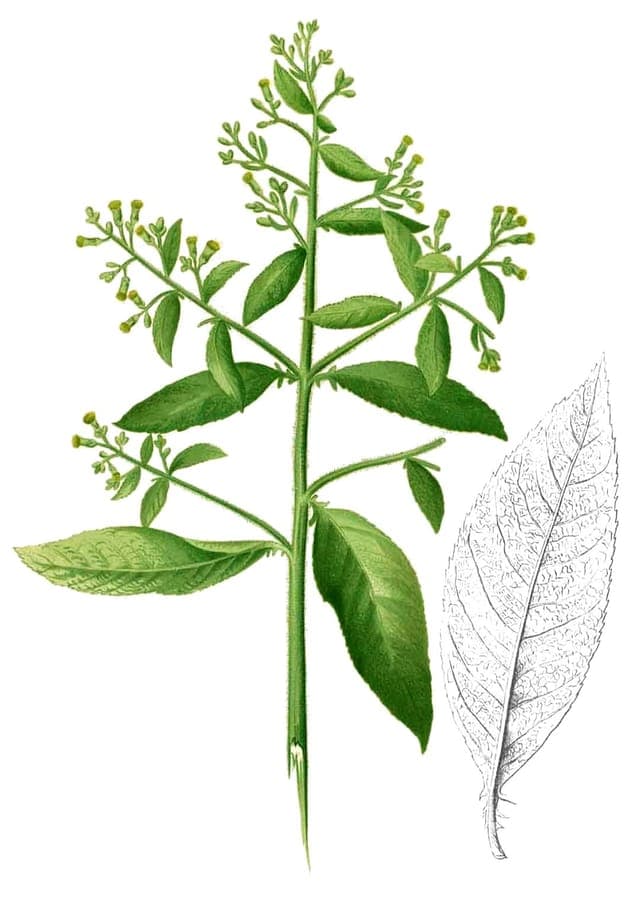
Francisco Manuel Blanco (O.S.A.) / Public domain, via Wikimedia Commons
Blumea balsamifera: complete guide
Blumea balsamifera
Want to see Blumea balsamifera: complete guide in your garden?
1 minute, no credit card
Blumea balsamifera, commonly known as Ngai camphor, Buffalo-ear, or Sambong, is a captivating East Asian shrub belonging to the Asteraceae family. This plant naturally occurs throughout tropical and subtropical regions spanning from the Himalayan foothills through South and Southeast China, and across much of Southeast Asia including Indonesia. The plant holds significant importance in traditional medicine systems and is valued for its intensely aromatic foliage that releases a distinctive camphor-like fragrance when touched or brushed against. For home gardeners seeking fragrant plants, Blumea balsamifera offers remarkable value through its dual purpose as both ornamental and medicinal plant.
The plant typically reaches heights between 60 and 150 centimeters under average growing conditions though can exceed this in optimal circumstances. Blumea balsamifera develops a compact, well-branched shrubby form with numerous slender stems packed closely together. The leaves are narrowly linear, measuring 5 to 15 centimeters in length, with a velvety texture and grayish-green coloration that provides visual interest. When touched, the foliage releases an intense aroma strikingly reminiscent of camphor tincture, making this plant extraordinarily popular in aromatherapy and medicinal herb gardens throughout warm regions.
Blooming typically occurs from May through September, with peak flowering during spring and early summer months in subtropical regions. The flowers are produced in dense terminal clusters at the branch tips throughout the blooming season. Individual flower heads are tiny, but collectively they form bright yellow flower plumes measuring 10 to 20 centimeters in length. This distinctive inflorescence attracts butterflies and bees while providing striking color contrast within garden settings. The flowers emit a subtle fragrance that appeals to pollinators and contributes additional sensory dimension to garden spaces.
Proper site selection is critical for success with this subtropical-origin plant. Blumea balsamifera performs best in full sun, requiring minimum 6 to 8 hours of direct daily sunlight for maximum flowering. The plant tolerates partial shade but produces fewer flowers and diminished fragrance in shadier positions. Provide protection from intense afternoon sun in extremely hot climates, which can scorch foliage and reduce plant vigor. Wind exposure should be minimized as the delicate leaves bruise easily from strong wind currents and can reduce photosynthetic capacity.
Soil must be well-draining, as Blumea balsamifera cannot tolerate waterlogging and develops root rot in poorly drained conditions. An ideal mixture combines potting soil, coarse sand, and perlite in a 2:1:1 ratio. The plant adapts to various soil types but prefers slightly acidic to neutral conditions with pH ranging from 6.0 to 7.0. Heavy clay soils require amendment with organic matter to improve drainage significantly. Add 2 to 3 centimeters of compost or aged humus to the planting hole. Container cultivation works excellently when containers hold minimum 20 liters providing adequate soil volume.
Watering requires careful attention, especially during active growing season. Keep soil consistently moist but never waterlogged, resembling a well-wrung sponge. Summer months demand more frequent irrigation, potentially twice weekly or more. Before watering, check soil moisture by inserting your finger 5 centimeters deep into the earth; water only when dry at this depth. Winter dormancy requires reducing water to approximately half growing-season amounts. Ensure excellent drainage and remove standing water immediately, as roots rot rapidly in waterlogged conditions.
Regular pruning and maintenance is necessary to maintain a full, compact form. Cut stems back to 30-50 centimeters in early spring before new growth emerges. This stimulates abundant lateral branching and increases flower production significantly. Remove spent flowers regularly throughout the growing season to encourage continuous blooming. Light pruning (cutting 15-25 centimeters) after flowering maintains compact shape and vigor. Always use clean, sharp pruning shears for hygienic pruning.
This plant requires moderate fertilization. Container specimens benefit from balanced, water-soluble fertilizer (10-10-10 NPK formula) at half strength applied every four weeks during growing season. In-ground specimens respond well to annual applications of 5 centimeters of compost applied around the root zone in spring. Slow-release fertilizer granules applied in early spring support vigorous growth and abundant flowering.
Frost hardiness depends significantly on your local climate and seasonal temperature fluctuations. Blumea balsamifera lacks frost tolerance and suffers severe damage below 10 degrees Celsius. Where temperatures regularly drop below 5 degrees Celsius, treat as annual or grow in containers moved indoors during winter. In mild winter climates remaining above 15 degrees Celsius, permanent outdoor cultivation works successfully. In frost-prone regions, containerize for winter protection. Wrap container plants with burlap or bubble wrap when temperatures approach freezing.
Blumea balsamifera pairs well with numerous garden companions and design styles. Combine with Lantana for additional color intensity and extended bloom, place alongside Rosemary and Lavender for fragrant gardens, or use as background shrub behind lower blooming plants like Calibrachoa or Portulaca. Golden flowers coordinate beautifully with purple bloomers, making Sage, Salvia, and Catmint excellent companions. In Mediterranean gardens, pair with Olive trees and Agapanthus for cohesive design. For medicinal herb gardens, position alongside Mint, Basil, and Oregano.
Blumea balsamifera represents an exceptional choice for gardeners seeking fragrant, colorful shrubs in subtropical settings. With full sun exposure, well-draining soil, and regular maintenance, this plant delivers years of aromatic golden flower clusters. Exercise caution regarding frost sensitivity in cold climates, though mild-winter regions present minimal cultivation challenges with this valuable ornamental and medicinal plant.
Want to see Blumea balsamifera: complete guide in your garden? Make a free design now.
Upload a photo, pick a style, and get a photorealistic design with plant list in under a minute.
No credit card required


Similar plants
Calendula stellata: complete guide
Calendula stellata
Complete guide to Calendula stellata, the star-flowered marigold from Sicily: location, soil, watering and companion planting tips.
Korean chrysanthemum: complete guide
Chrysanthemum x rubellum
Chrysanthemum x rubellum is a hardy autumn perennial with single pink to copper flowers from August to November. Care and combinations.
Helianthus divaricatus: complete guide
Helianthus divaricatus
Helianthus divaricatus is a North American woodland sunflower with yellow summer blooms, ideal for naturalistic borders and shady edges.