
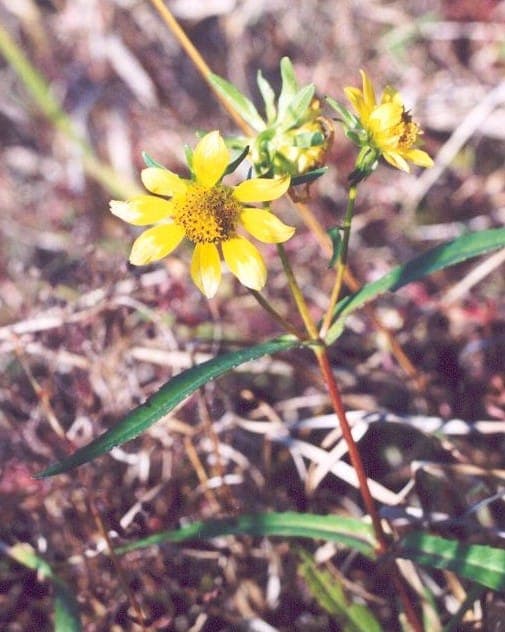
Jennifer Anderson / Public domain, via Wikimedia Commons
Smooth beggarticks: complete guide
Bidens laevis
Want to see Smooth beggarticks: complete guide in your garden?
1 minute, no credit card
Overview
Bidens laevis, known in English as smooth beggarticks or bur marigold, is a striking herbaceous perennial belonging to the daisy family (Asteraceae). The species name laevis means 'smooth', referring to the glabrous, hairless leaves that distinguish this species from rougher members of the genus. In its natural range it grows in marshes, along ditches, river banks, and other wet habitats across a vast swathe of North, Central, and South America. With its large, brilliant yellow daisy-like flowers that appear from late summer through autumn, smooth beggarticks delivers a spectacular seasonal display at precisely the time when most other garden plants are beginning to fade. Visit gardenworld.app to explore how wetland plants like this one can anchor a beautiful pond margin or moist border planting scheme.
The species was formally described in 1888 by Britton, Sterns, and Poggenb., drawing on earlier work by Linnaeus. The genus Bidens contains more than 200 species worldwide, but B. laevis stands out for its large flower heads and wide, hairless leaves. The common names 'smooth beggarticks' and 'bur marigold' both allude to the barbed seeds that cling tenaciously to clothing, fur, and feathers - a highly effective dispersal strategy. Despite the somewhat unglamorous name, the ornamental appeal of the flowers is undeniable: eight to twelve brilliant yellow ray florets surround a compact yellow disc, creating an effect very similar to a miniature sunflower.
Appearance and bloom cycle
Smooth beggarticks is a fast-growing annual or short-lived perennial that can reach 60 to 120 cm in height within a single season, and occasionally more on exceptionally fertile, waterlogged ground. The stems are upright, green to light green, and noticeably smooth and hairless. The leaves are opposite, elongated to lance-shaped with toothed margins, and smooth to the touch - hence the species name. Characteristically, the leaves are sessile, attaching directly to the stem without a leaf stalk, and often clasp or partially wrap around the stem at the base.
Flowering is the undoubted highlight of the season: from August through October, and sometimes into November in mild years, the large flower heads measuring 3 to 5 cm across open on long, elegant stalks held well above the foliage. Eight to twelve golden yellow ray florets radiate around a compact yellow disc. This extended late-season bloom makes smooth beggarticks exceptionally valuable for the wildlife pond and damp border, providing colour and nectar at a time when most garden plants have finished. After flowering, the characteristic two-pronged barbed seeds develop, ready to hitch rides on passing animals and garden visitors.
Ideal location
The perfect site for Bidens laevis is a sunny to lightly shaded position with permanently wet or waterlogged soil. In nature, this plant grows most vigorously in shallow water up to 20 cm deep, at the margins of ponds, ditches, and slow-moving streams. In the garden it is therefore ideal for:
- The marginal or bog zone of an ornamental pond
- Wet ditch margins and rain gardens
- Damp to wet borders with heavy clay soil
- Planting baskets submerged in shallow pond water
Full sun encourages the most prolific flowering. In light partial shade the plant will still bloom, though less abundantly. Dry, free-draining, or sandy soils are unsuitable; in these conditions the plant grows poorly and rarely flowers well. In temperate European gardens smooth beggarticks is not yet as widely grown as it deserves, but it offers a distinctive texture and a bloom season that few other moisture-loving plants can match.
Soil
Bidens laevis thrives in wet to waterlogged, fertile soil. A rich clay or loam with a pH of 5.0 to 7.0 is ideal. The plant loves nutrient-rich ground with high organic matter content, exactly the kind found in marshland and river margins. In a garden pond, plant it in an aquatic planting basket filled with pond compost or heavy clay, topped with a thin layer of gravel to stop the compost washing away. Standard potting compost is too light and free-draining; nutrients leach out rapidly in wet conditions. Use a specialist aquatic or bog plant compost with a high clay content. For wet borders in open ground, a clay-rich or loamy soil is best; improve light sandy soils with generous additions of garden compost and clay. The plant also tolerates mildly brackish conditions and periodic flooding without complaint.
Watering
With smooth beggarticks, the watering challenge is the reverse of most garden plants: not too little, but always enough. At a pond margin or ditch edge, nature handles this automatically. In a bog bed or wet border, the key is to ensure the soil never dries out completely, especially during summer. In dry spells with sustained warm weather and no rain, daily watering of a wet border may be necessary. Use rainwater where possible, or tap water left to stand for a day to allow the chlorine to dissipate. In an aquatic planting basket, no separate watering is needed; simply maintain a stable water level and ensure the roots remain in the wet medium at all times. A week or more of dry conditions in a wet border leads to yellowing leaves and diminished flowering - respond promptly to prevent lasting damage. You will find practical advice on setting up bog gardens and pond margins at gardenworld.app.
Free design
Want to see Smooth beggarticks: complete guide in your garden? Make a free design now.
Pruning
Smooth beggarticks requires no pruning in the conventional sense. What you can do is cut the plant back to a few centimetres above the ground in late autumn after flowering finishes and frost has knocked back the top growth. This keeps the planting tidy and reduces the amount of self-seeding. The barbed seeds are very effective at attaching to clothing, dog fur, and bird feathers, so the plant can spread enthusiastically if left unchecked. Cutting down after the first hard frost is a natural timing point; the plant is already dying back at this stage. Gardeners who want to encourage naturalisation can leave the seed heads in place and see where new plants appear the following spring; unwanted seedlings are easily pulled when small. Deadheading individual spent flower heads during the season can extend the overall flowering display slightly by encouraging more buds.
Maintenance calendar
March-April: clear away the remains of the previous season's growth if not done in winter; watch for new shoots emerging. May-June: rapid upward growth; keep the site consistently wet; remove competing weeds. July: first flower buds appear; plant reaches maximum height. August-October: full flowering with brilliant yellow blooms; exceptional value for butterflies and bees during this late-season nectar period. November: flowering ends after the first hard frost; cut back to ground level to limit self-seeding if desired. December-February: dormant period; in pond margins no action needed; in bog borders a light mulch can be applied over the cut-back stumps.
Winter hardiness
Bidens laevis is a surprisingly cold-hardy plant for a species with such a lush, tropical-looking display. Native across an enormous range from the temperate northern United States to South America, it tolerates moderate frost well. In USDA hardiness terms it is generally rated for zones 5 to 10. In colder zones the above-ground growth dies back in autumn, but the roots can overwinter successfully if kept frost-free - under a layer of water at the pond margin, or beneath a thick mulch in a bog border. In mild winters the plant may remain semi-evergreen. In the coldest parts of northern Europe it may be safer to overwinter the rootstock under cover or treat the plant as an annual, starting fresh from seed each spring. In practice it is frequently grown as an annual in temperate gardens and still delivers an outstanding first-season flower display from a spring sowing.
Companion plants
Smooth beggarticks combines beautifully with other wet-site perennials. At the pond margin it works well alongside yellow flag iris (Iris pseudacorus), purple loosestrife (Lythrum salicaria), and marsh marigold (Caltha palustris). The vivid purple of loosestrife creates a stunning contrast with the golden yellow flowers of the beggarticks. Swamp milkweed (Asclepias incarnata) and blue vervain (Verbena hastata) are excellent companions for a wildlife-rich wet border with an overlapping flowering season. For vertical interest and texture, joe-pye weed (Eutrochium maculatum) and tall native sedges make impressive backdrops. Avoid combining with drought-tolerant plants such as lavender or ornamental grasses suited to dry conditions; their soil and water requirements are incompatible. In a naturalistic water garden, reed (Phragmites australis) and bulrush (Schoenoplectus lacustris) serve as tall background planting.
Ecological value
Bidens laevis is a genuine asset in the wildlife-friendly garden. Its flowers are particularly attractive to late-season butterflies, bumblebees, and hoverflies seeking nectar and pollen as autumn approaches. The seeds are relished by seed-eating birds including finches and sparrows, which visit the spent flower heads throughout autumn and winter. The barbed seed dispersal mechanism is ecologically fascinating and ensures the plant spreads to suitable habitats over time. In a pond or bog ecosystem, the plant contributes to water quality by absorbing excess nutrients. Gardeners aiming to create a habitat for native insects, birds, and amphibians will find smooth beggarticks an indispensable addition to the wet zone of the garden. Explore gardenworld.app for ideas on designing ecologically rich gardens with native and near-native wetland plants.
Closing
Smooth beggarticks is a plant that deserves far wider recognition in temperate gardens. Its spectacular late-season yellow flowers, ease of cultivation in wet conditions, and high value for insects and birds make it a versatile addition to any garden with a pond, ditch margin, or wet border. Its rapid growth and prolific flowering make it especially rewarding for gardeners who want quick, high-impact results. Look for it in the aquatic or bog plant sections of garden centres, or source it from a specialist wetland nursery. Plan your pond planting with gardenworld.app to find the combination of marginal plants that will give you the best seasonal display from spring to late autumn.
Want to see Smooth beggarticks: complete guide in your garden? Make a free design now.
Upload a photo, pick a style, and get a photorealistic design with plant list in under a minute.
10,000+ gardens designed already
No credit card required


Similar plants
Black-eyed-susan: complete guide
Rudbeckia hirta
Black-eyed-susan (Rudbeckia hirta) is a hardy annual or short-lived perennial with bright yellow blooms. Perfect for sunny borders and pollinator gardens. 150-160 chars.
Fall Sneezeweed (Helenium autumnale): complete guide
Helenium autumnale L.
Discover Fall Sneezeweed, a stunning late-season bloomer with red, yellow, and copper flowers. Hardy perennial for borders and late-season color.