
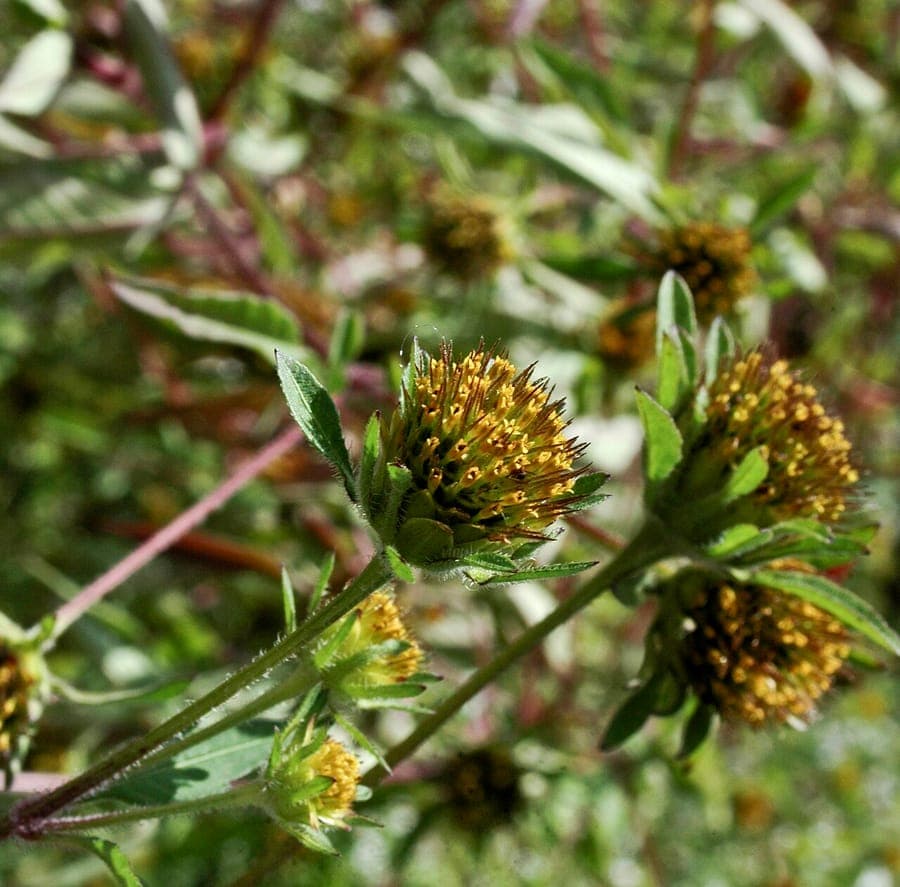
Frank Mayfield / CC BY-SA 2.0, via Wikimedia Commons
Beggar-ticks: complete guide
Bidens frondosa
Want to see Beggar-ticks: complete guide in your garden?
1 minute, no credit card
Overview
Bidens frondosa, commonly known as Beggar-ticks, is a resilient annual or short-lived perennial that brings airy texture and long-lasting colour to the garden. Native to regions across North America - including Alabama, Alaska, Arizona, and British Columbia - this plant has adapted well to disturbed soils and moist environments. While sometimes considered a weed due to its self-seeding habit, when cultivated with intention, it becomes a valuable asset in naturalistic planting schemes.
A member of the Asteraceae family, Beggar-ticks produce dozens of small, bright yellow daisy-like flowers from midsummer into autumn. The plant typically reaches 60–100 cm in height with a spread of about 40 cm, forming loose, branching clumps. Its finely divided, dark green foliage gives it a soft, feathery appearance, making it ideal for blending into wildflower meadows or cottage-style borders.
On gardenworld.app, you can design a planting plan that integrates Beggar-ticks seamlessly into your seasonal garden layout, especially in areas where low-maintenance, pollinator-friendly plants are key.
Appearance & bloom cycle
The flowering period runs from July through October, offering a reliable source of nectar when many other plants begin to fade. Each flower is roughly 1–1.5 cm in diameter, with five to eight ray florets surrounding a darker yellow central disc. The blooms appear in loose clusters at the ends of slender stems.
After flowering, the plant develops its signature seeds - narrow, black, two-pronged achenes that easily latch onto clothing or animal fur, hence the name 'Beggar-ticks'. While this aids in natural dispersal, it can lead to widespread seeding if not managed.
The foliage is pinnately divided, with lance-shaped leaflets that taper to a point. Stems are square in cross-section and often purplish at the base, especially in young growth. The overall form is upright but tends to sprawl slightly under the weight of flowers, so planting in groups helps support individual stems.
Ideal location
Beggar-ticks thrives in full sun but tolerates partial shade, particularly in hotter climates. For best flowering, aim for at least 6 hours of direct sunlight daily. It performs well in moist, open areas - think stream banks, pond edges, or damp garden corners. That said, it adapts to average garden soil as long as it doesn't dry out completely.
Plant in groups of five or more for visual impact. It works well in the middle of a border or as a filler between sturdier perennials. Avoid overcrowding with aggressive spreaders like mint or goldenrod, which can outcompete it for light and nutrients.
Soil requirements
This plant prefers moist, loamy soil rich in organic matter, but it's surprisingly adaptable. It grows in clay, sandy loam, or even slightly acidic soils (pH 5.5–7.0). Avoid waterlogged conditions, though it can withstand temporary flooding.
In early spring, work in a layer of compost or well-rotted manure to boost fertility. Don't over-fertilize - excess nitrogen promotes leafy growth at the expense of flowers.
Free design
Want to see Beggar-ticks: complete guide in your garden? Make a free design now.
Watering
Keep the soil consistently moist, especially during dry spells in summer. Water deeply once or twice a week, depending on rainfall. Drip irrigation or soaker hoses are ideal, delivering moisture directly to the root zone without wetting foliage, which helps prevent mildew.
In containers or raised beds, monitor more closely - these dry out faster, and Bidens frondosa will wilt quickly if stressed.
Pruning
While not required, light pruning improves shape and prolongs blooming. In early June, pinch back the tips by one-third to encourage bushier growth. If the plant becomes leggy by mid-August, cut it back by half. This second trim often triggers a fresh flush of flowers in September.
Use clean, sharp pruners to avoid disease spread. Remove spent flower heads if you want to limit self-seeding.
Maintenance calendar
- March–April: Sow seeds indoors or directly in the garden after last frost
- May: Transplant seedlings outdoors. Begin regular watering
- June: Pinch back for bushier growth
- July–September: Peak bloom. Monitor for moisture and pests
- October: Allow some seed heads to mature for next year, or deadhead to control spread
- November: Plants die back. Remove or leave for winter texture and bird food
Winter hardiness
Bidens frondosa is not winter-hardy in most climates. It's typically grown as an annual in USDA zones 3–8. In milder zones (7–8), it may survive mild winters or self-seed reliably. In colder areas, seeds can overwinter in the soil and germinate in spring when soil temperatures reach 15°C.
No winter protection is needed. Clean up dead foliage in late winter to make space for new growth.
Companion plants
Pair Beggar-ticks with late-season companions:
- Eutrochium maculatum – for height and moisture-loving synergy
- Monarda fistulosa – for contrasting colour and pollinator draw
- Solidago spp. – goldenrods that echo its late bloom time
- Carex vulpinoidea – for grassy texture and compatible habitat
Avoid planting near drought-tolerant species like lavender or sedum, which prefer drier conditions.
Closing
Beggar-ticks is an underrated garden workhorse. It asks little, gives back in waves of flowers, and supports pollinators when they need it most. Its self-seeding nature means it can return year after year with minimal effort.
Find seeds or young plants at garden centres like those in the UK or independent nurseries. Look for organically grown stock to ensure chemical-free blooms for bees and butterflies.
On gardenworld.app, you can create a seasonal planting scheme that places Beggar-ticks exactly where it'll thrive - and where its beauty and function are fully appreciated.
Want to see Beggar-ticks: complete guide in your garden? Make a free design now.
Upload a photo, pick a style, and get a photorealistic design with plant list in under a minute.
No credit card required


Similar plants
Calendula stellata: complete guide
Calendula stellata
Complete guide to Calendula stellata, the star-flowered marigold from Sicily: location, soil, watering and companion planting tips.
Korean chrysanthemum: complete guide
Chrysanthemum x rubellum
Chrysanthemum x rubellum is a hardy autumn perennial with single pink to copper flowers from August to November. Care and combinations.
Helianthus divaricatus: complete guide
Helianthus divaricatus
Helianthus divaricatus is a North American woodland sunflower with yellow summer blooms, ideal for naturalistic borders and shady edges.