
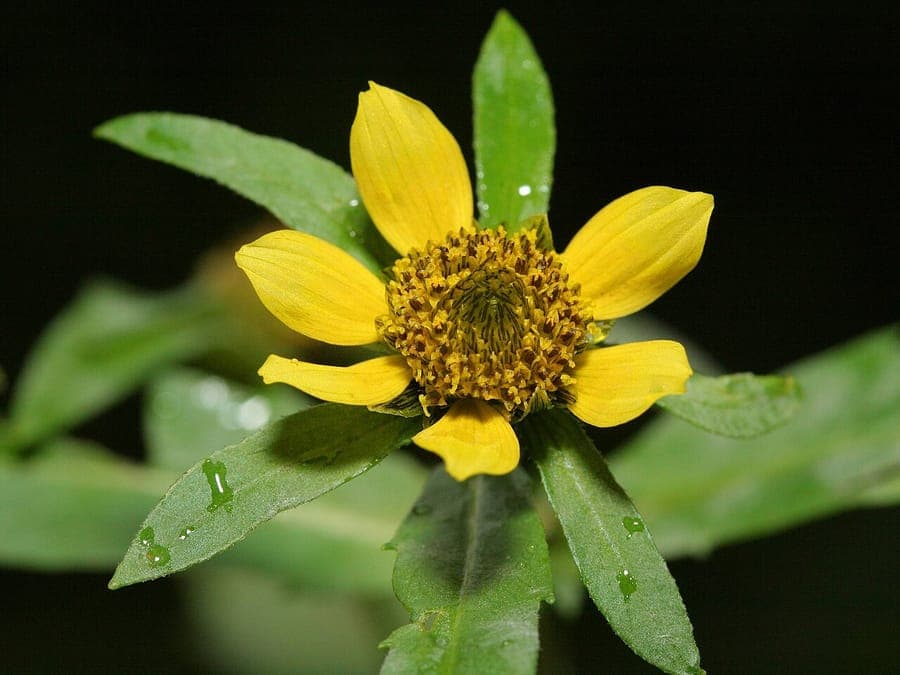
Kristian Peters -- Fabelfroh 11:10, 21 October 2007 (UTC) / CC BY-SA 3.0, via Wikimedia Commons
Nodding beggar-ticks: complete guide
Bidens cernua
Want to see Nodding beggar-ticks: complete guide in your garden?
1 minute, no credit card
Overview
Nodding beggar-ticks (Bidens cernua) is a slender annual forb in the Asteraceae family, native to wetlands across North America and parts of Europe and Asia. It thrives in consistently moist to saturated soils, making it a superb choice for rain gardens, pond margins, and wet meadows. This plant reaches 30 to 90 cm in height and features an upright, branching habit with narrow leaves and bright yellow daisy-like flowers that bloom from July through October.
Despite its modest appearance, nodding beggar-ticks is a powerhouse for pollinators. Bees, hoverflies, and small butterflies frequent its blooms, drawn by the open flower structure and accessible nectar. It's not aggressive in cultivation but can self-seed in ideal conditions. On gardenworld.app, you can design a moisture-loving planting scheme that includes nodding beggar-ticks and other wetland species for year-round interest.
Appearance & bloom cycle
The foliage of Bidens cernua consists of opposite, lance-shaped leaves that grow 4 to 8 cm long with finely toothed margins. The leaves are dark green, slightly glossy, and sit on short petioles. The flowers emerge in loose corymbs at stem tips, nodding slightly - hence the common name. Each flower head is 1 to 2 cm wide, with 5 to 8 yellow ray florets surrounding a dense central disc.
Blooming begins in mid-summer and continues into early autumn, peaking in August and September. Unlike showier garden asters, nodding beggar-ticks has no fragrance, but its extended bloom period and open form make it highly valuable in ecological planting. The seeds are slender achenes with two small barbed awns, which easily attach to clothing or animal fur. This adaptation aids dispersal but means you should monitor self-seeding in small gardens.
Ideal location
This plant demands full sun - aim for a light level of 8 or higher on a 10-point scale. It performs best with at least 6 to 8 hours of direct sunlight daily. Partial shade is tolerated, but flowering will be reduced. Ideal sites include wet ditches, bog gardens, or the shallow edges of ponds.
Because the stems are hollow and somewhat fragile, avoid exposed, windy areas unless supported by neighboring plants. It works well in wildflower meadows or native plant borders in USDA hardiness zones 5 to 9. Use gardenworld.app to map your garden's sun exposure and pinpoint the best spot for moisture-loving plants like nodding beggar-ticks.
Soil requirements
Bidens cernua prefers moist to wet, organically rich soils with a pH between 5.1 and 7.0. It tolerates both loam and clay as long as drainage is slow and moisture remains constant. Sandy or drought-prone soils are unsuitable. Avoid planting in raised beds or dry borders unless you commit to daily watering in summer.
No fertilizer is needed. If amending soil, work in compost or well-rotted manure in early spring. A 5–7 cm mulch of leaf mold or straw helps retain moisture and suppress weeds. Never let the soil dry out completely during active growth.
Free design
Want to see Nodding beggar-ticks: complete guide in your garden? Make a free design now.
Watering
Consistent moisture is non-negotiable. This species can withstand temporary flooding up to 5 cm deep and even grows in shallow, slow-moving water. In garden settings, water daily during dry spells, especially for young plants. If planted near a pond or in a rain garden, natural runoff may suffice.
Use rainwater when possible, as chlorinated or hard tap water may stress the plant over time. Install a rain barrel to support sustainable watering practices.
Pruning
Pruning isn't required, but pinching back tips in early June encourages bushier growth and reduces flopping. Deadhead spent flowers regularly to prolong blooming and limit self-seeding if desired. Use clean, sharp shears to avoid disease transmission.
Cut back dead foliage in late autumn or leave it standing through winter to provide shelter for beneficial insects. Remove in early spring before new growth emerges.
Maintenance calendar
- Jan: Dormant; no action needed
- Feb: Dormant; check seed storage if starting indoors
- Mar: Sow seeds indoors or in a greenhouse
- Apr: Harden off seedlings; plant out after last frost
- May: Water regularly; watch for slugs and snails
- Jun: Pinch back for bushiness; mulch to retain moisture
- Jul: Flowers begin; maintain consistent soil moisture
- Aug: Peak bloom; monitor for water stress
- Sep: Continue blooming; seeds start to form
- Oct: Allow some plants to set seed; cut back diseased material
- Nov: Plants die back; compost residue
- Dec: Dormant; no care required
Winter hardiness
As an annual, nodding beggar-ticks does not survive winter. However, it readily self-seeds in favorable conditions. Seeds overwinter in the soil and germinate in spring when temperatures rise above 15°C. It's hardy in USDA zones 5–9 for natural reseeding.
No winter protection needed. Leave seed heads intact for wildlife if you welcome natural volunteers.
Companion plants
Pair with other moisture-loving species such as Joe-Pye weed (Eutrochium maculatum), cardinal flower (Lobelia cardinalis), blue flag iris (Iris versicolor), and tussock sedge (Carex elata 'Aurea'). These combinations create vertical layers and extend seasonal interest.
Avoid pairing with drought-tolerant plants like lavender or sedum. Instead, integrate nectar-rich perennials such as New England aster (Symphyotrichum novae-angliae) to support pollinators visiting nodding beggar-ticks.
Closing
Nodding beggar-ticks is a low-maintenance, ecologically rich plant perfect for wet areas where few others thrive. It's not flashy, but its reliability and pollinator value make it a hidden gem. Start seeds indoors or buy young plants from garden centres like those found at major retailers. With proper placement and care, it will return year after year through self-seeding, adding quiet charm to your wetland garden.
Want to see Nodding beggar-ticks: complete guide in your garden? Make a free design now.
Upload a photo, pick a style, and get a photorealistic design with plant list in under a minute.
No credit card required


Similar plants
Calendula stellata: complete guide
Calendula stellata
Complete guide to Calendula stellata, the star-flowered marigold from Sicily: location, soil, watering and companion planting tips.
Korean chrysanthemum: complete guide
Chrysanthemum x rubellum
Chrysanthemum x rubellum is a hardy autumn perennial with single pink to copper flowers from August to November. Care and combinations.
Helianthus divaricatus: complete guide
Helianthus divaricatus
Helianthus divaricatus is a North American woodland sunflower with yellow summer blooms, ideal for naturalistic borders and shady edges.