
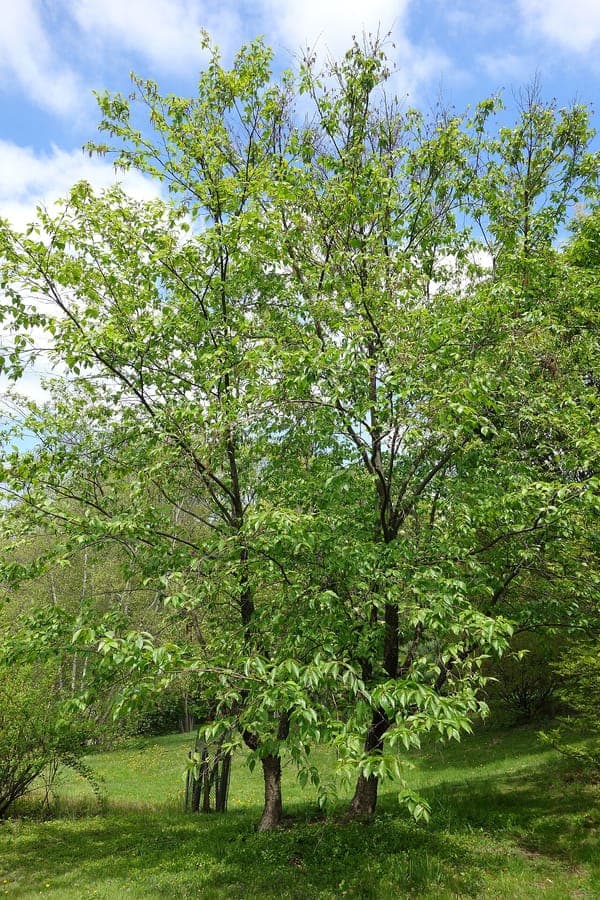
Daderot / CC0, via Wikimedia Commons
Schmidt's Birch: complete guide
Betula schmidtii
Want to see Schmidt's Birch: complete guide in your garden?
1 minute, no credit card
Overview
Betula schmidtii, known as Schmidt's Birch or Iron Birch, is an ornamental tree from East Asia, native to Japan, Korea, Manchuria, and Primorye (Russia). This intermediate-sized tree is prized for its elegant gray bark, fine branch architecture, and delicate finely-divided foliage. The tree grows at a moderate to fast rate and typically reaches 15 to 25 meters at maturity.
Betula schmidtii is hardy in USDA zones 4 to 8 and is appreciated in modern landscape architecture for its elegant silhouette and year-round ornamental value. The tree suits gardens of all types, from traditional Japanese gardens to contemporary minimalist designs.
Appearance and bloom
Betula schmidtii grows as a slender, upright tree with narrow to medium crown. The bark is characteristically grayish-white to gray-brown, often with dark lenticels creating vertical stripe patterns. The bark displays interesting texture and color year-round.
Leaves are small, approximately 3 to 6 cm long, oval to elliptical in shape, and dark green in summer. Foliage transforms to yellow-gold in autumn, providing exceptional fall color. Male catkins appear in spring and reach approximately 6 cm, yellow to brown. Female catkins are shorter, approximately 1 to 2 cm long.
Nuts are extremely small, about 5 mm, with wings. They disperse via wind. The tree is deciduous, shedding all leaves in autumn.
Ideal location
Betula schmidtii thrives in full sun to light partial shade. The tree grows best in sunny locations with minimum 4-6 hours daily sunlight. In deep shade, growth becomes less compact and structure less defined.
The tree is highly suitable for windy sites and tolerates harsh wind and air pollution well. Therefore, it suits urban environments and park landscapes. Ideal in groups or as single specimen in modern landscaping.
Soil
Betula schmidtii is extremely flexible regarding soil type. The tree grows in sand, loam, clay, and gravel. The tree prefers well-drained soils and cannot tolerate waterlogging. In native habitat, the tree grows in forests with various soil types.
The tree is highly tolerant of acidic soils (pH 4.5-6) and can also grow in neutral to slightly alkaline soils. Organic matter addition promotes growth, but the tree also thrives in lean soils.
Free design
Want to see Schmidt's Birch: complete guide in your garden? Make a free design now.
Watering
Betula schmidtii requires regular watering during the first growing year until well-established. Thereafter, watering can be reduced. Once established, the tree tolerates moderate drought well.
During very dry periods, regular watering promotes optimal growth. In wet winters, the tree tolerates moisture provided drainage is excellent. Waterlogging must be avoided.
Pruning
Betula schmidtii requires minimal pruning. The tree naturally develops attractive form. Dead or damaged branches can be removed in spring or winter.
Pruning can also control form and size. The tree responds well to moderate pruning and will regrow vigorously. Heavy pruning is not recommended.
Maintenance calendar
March-April: Inspect for winter damage, remove dead branches, begin feeding. May-July: Growth phase, regular watering during dry spells, monitor for pests. August-October: Foliage color change, reduce watering, prepare for autumn. November-February: Winter rest, minimal maintenance, prune dead branches.
Winter hardiness
Betula schmidtii is hardy in USDA zones 4 to 8. The tree tolerates temperatures to -30 degrees Celsius. The tree is also highly tolerant of low temperatures and ice formation.
In very warm climates (zone 9+), the tree may suffer in extreme heat. In warm zones, shading and regular watering may be beneficial. The tree is, however, better suited to temperate and cold climates.
Companion plants
Betula schmidtii combines well with other hardwood trees and shrubs, such as Amelanchier, Cornus, and Sambucus. Also, understory planting with shade-tolerant plants like Helleborus, Hosta, and ferns works well.
In modern gardens, the tree combines excellently with structural plants such as grasses, bamboo, and low shrubs. For contrast, dark conifers or dark-green shrubs can be used.
Closing
Betula schmidtii is an elegant tree for those seeking ornamental value year-round. Gray bark, fine foliage, and autumn color provide constant visual interest. The tree is hardy, low-maintenance, and suitable for contemporary and traditional gardens. For urban park landscapes, small gardens, and as specimen tree in larger gardens, this tree delivers outstanding performance.
Find this tree at specialized nurseries and online. For garden design visit gardenworld.app.
Want to see Schmidt's Birch: complete guide in your garden? Make a free design now.
Upload a photo, pick a style, and get a photorealistic design with plant list in under a minute.
No credit card required


Similar plants
Heart-leaf birch: complete guide
Betula cordifolia
Heart-leaf birch is an attractive North American birch tree for large gardens. Discover growth, white papery bark and winter hardiness.
Tropical hornbeam: complete guide
Carpinus tropicalis
Everything about Carpinus tropicalis, the tropical hornbeam from Central America. Growing tips, location, care, and garden use explained.
Japanese Alder (Alnus firma): complete guide
Alnus firma
Learn everything about Japanese Alder in our complete guide. Discover care, growth, and applications for larger gardens.