
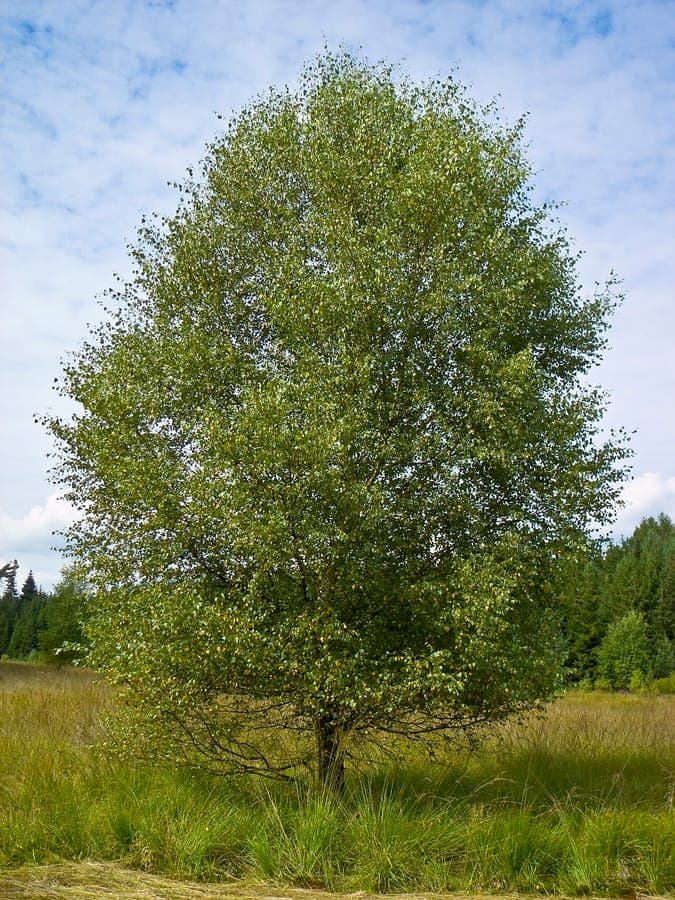
Willow / CC BY 2.5, via Wikimedia Commons
White birch: complete guide
Betula pubescens
Want to see White birch: complete guide in your garden?
1 minute, no credit card
Overview
Betula pubescens, commonly known as white birch, is a resilient, fast-growing deciduous tree native to northern and central Europe. Unlike its relative Betula pendula, this species thrives in wetter conditions, making it ideal for gardens with poor drainage or near water features. It's often found in the wild growing along stream banks, in peat bogs, and on damp heaths. Standing 15–20 meters tall at maturity, with a spread of 8–10 meters, it brings vertical structure and seasonal interest without dominating the space. If you've got a soggy corner or a cool, damp microclimate, this tree could be your best ally.
On gardenworld.app you can create a garden layout that highlights the white birch's elegance, especially when paired with other moisture-tolerant plants. It's also perfect for naturalistic designs, woodland edges, or as a solitary specimen near a pond.
Appearance & bloom cycle
The white birch has a slender, white trunk that peels in thin, papery layers. The bark is smooth and often appears slightly hairy on young twigs - a key trait behind its name 'pubescens'. Leaves are diamond-shaped, 3–6 cm across, with finely serrated edges and a pointed tip. They emerge in April, bright green at first, then deepen slightly through summer before turning a soft yellow in autumn. Leaf drop occurs in November, typically without dramatic fall colour, but the clean yellow is still pleasing.
Male and female catkins appear in April, before the leaves. Male catkins are 3–4 cm long, dangling, and release pollen in early spring. Female catkins are smaller, upright, and mature into cone-like structures by late summer, releasing tiny winged seeds from September to December.
Bloom period: April–May Foliage season: April–November
Ideal location
Choose a spot in full sun to light shade. While it tolerates partial shade, full sun encourages denser foliage and better form. Allow at least 4 meters of clearance from buildings or other trees to prevent root competition and ensure proper air circulation. Avoid planting near septic systems or water lines - its roots can spread widely in search of moisture.
This tree handles exposed, windy sites well, even near coastal areas (though not in salty spray). It's also suitable for urban gardens if soil moisture is maintained. Avoid tight courtyard spaces - it needs room to breathe and grow.
Soil requirements
White birch prefers moist, acidic soils with a pH between 4.5 and 6.5. It thrives in peaty, loamy, or sandy clay soils that retain water but drain slowly. It does poorly in dry, sandy soils unless irrigated regularly. Avoid heavy compaction - this species has shallow, spreading roots that need oxygen.
Do not add fertilizer at planting. Native to nutrient-poor environments, Betula pubescens can suffer from excessive nitrogen, leading to weak growth and pest susceptibility. If amending soil, use only well-rotted leaf mould or composted bark.
Free design
Want to see White birch: complete guide in your garden? Make a free design now.
Watering
In the first two years, water deeply once a week during dry spells - about 20–30 liters per session. After establishment, it becomes largely self-sufficient unless facing prolonged drought (4+ weeks without rain). In such cases, deep watering every 10–14 days helps prevent stress. Mulch with 5–7 cm of bark to retain moisture and suppress weeds.
On gardenworld.app, you can design a drip irrigation plan that suits your white birch's needs, especially helpful during its early years or in drier climate zones.
Pruning
Minimal pruning is required. If shaping is needed, remove low branches up to 1.5 meters to create a clean trunk - do this gradually over 2–3 years. Only prune between July and September to avoid heavy sap bleeding, which occurs in late winter and early spring.
Remove dead, damaged, or crossing branches with clean tools. Avoid topping or heavy cutting - recovery is slow, and the tree may become unbalanced.
Maintenance calendar
- Jan: inspect for storm damage, check for rodent marks on trunk
- Feb: prepare planting site if planned
- Mar: safe planting window opens (if soil isn't frozen)
- Apr: leaves emerge, catkins bloom
- May: monitor for aphids, especially on new growth
- Jun: check soil moisture for young trees
- Jul: light pruning window opens
- Aug: final pruning opportunity
- Sep: seed dispersal begins, foliage starts yellowing
- Oct: leaf drop begins, collect fallen leaves if desired
- Nov: final inspection, clear debris
- Dec: protect young trunks from rodents with guards
Winter hardiness
White birch is extremely cold-hardy, thriving in USDA zones 2–7. It tolerates temperatures as low as -40°C. In the UK, Netherlands, and Scandinavia, it survives harsh winters without protection. Young trees benefit from trunk guards to prevent bark damage from voles and rabbits.
Companion plants
Pair white birch with other moisture-loving species:
- Tufted hairgrass (Deschampsia cespitosa) – 90 cm, airy plumes
- Marsh marigold (Caltha palustris) – spring, yellow flowers
- Cotton grass (Eriophorum angustifolium) – unique white seed heads
- Hazel (Corylus avellana) – understory shrub
- Ling heather (Calluna vulgaris) – low, purple bloom in late summer
Birds such as siskins, redpolls, and treecreepers are drawn to the seeds and sheltered canopy.
Closing
Betula pubescens is a graceful, low-maintenance tree perfect for wet gardens. Its white bark and fluttering leaves add movement and light, while its ecological value supports local wildlife. Give it space, avoid over-fertilising, and let it grow naturally.
In the UK and Ireland, you can find white birch at garden centres like Dobbies, Wyevale, and local nurseries. Look for container-grown specimens in spring or autumn for best results. With a little patience, this tree becomes a long-lived focal point in your landscape.
Want to see White birch: complete guide in your garden? Make a free design now.
Upload a photo, pick a style, and get a photorealistic design with plant list in under a minute.
10,000+ gardens designed already
No credit card required


Similar plants
Heart-leaf birch: complete guide
Betula cordifolia
Heart-leaf birch is an attractive North American birch tree for large gardens. Discover growth, white papery bark and winter hardiness.
Tropical hornbeam: complete guide
Carpinus tropicalis
Everything about Carpinus tropicalis, the tropical hornbeam from Central America. Growing tips, location, care, and garden use explained.
Japanese Alder (Alnus firma): complete guide
Alnus firma
Learn everything about Japanese Alder in our complete guide. Discover care, growth, and applications for larger gardens.