
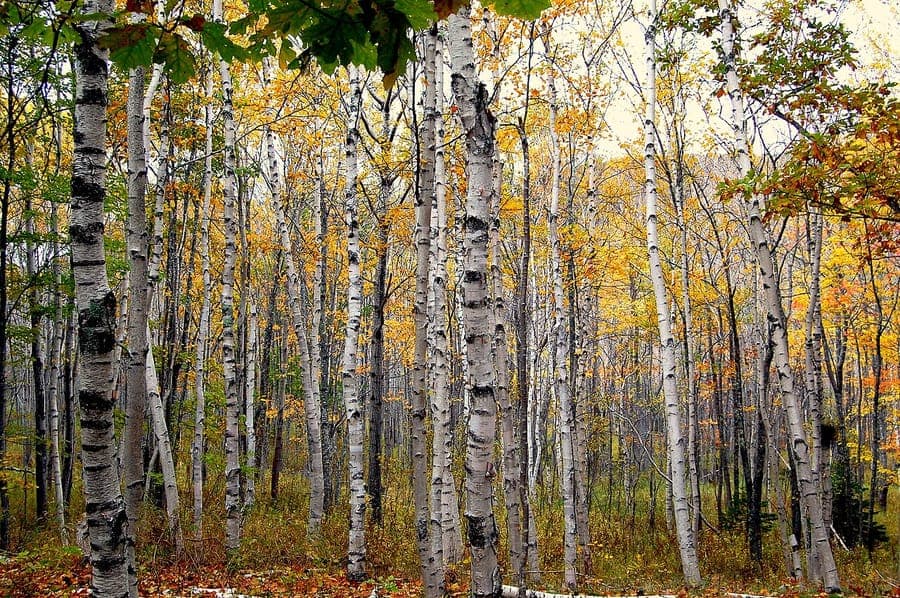
InAweofGod'sCreation / CC BY 2.0, via Wikimedia Commons
Canoe birch: complete guide
Betula papyrifera
Want to see Canoe birch: complete guide in your garden?
1 minute, no credit card
Overview
Betula papyrifera, commonly known as Canoe birch or paper birch, is a standout deciduous tree admired for its bright white, peeling bark and graceful form. Native to northern North America, it thrives from Alaska through much of Canada and into the northern United States, including Colorado and Illinois. In garden settings, especially in temperate climates, it's valued not just for looks but for its resilience and seasonal interest. On gardenworld.app, you can create a garden layout that accounts for its mature spread and light shade, ensuring it fits perfectly into your long-term design.
This tree grows quickly, reaching 18–21 meters in height with a spread of 8–12 meters. It's hardy to USDA zone 2 (-40°C), making it suitable for cold gardens across the UK, northern Europe, and similar climates. With proper care, a paper birch can live 100 to 140 years, though some wild specimens exceed 200 years. It's not a low-maintenance tree, but its beauty justifies the effort.
Appearance & bloom cycle
In late spring, around April to early May, Betula papyrifera produces catkins - slender, drooping flower clusters. Male catkins are brown, 5–8 cm long, and hang in groups of two or three. Female catkins are shorter, 2–3 cm, and greenish, standing upright before curving down after pollination. By autumn, they mature into small, cone-like strobiles that release tiny winged seeds.
The leaves are diamond-shaped or triangular, 4–7 cm long, with a finely serrated edge. They emerge light green in spring, darken in summer, and turn a brilliant yellow in fall, creating a striking seasonal shift. The bark, though, is the true standout: chalk-white, papery, and peeling in thin curls. Young trees have smoother bark, but by age 5–7, the full peeling effect develops, revealing dark reddish-brown inner layers.
This tree is equally ornamental in winter, when the white bark contrasts sharply with snow and evergreens.
Ideal location
Plant your Canoe birch where it has room to grow - at least 5 meters from buildings or other large trees. It prefers full sun (6+ hours of direct light daily) but tolerates light shade. In dense shade, the crown becomes thin and weak.
It works well as a specimen tree in open lawns or as part of a mixed woodland edge. On gardenworld.app, you can simulate how the tree will look over time, including canopy spread and root zone, helping you plan companion plants and hardscaping without future conflicts. Keep in mind: its roots are shallow and can lift paving if planted too close.
Free design
Want to see Canoe birch: complete guide in your garden? Make a free design now.
Soil requirements
Paper birch thrives in moist, well-drained, slightly acidic to neutral soil (pH 5.5–7.0). It does best in sandy or loamy soils. Avoid heavy clay or constantly waterlogged ground, as these lead to root rot. While it tolerates brief dry spells, prolonged drought stresses the tree, especially when young.
If your soil is poor, amend the planting hole with compost and coarse sand. Do not use fertilizers high in chlorine or salts - this species is sensitive.
Watering
For the first two years, water deeply once a week during dry periods. Aim for 20–30 liters per session. Use a drip hose or watering can, avoiding direct spray on the trunk. After establishment, it relies mostly on rainfall, but prolonged summer droughts still require supplemental watering.
Mulch around the base with wood chips (5–8 cm layer), keeping it 10 cm away from the trunk to prevent collar rot. Replenish mulch annually in spring.
Pruning
Pruning is minimal. Only remove dead, damaged, or crossing branches. The best time is late winter or early spring, before sap begins to flow. Avoid pruning in summer - this attracts the bronze birch borer, a common pest that targets wounded trees.
If shaping is needed, do so gradually over several years. Always use clean, sharp tools to prevent disease.
Maintenance calendar
- January: Inspect for winter damage
- February: Light pruning if needed
- March: Top up mulch, check for seedlings
- April: Catkins appear, growth resumes
- May: No action required
- June: Monitor for dry spells
- July: Check leaves for pests or fungal spots
- August: Avoid pruning - borer season
- September: Replenish mulch
- October: Leaves turn yellow, seeds disperse
- November: Leave fallen leaves as natural mulch
- December: Final inspection before winter
Winter hardiness
Hardy to USDA zone 2, the Canoe birch handles extreme cold without issue. Young trees may benefit from tree wrap to prevent rabbit or rodent damage to the thin bark. Avoid de-icing salts near the root zone - they cause serious damage.
Companion plants
Choose plants that thrive in moist, slightly acidic soil and light shade. Good companions include: Vaccinium corymbosum (highbush blueberry), Carex vulpinoidea (fox sedge), Heuchera spp., and ferns like Dryopteris erythrosora. The open canopy allows enough light for understory growth.
Avoid invasive groundcovers like Vinca minor, which can compete aggressively with shallow roots.
Closing
Betula papyrifera isn't a typical garden tree, but for those seeking year-round drama, it's hard to beat. With space, proper planting, and early care, it becomes a focal point for decades. Remember: sun, moisture, and protection from salt and borers. You can find young trees at garden centres in the UK and northern Europe, especially in spring and fall. On gardenworld.app, you can create a garden layout that accounts for its mature spread and light shade, ensuring it fits perfectly into your long-term design.
Want to see Canoe birch: complete guide in your garden? Make a free design now.
Upload a photo, pick a style, and get a photorealistic design with plant list in under a minute.
No credit card required


Similar plants
Heart-leaf birch: complete guide
Betula cordifolia
Heart-leaf birch is an attractive North American birch tree for large gardens. Discover growth, white papery bark and winter hardiness.
Tropical hornbeam: complete guide
Carpinus tropicalis
Everything about Carpinus tropicalis, the tropical hornbeam from Central America. Growing tips, location, care, and garden use explained.
Japanese Alder (Alnus firma): complete guide
Alnus firma
Learn everything about Japanese Alder in our complete guide. Discover care, growth, and applications for larger gardens.