
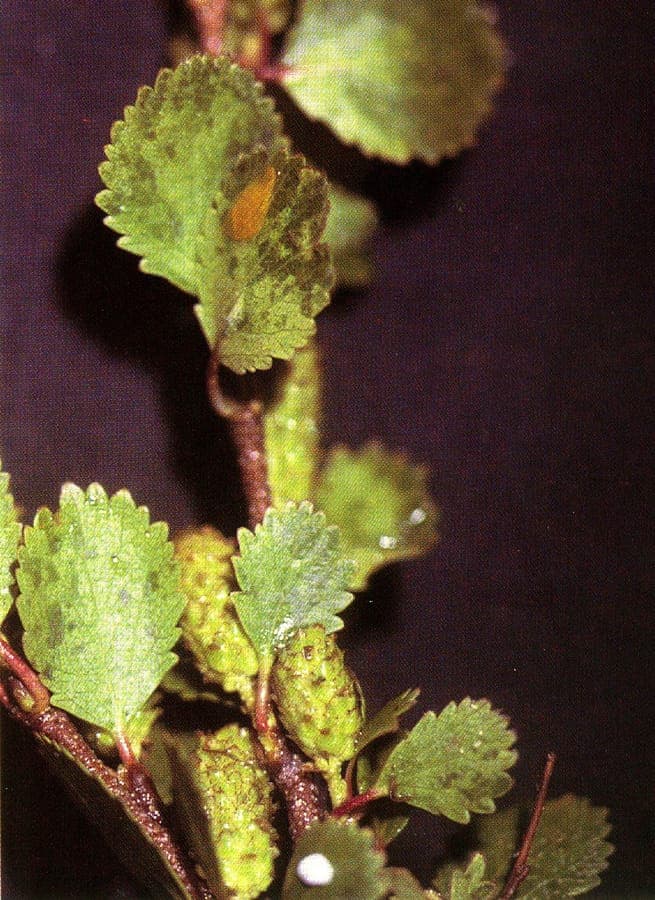
USDA photo, uploader user:MPF / Public domain, via Wikimedia Commons
Arctic dwarf birch: complete guide
Betula nana
Want to see Arctic dwarf birch: complete guide in your garden?
1 minute, no credit card
Overview
Betula nana, commonly known as the Arctic dwarf birch, is a low-growing deciduous shrub from the Betulaceae family. Unlike its tall relatives, such as the silver birch, this species rarely exceeds 80 cm in height. Native to cold regions across northern and central Europe-including Finland, the Baltic States, Austria, and parts of Russia-it thrives in cool, moist environments. While not native to the UK or Ireland, it adapts well to temperate gardens with the right conditions. Its creeping habit and compact form make it ideal for rock gardens, alpine beds, or as ground cover in woodland-style planting schemes.
On gardenworld.app, you can design a garden layout that suits the dwarf birch's preference for partial shade and moist, acidic soil.
Appearance & bloom cycle
The Arctic dwarf birch has a dense, spreading growth habit, typically reaching 30–80 cm tall and spreading up to 1.2 m wide. It forms multiple slender stems with dark brown to blackish bark that becomes rough with age. The leaves are small, round to slightly heart-shaped, 1–3 cm across, with finely toothed margins. They emerge bright green in spring, deepen in summer, and turn vibrant shades of yellow, orange, and red in autumn-offering a subtle but striking fall display.
In May, the plant produces separate male and female catkins on the same shrub (monoecious). Male catkins are pale yellow, drooping, and up to 2 cm long, while female catkins are shorter, upright, and greenish. After pollination, they develop into small, cone-like fruits that release tiny seeds in late summer or autumn.
Ideal location
The dwarf birch prefers partial shade to light sun, around level 7 on a 1–10 light scale (10 being full sun). It performs best in cool, sheltered spots-such as north- or east-facing slopes, woodland edges, or shaded rockeries. Full sun is acceptable if soil moisture is consistently maintained, but intense afternoon sun in warmer climates can stress the plant. Deep shade should be avoided, as it leads to sparse growth and reduced flowering.
In UK and Irish gardens, a dappled shade position under open-canopy trees works well. Use gardenworld.app to visualise seasonal light patterns and choose the optimal planting spot.
Soil requirements
Betula nana requires moist, well-drained, acidic soil with a pH between 4.9 and 6.5. It thrives in humus-rich, peaty soils that retain moisture without becoming waterlogged. Avoid heavy clay or alkaline soils-these cause chlorosis, visible as yellowing between leaf veins. If your soil is too alkaline, grow the plant in a raised bed or container using ericaceous compost.
For in-ground planting, amend the soil with leaf mould, composted pine bark, and coarse sand to improve drainage and acidity. In containers, use a mix of ericaceous compost and perlite. Test your soil pH with a simple kit available at garden centres.
Free design
Want to see Arctic dwarf birch: complete guide in your garden? Make a free design now.
Watering
This shrub prefers consistent moisture, especially in the first two growing seasons. Water weekly during dry spells in spring and summer. Apply water at the base to avoid wetting foliage, which can encourage fungal diseases. Mulch with pine needles or shredded bark to conserve moisture and suppress weeds.
Once established, Betula nana tolerates short dry periods, but prolonged drought leads to leaf scorch and dieback. Avoid overwatering-soggy soil promotes root rot.
Pruning
Pruning is rarely needed. Remove only dead, damaged, or crossing branches in late winter or early spring before new growth starts. Do not cut back healthy stems heavily, as this disrupts the plant's natural form. Light shaping is acceptable, but leave at least 10 cm of stem to ensure regrowth.
Dispose of pruned material carefully-birch clippings can carry fungal spores. Burn them or place in green waste, not on the compost heap.
Maintenance calendar
- January: inspect for winter damage, remove dead wood
- February: final pruning window
- March: check soil moisture, add organic matter if needed
- April: monitor for aphids or leaf spot
- May: flowering period, no pruning
- June: water during dry spells
- July: mulch to retain moisture
- August: watch for drought stress
- September: leave fallen leaves as natural mulch
- October: remove diseased foliage
- November: reduce watering, no feeding
- December: protect young plants with bracken or pine boughs
Winter hardiness
The Arctic dwarf birch is extremely cold-hardy, surviving in USDA zones 3–7. It tolerates temperatures down to -40°C, making it suitable for most of the UK, northern Europe, and even parts of Canada. Established plants need no protection, but young specimens may suffer from frost heave in fluctuating winter conditions. Apply a thin layer of organic mulch in late autumn to insulate roots.
Companion plants
This shrub pairs well with other acid-loving, woodland, or alpine species. Good companions include blueberry (Vaccinium corymbosum), heather (Calluna vulgaris), ferns (like Dryopteris), wood anemone (Anemone nemorosa), and tufted hair grass (Deschampsia cespitosa). Avoid aggressive ground covers that compete for moisture. Plant in groups of 3–5 for a naturalistic effect, especially in rock gardens or on sloping banks.
Closing
Betula nana is an underrated gem for small gardens, containers, or naturalistic planting. With minimal care, it offers year-round interest-spring foliage, summer structure, autumn colour, and winter form. Purchase healthy plants from reputable garden centres, especially those specialising in native or alpine species. For design inspiration, visit gardenworld.app to explore planting combinations and create a garden plan that highlights the dwarf birch's unique charm.
Want to see Arctic dwarf birch: complete guide in your garden? Make a free design now.
Upload a photo, pick a style, and get a photorealistic design with plant list in under a minute.
No credit card required


Similar plants
Heart-leaf birch: complete guide
Betula cordifolia
Heart-leaf birch is an attractive North American birch tree for large gardens. Discover growth, white papery bark and winter hardiness.
Tropical hornbeam: complete guide
Carpinus tropicalis
Everything about Carpinus tropicalis, the tropical hornbeam from Central America. Growing tips, location, care, and garden use explained.
Japanese Alder (Alnus firma): complete guide
Alnus firma
Learn everything about Japanese Alder in our complete guide. Discover care, growth, and applications for larger gardens.