
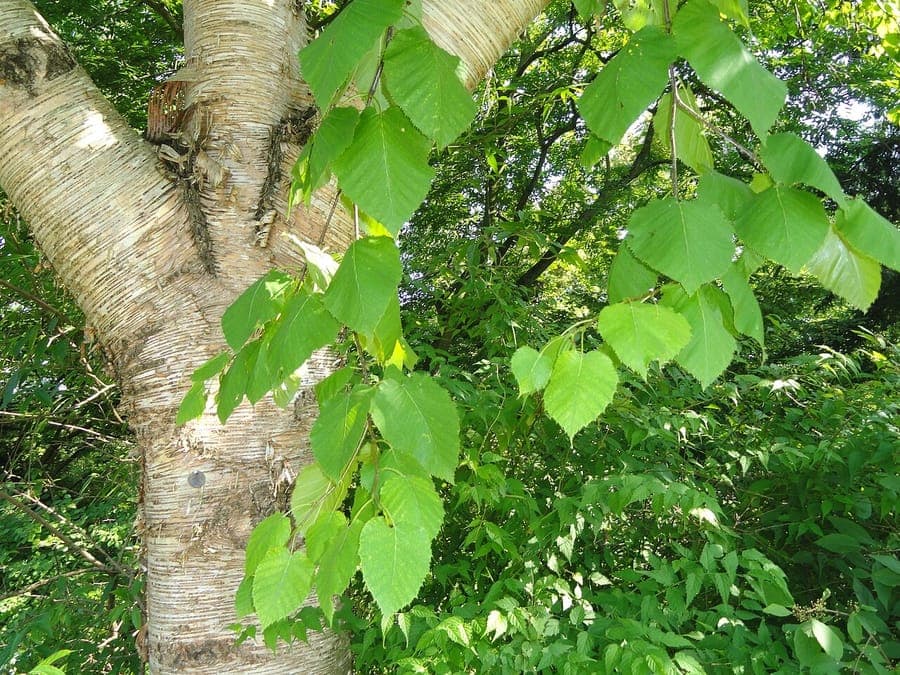
Daderot / CC0, via Wikimedia Commons
Monarch birch: complete guide
Betula maximowicziana
Want to see Monarch birch: complete guide in your garden?
1 minute, no credit card
Overview
The monarch birch (Betula maximowicziana) is a stately deciduous tree native to Japan and the Kuril Islands. Standing 15 to 20 meters tall with a spread of 8 to 12 meters, it's built for presence in larger landscapes. Unlike many birches that stay slender, this species develops a broad, rounded crown that offers light shade without overwhelming nearby plants. Its glossy, heart-shaped leaves and exfoliating, cinnamon-colored bark make it a standout in any garden.
On gardenworld.app, you can design a planting plan that factors in the monarch birch's mature size and root spread, helping you avoid future space conflicts with structures or utilities.
Appearance & bloom cycle
This birch earns its name from its notably large leaves-typically 8 to 15 cm across-with coarsely serrated edges and a rich, dark green upper surface. In spring, the foliage emerges bright green, deepening through summer. Fall color is exceptional: a vibrant mix of golden yellow, amber, and copper that peaks from late September to mid-October.
Flowering occurs in April with the appearance of catkins. Male catkins hang down, 4–6 cm long, and release pollen in mid-spring. Female catkins are shorter and upright. After pollination, small winged seeds form and disperse in late autumn. While not showy, the bloom cycle supports local pollinators and adds ecological value.
Ideal location
Monarch birch thrives in full sun to light shade. Full sun maximizes leaf color and density, but in hot summers, afternoon shade helps prevent leaf scorch. Give it room to grow-plant at least 4 meters from buildings or large trees to accommodate its wide crown and root system.
Avoid confined urban spots with compacted soil. This tree needs space to breathe and expand. On gardenworld.app, you can overlay growth projections to see how your garden will evolve over the next 10–20 years with this tree in place.
Soil requirements
It prefers moist, well-drained soil with a slightly acidic to neutral pH (5.5–7.0). While it tolerates clay if drainage is adequate, it struggles in dry, sandy soils without supplemental watering. Young trees are especially sensitive to drought.
Amend the planting hole with compost or well-rotted manure to boost organic matter. A 5–7 cm mulch layer of shredded bark helps retain moisture and regulate soil temperature. Avoid piling mulch against the trunk to prevent rot.
Watering
During the first two growing seasons, water deeply twice a week during dry spells-deliver 10–15 liters per young tree. Once established, it's moderately drought-tolerant but performs best with consistent moisture.
Use rainwater if possible, as this birch dislikes highly alkaline tap water. During heatwaves above 28°C, increase watering frequency. Drip irrigation works well for maintaining even soil moisture without runoff.
Free design
Want to see Monarch birch: complete guide in your garden? Make a free design now.
Pruning
Pruning is minimal. Focus on structural pruning in the first 3–5 years to develop a strong central leader and balanced canopy. Remove dead, crossing, or inward-growing branches in late autumn or early winter when the tree is dormant.
Avoid summer pruning-birches bleed sap heavily when cut during active growth. Use clean, sharp tools and never remove more than 20% of the canopy in a single year.
Maintenance calendar
- January: Inspect for storm damage; remove any dead wood.
- February: Light structural pruning; check tree stakes on young specimens.
- March: Apply compost around the base; refresh mulch layer.
- April: New leaves emerge; watch for aphids or sawfly larvae.
- May: Water during dry spells; monitor for leaf spot or mildew.
- June: Low maintenance; ensure grass isn't competing at the base.
- July: Deep water during heatwaves; inspect for borers near the trunk.
- August: No pruning; avoid disturbing roots.
- September: Fall color begins; reduce watering gradually.
- October: Rake fallen leaves; compost or use as mulch elsewhere.
- November: Final inspection; mulch again for winter root protection.
- December: Wrap young trunks with light-colored tree wrap to prevent sunscald.
Winter hardiness
Hardy in USDA zones 4–7 (down to -34°C), the monarch birch handles cold winters well. Young trees may suffer from frost cracks on the south-facing bark due to rapid temperature swings. Protect trunks with tree wrap for the first three winters.
The tree is fully deciduous, dropping leaves in November. The exfoliating bark provides winter interest, peeling in papery curls to reveal cinnamon-toned layers beneath.
Companion plants
Due to its deep root system, it pairs well with shallow-rooted perennials and groundcovers. Consider:
- Helleborus orientalis – early bloom, shade-tolerant
- Carex vulpinoidea – soft-textured sedge for moist areas
- Hosta 'Sum and Substance' – bold foliage contrast
- Dicentra formosa – long-blooming native bleeding heart
- Polystichum acrostichoides – evergreen fern for woodland edges
Avoid invasive groundcovers like periwinkle (Vinca minor), which may choke young roots.
Closing
The monarch birch is a long-term investment with high ornamental payoff. With proper siting and early care, it grows into a majestic focal point that lasts generations. Prioritize space, moisture, and protection in youth.
Purchase young trees from reputable garden centres-look for healthy root balls and smooth bark. Avoid specimens with circling roots or trunk damage. Once established, this birch asks little and gives much: shade, beauty, and habitat. It's a true monarch of the garden.
You'll find quality stock at major retailers like garden centres across the UK and North America, where knowledgeable staff can help you select a vigorous sapling.
Want to see Monarch birch: complete guide in your garden? Make a free design now.
Upload a photo, pick a style, and get a photorealistic design with plant list in under a minute.
No credit card required


Similar plants
Heart-leaf birch: complete guide
Betula cordifolia
Heart-leaf birch is an attractive North American birch tree for large gardens. Discover growth, white papery bark and winter hardiness.
Tropical hornbeam: complete guide
Carpinus tropicalis
Everything about Carpinus tropicalis, the tropical hornbeam from Central America. Growing tips, location, care, and garden use explained.
Japanese Alder (Alnus firma): complete guide
Alnus firma
Learn everything about Japanese Alder in our complete guide. Discover care, growth, and applications for larger gardens.