
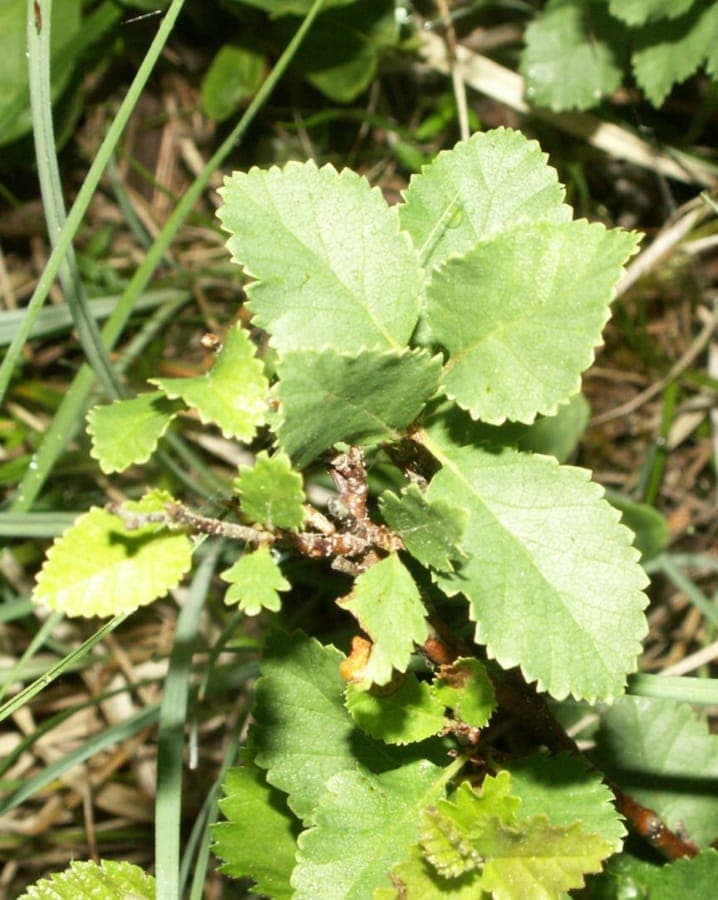
b.gliwa / CC BY-SA 2.5, via Wikimedia Commons
Shrubby birch: complete guide
Betula humilis
Want to see Shrubby birch: complete guide in your garden?
1 minute, no credit card
Overview
Betula humilis, commonly known as shrubby birch, is a compact, suckering shrub that thrives where few others dare - in consistently moist to wet soils. Native to damp woodlands across Central and Eastern Europe, from Germany to western Siberia, it rarely exceeds 1.5 meters in height, making it ideal for smaller gardens or naturalistic planting schemes. Unlike tall forest birches, this species spreads horizontally through underground rhizomes, forming loose thickets over time.
It's an excellent choice for rain gardens, pond margins, or areas with poor drainage. Because of its spreading habit, it's wise to plan its placement carefully. On gardenworld.app, you can simulate how Betula humilis will expand over five years, helping you avoid overcrowding in mixed borders.
Appearance & bloom cycle
In early spring, Betula humilis pushes out small, rounded leaves 2–4 cm wide, with finely serrated edges and a soft down on the underside. The foliage emerges bright green, maturing to a richer olive tone by midsummer. In autumn, it turns a soft golden yellow - not flashy, but warm and harmonious in the seasonal palette.
Flowering occurs in April and May. Male catkins dangle in slender chains 4–6 cm long, while female catkins are shorter and upright. After pollination, they develop into small, cone-like strobiles that persist through winter, releasing tiny winged seeds that attract finches and siskins.
Ideal location
Choose a site with full sun to partial shade. Full sun is acceptable only if soil moisture remains high; otherwise, leaves may scorch in hot summers. Partial shade, especially under open canopies or near water features, suits it best.
This birch excels in wetland gardens, damp woodland edges, or low-lying areas that collect runoff. It's perfect for softening pond banks or stabilising stream sides. If you're unsure whether your garden has the right hydrology, gardenworld.app offers moisture mapping tools to identify suitable spots for moisture-loving plants like Betula humilis.
Soil requirements
It demands consistently moist, humus-rich soil. Sandy or fast-draining soils are unsuitable unless amended with copious compost or leaf mould. Ideal conditions include heavy clay or loam with a pH between 5.5 and 7.0. Avoid highly alkaline or chalky soils, as they can cause chlorosis.
For dry gardens, consider installing a mulch ring of wood chips or pine needles to retain moisture and suppress weeds. This mimics its natural forest floor habitat.
Free design
Want to see Shrubby birch: complete guide in your garden? Make a free design now.
Watering
Young plants need weekly deep watering during their first two growing seasons, especially in dry spells. Once established, Betula humilis is more resilient but still depends on reliable soil moisture. Signs of drought stress include leaf curling, browning margins, and premature drop.
Use rainwater when possible - tap water with high chlorine or fluoride levels can harm sensitive root systems. A simple rain barrel near your shed can make a big difference.
Pruning
Pruning is rarely needed. The shrub naturally forms an open, spreading shape. If containment is necessary, prune in late winter or early spring before sap flow begins. Avoid summer pruning to prevent excessive bleeding.
Remove only dead, damaged, or crossing branches. To control suckering, cut emerging shoots at ground level or dig out rhizomes selectively. For formal edges, trim lightly in early spring.
Maintenance calendar
- January: Inspect for winter damage; remove broken branches
- February: No action required
- March: Apply compost or leaf mould as mulch
- April: Monitor for new growth; fertilise if soil is poor
- May: Water deeply during dry periods
- June: Check for aphids; avoid chemical sprays
- July: Maintain soil moisture; watch for suckers
- August: Stop fertilising; continue watering
- September: Begin reducing water as growth slows
- October: Leave fallen leaves as natural mulch
- November: Observe bird activity on seed cones
- December: Final inspection; ensure mulch layer is intact
Winter hardiness
Betula humilis is extremely cold-hardy, thriving in USDA zones 3 to 7. It tolerates temperatures down to -35°C without damage. Branches remain flexible, and dieback is rare. The persistent seed cones add winter interest and support overwintering birds.
Young plants benefit from a 5–10 cm mulch layer to insulate roots in harsh winters. No additional winter protection is needed in most temperate climates.
Companion plants
Pair with moisture-loving perennials like Carex vulgaris, Filipendula rubra, or Iris versicolor. For structure: Gunnera manicata (in sheltered spots) or dwarf rhododendrons.
Low-growing companions: Eutrochium maculatum, Caltha palustris, or Osmunda regalis. These combinations create layered, dynamic plantings that evolve through the seasons.
Avoid drought-tolerant species like lavender, sedum, or ornamental grasses that prefer dry conditions.
Closing
Betula humilis isn't a head-turner, but it's a resilient workhorse for wet areas. It provides year-round texture, supports wildlife, and asks little in return. For gardeners embracing natural processes over perfection, it's a quiet hero.
Its real strength lies in adaptability and persistence. If you're planning a bog garden or rehabilitating a soggy patch, check planting layouts on gardenworld.app - you'll see how this shrub integrates beautifully into ecological designs.
Want to see Shrubby birch: complete guide in your garden? Make a free design now.
Upload a photo, pick a style, and get a photorealistic design with plant list in under a minute.
No credit card required


Similar plants
Heart-leaf birch: complete guide
Betula cordifolia
Heart-leaf birch is an attractive North American birch tree for large gardens. Discover growth, white papery bark and winter hardiness.
Tropical hornbeam: complete guide
Carpinus tropicalis
Everything about Carpinus tropicalis, the tropical hornbeam from Central America. Growing tips, location, care, and garden use explained.
Japanese Alder (Alnus firma): complete guide
Alnus firma
Learn everything about Japanese Alder in our complete guide. Discover care, growth, and applications for larger gardens.