
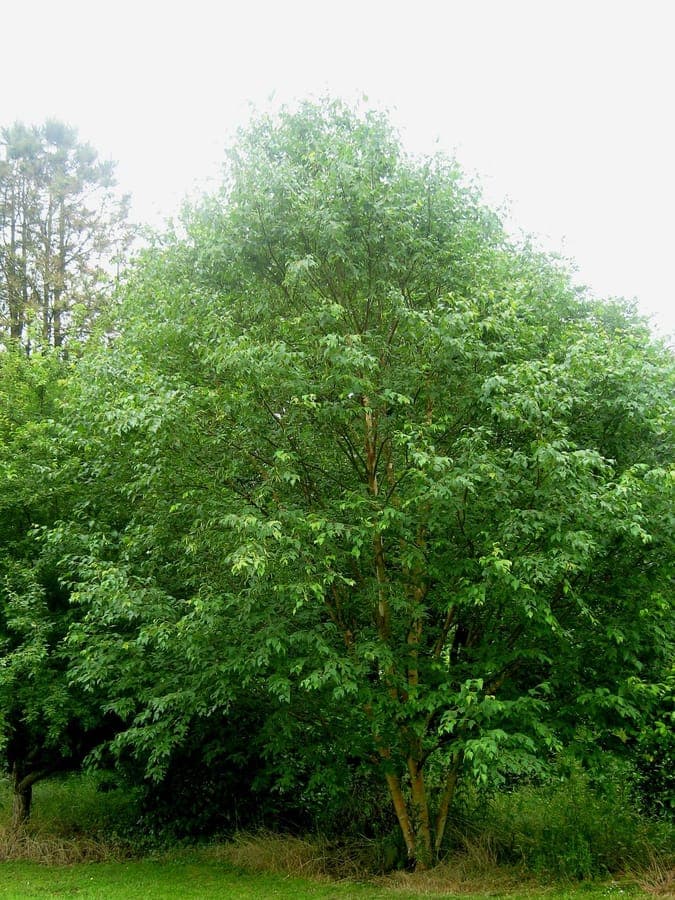
Ptelea / CC BY-SA 4.0, via Wikimedia Commons
Japanese Cherry Birch: complete guide
Betula grossa
Want to see Japanese Cherry Birch: complete guide in your garden?
1 minute, no credit card
Betula grossa, the Japanese cherry birch, is an elegant ornamental tree native to central and southern Japan. This is one of the largest birch species, reaching mature heights of 20-25 meters in its native forest habitat, though in gardens it typically grows to 15-18 meters. It is a highly ornamental tree with upright, clean branching, fine foliage texture, and several features that make it extremely attractive for large gardens.
Bark coloring is one of the most striking characteristics. Young trunks display rich dark-brown, slightly rough bark with distinctive reddish-brown to silvery-gray mottling. With age, the bark darkens and maintains textural interest, eventually developing into reddish-brown with deeper fissured patterns. This makes the tree visually compelling even in winter when leaves have fallen.
The foliage is fine and elongated-ovate, typically 5-8 cm in length, bright green with fine saw-tooth margins. In autumn, the leaves transform into beautiful golden-yellow and orange tones - particularly spectacular in October-November. Leaf fall is gradual, resulting in less debris accumulation compared to some other ornamental trees.
In early spring (March-April), characteristic pendant catkins appear. The male catkins are golden-yellow and highly decorative. Female flowers are less showy but develop into small seeds in hanging catkins that remain attractive throughout winter.
For location, Betula grossa performs best in full sun to partial shade. It requires well-drained soil that is slightly acidic to neutral with consistent moisture levels - it dislikes being very dry but also cannot tolerate waterlogging. In Germany, Poland, and the Netherlands, it thrives in standard garden soils amended with compost at planting.
Planting: Plant in autumn or early spring. Choose a protected location away from strong winds, though birch trees generally resist wind damage. Excavate a hole twice the width of the root ball and incorporate compost. The tree requires good drainage - planting sites that become waterlogged are unsuitable.
Watering: Once established, Betula grossa grows with relatively little support. Water regularly during the first year after planting. In dry summers, provide supplemental water. In typical European climates, drought stress is rarely an issue after establishment.
Fertilizing: No special feeding is required. In very poor soils, an application of slow-release tree fertilizer in spring can help. Compost applied around the base annually maintains vitality.
Pruning is generally unnecessary. In the tree's youth, you can remove some lower limbs to develop clear trunk structure, but the tree naturally assumes an elegant form. Remove dead branches as soon as visible.
Pest problems are very limited. Japanese sawfly can occasionally occur but is rarely severely damaging. Wood boring beetles may sometimes affect stressed trees, but healthy specimens are resilient.
Winter hardiness is excellent. Betula grossa is hardy to USDA zone 4, surviving minimum temperatures around -30 to -35 degrees Celsius. This makes it suitable for all of northern Europe including Scandinavia.
Companion plants in the garden: Japanese cherry birch combines well with other Asian specimens like Japanese maples, small conifers, and understory plantings with light, fine texture. The shade beneath the tree is ideal for ferns, hellebores, and other shade-loving plants.
Large garden design: Use this tree as a special specimen or in groupings of 3-5 trees for more dramatic effects. The mature size requires an open location where the natural form can fully express itself. In rural landscapes, birch trees work perfectly in woodland edge transitions.
Find Betula grossa at specialized tree nurseries and premium garden centers. In the UK and northern Europe, contact forestry associations for suppliers. German tree nurseries regularly stock them. Prices range from 50 euros for young plants to 500+ euros for established trees with well-formed structure.
Betula grossa requires space and patience to reach its full potential, but the reward is a truly architectural tree that adds value to a garden landscape for decades. Visit gardenworld.app to create a complete garden design centered on this magnificent tree.
Want to see Japanese Cherry Birch: complete guide in your garden? Make a free design now.
Upload a photo, pick a style, and get a photorealistic design with plant list in under a minute.
No credit card required


Similar plants
Heart-leaf birch: complete guide
Betula cordifolia
Heart-leaf birch is an attractive North American birch tree for large gardens. Discover growth, white papery bark and winter hardiness.
Tropical hornbeam: complete guide
Carpinus tropicalis
Everything about Carpinus tropicalis, the tropical hornbeam from Central America. Growing tips, location, care, and garden use explained.
Japanese Alder (Alnus firma): complete guide
Alnus firma
Learn everything about Japanese Alder in our complete guide. Discover care, growth, and applications for larger gardens.