
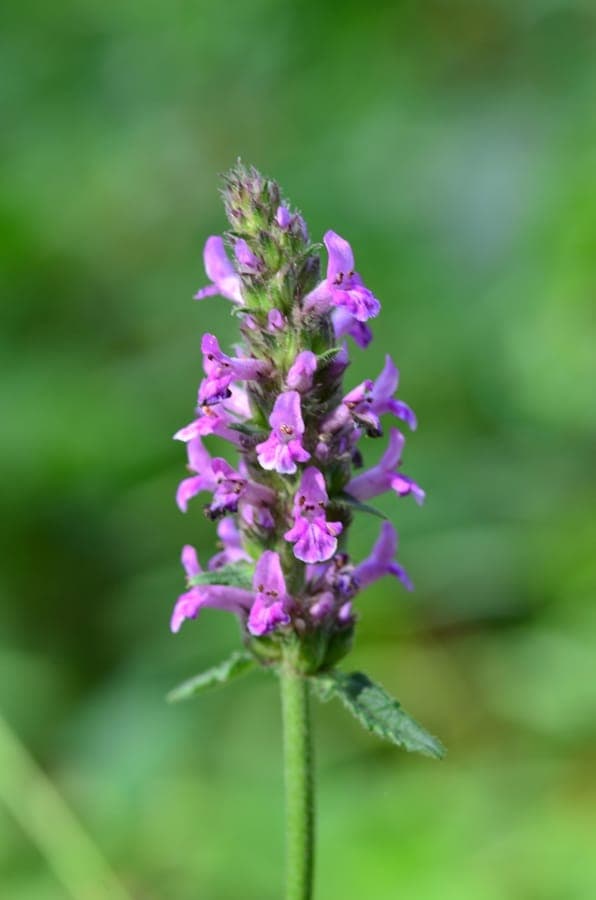
Radio Tonreg from Vienna, Austria / CC BY 2.0, via Wikimedia Commons
Betony: complete guide
Betonica officinalis
Want to see Betony: complete guide in your garden?
1 minute, no credit card
Overview
Betony - botanically Betonica officinalis, also widely known under its synonym Stachys officinalis - is a clump-forming perennial native across most of Europe and extending east to West Siberia and the Caucasus. A member of the mint family (Lamiaceae), it grows naturally on open heathland, woodland edges, and dry meadows, especially on slightly acidic, free-draining soils. For centuries, betony held an almost legendary status in herbal medicine: medieval manuscripts credited it with curing dozens of ailments, from headaches to nightmares, and it was planted in monastery gardens throughout Britain and continental Europe.
Today betony has found a well-deserved place in the ornamental garden. Its long-lasting purple flower spikes make it a magnet for bees, bumblebees, and butterflies, while its compact habit keeps it neat and easy to manage. Whether in a cottage border, a wildlife patch, or a naturalistic planting scheme, betony brings reliable colour and ecological value from June through August. If you are planning a planting scheme that includes native species, gardenworld.app provides design inspiration tailored to your front garden.
Appearance and bloom cycle
Betony forms a low, spreading rosette of dark green, oval to heart-shaped leaves. The leaf surface is finely textured and slightly rough to the touch; the edges are scalloped in a distinctive way that makes the plant recognisable even before it flowers. The leaves remain attractive through autumn and often persist as a semi-evergreen rosette through mild winters.
From June into July, the plant sends up stiff, square stems reaching 30 to 60 cm in height. At the summit of each stem appears a dense, cylindrical flower spike packed with bright magenta-pink blooms. Each individual flower follows the classic two-lipped structure of the mint family: an upper lip and a three-lobed lower lip that provides a perfect landing platform for foraging bees. The colour ranges from deep cerise to soft lavender-pink depending on the seedlot and growing conditions.
The flowering period extends over six to eight weeks. Once the flowers fade, small nutlets develop that birds readily collect. If the spent stems are left in place, betony self-seeds gently through the garden, gradually naturalising in spots where conditions suit it. This quality makes it ideal for informal plantings and wildlife areas where a degree of natural spread is welcome.
Ideal location
Betony performs best in full sun to light partial shade. In its native habitat it typically occupies sunny, open positions - heathland clearings, south-facing meadow slopes, and dry woodland margins. In the garden, a spot receiving at least four to six hours of direct sunlight per day gives the finest flowering. The plant tolerates afternoon shade without complaining, though flowering can be slightly reduced.
The plant copes well in exposed or windy positions thanks to its sturdy stems, which rarely need staking. It is equally at home in a sheltered cottage garden border as it is in a more exposed, windswept wildlife patch. Avoid deeply shaded positions under dense tree canopy, where the plant tends to become etiolated and produces fewer flowers.
Soil requirements
One of betony's greatest strengths is its contentment with poor to moderately fertile, well-drained soils. In fact, overly rich, highly fertile soils tend to produce lush foliage at the expense of flowers - the plant invests its energy in stems and leaves rather than bloom. An ideal pH sits between 5.5 and 6.5, matching the slightly acid conditions of its natural habitats. Sandy loams, chalky grassland soils, and light clay-sandy mixes all suit it well.
Heavy, waterlogged clay soils are the main challenge: betony dislikes prolonged wet conditions around its roots and may suffer root rot in poorly drained ground. If your soil is heavy, incorporate grit or coarse sand when planting to improve drainage. Avoid adding large quantities of garden compost or manure, as this raises fertility above what betony prefers.
Free design
Want to see Betony: complete guide in your garden? Make a free design now.
Watering
Once established, betony is genuinely drought-tolerant and rarely needs supplementary watering in climates with average annual rainfall above 500 mm. In most of northern and central Europe, rainfall alone will sustain the plant through a normal growing season. Only during prolonged dry spells in midsummer - lasting more than three weeks with no significant rain - is occasional watering helpful.
Newly planted specimens in their first growing season need more attention. Water regularly for the first four to six weeks after planting, allowing the soil to dry slightly between drinks, then progressively reduce watering as the plant establishes. A 5 cm mulch of leaf mould or bark chips around the base conserves moisture and suppresses competing weeds.
Pruning
Betony asks very little of the gardener in terms of cutting back. After the main flush of flowers in July and August, cutting the spent stems back to the basal rosette can encourage a secondary wave of smaller flower spikes in late August and September. This deadheading also keeps the plant looking tidy through late summer.
If you prefer to leave the seed heads intact - both for self-seeding and to provide food for finches and other seed-eating birds - simply leave the stems through autumn. In early spring, remove all old stems cleanly at the base before the new growth emerges. This is also the best moment to divide congested clumps: lift the whole plant, split it into sections of three to five rosettes, and replant immediately at the same depth.
Maintenance calendar
March - April: Cut back old stems from the previous year. Divide large clumps to rejuvenate them and spread the plant around the garden.
May: Apply a light mulch if the soil is very dry or sandy. Remove competing weeds from around the emerging rosettes.
June - July: Full flowering season. Let pollinators visit freely. Water only during extreme dry spells.
August: Deadhead spent spikes to encourage a secondary flush, or leave them for self-seeding and wildlife.
September - October: Collect seed if you want to propagate. Mark self-sown seedlings that appear spontaneously.
November - February: The plant rests as a semi-evergreen rosette. No protection needed in most of northern Europe.
Winter hardiness
Betonica officinalis is reliably hardy to USDA zone 4, tolerating temperatures down to approximately -20 degrees Celsius. Throughout the United Kingdom and most of northern continental Europe it overwinters without any protection whatsoever. Even after hard winters the plant regrows vigorously from its basal rosette. Leaves may bleach or partly die back in severe frost but the crowns survive and send up fresh growth as soon as temperatures rise in spring.
In particularly harsh or exposed gardens, a light covering of straw or dry leaves over the rosette provides a small measure of insurance, but this is rarely necessary. Container-grown specimens should be brought into a frost-free but cool greenhouse or cold frame over winter if temperatures are likely to drop below -15 degrees Celsius for extended periods.
Companion plants
Betony partners beautifully with a wide range of perennials and ornamental plants. Classic combinations include: Salvia pratensis (meadow clary) for a purple-on-purple colour harmony, Knautia arvensis (field scabious) for a wild meadow look, Geranium pratense (meadow cranesbill) for contrasting leaf texture and complementary blue-violet tones, and Achillea millefolium (common yarrow) for structural contrast and extended flowering interest.
For more structured borders, betony works well alongside Echinacea purpurea, Penstemon digitalis, and Verbascum species. Combining it with low ornamental grasses such as Festuca glauca or Deschampsia cespitosa introduces movement and texture that offsets the upright flower spikes beautifully. In a native plant garden, betony fits naturally alongside Primula veris, Centaurea scabiosa, and Leontodon hispidus.
When planning a combination planting for a naturalistic front garden, gardenworld.app offers ready-made design templates that incorporate native flowering perennials like betony into a cohesive scheme.
Closing thoughts
Betony is proof that a plant does not need to be exotic or demanding to be genuinely rewarding. With minimal soil requirements, real drought tolerance once established, and a long season of vivid flower colour that pollinators adore, it earns its place in any garden style from formal cottage to informal wildflower meadow. Its deep roots in European herbal tradition add a layer of historical interest that few purely ornamental plants can match. Look for young plants at specialist nurseries and garden centres throughout the UK and Ireland, and plant them in spring or early autumn for best establishment.
Want to see Betony: complete guide in your garden? Make a free design now.
Upload a photo, pick a style, and get a photorealistic design with plant list in under a minute.
10,000+ gardens designed already
No credit card required


Similar plants
Apple mint (Mentha x villosa): complete guide
Mentha x villosa
Meet apple mint (Mentha x villosa): a fruity-scented kitchen herb with woolly leaves, perfect for tea and mojitos.
Salvia peyronii: complete guide
Salvia peyronii
Discover Salvia peyronii, a rare Lebanese mountain sage. Growing tips, hardiness, and companion planting for a Mediterranean gravel garden.
Bigleaf mint (Mentha x rotundifolia): complete guide
Mentha x rotundifolia
Discover bigleaf mint: cultivation, care tips, and garden uses. Learn how to grow this aromatic herb with soft, hairy leaves.