
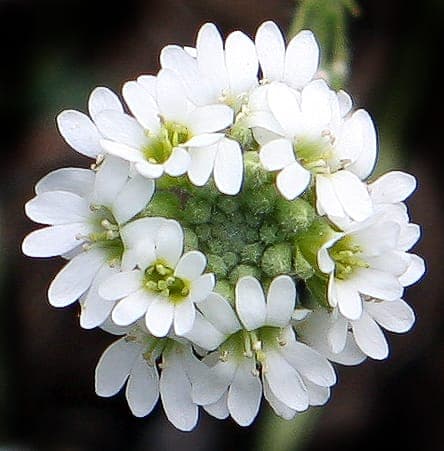
Hardyplants at English Wikipedia / Public domain, via Wikimedia Commons
Hoary alison: complete guide
Berteroa incana
Want to see Hoary alison: complete guide in your garden?
1 minute, no credit card
Overview
Hoary alison (Berteroa incana) is a striking annual forb from the Brassicaceae family, native to Central and Southeastern Europe, including Austria, the Baltic States, Belarus, and parts of northern China. Standing 30 to 50 cm tall and spreading up to 25 cm wide, it's a compact, upright plant with a long bloom season and silvery, hairy foliage that adds texture to any garden. Its modest size and airy white flowers make it perfect for dry borders, rock gardens, or gravel pathways. While not a common garden staple, it's gaining popularity among sustainable gardeners who value resilience and subtle beauty. On gardenworld.app, you can create a custom layout that positions Hoary alison where sun and drainage are optimal.
Appearance & bloom cycle
The plant features narrow, lance-shaped leaves densely covered in fine white hairs, giving them a soft, hoary appearance - hence the name. From June through September, it produces small, single white flowers with four petals and dark stamens that stand out against the pale blooms. Each flower is about 1 to 1.5 cm wide and appears in clusters at the stem tips. The blooming is continuous and self-seeding occurs if spent flowers are left in place. Deadheading encourages more flowers and keeps the plant tidy. The seed pods split open when mature, releasing seeds that may germinate the following spring.
Ideal location
Hoary alison thrives in full sun - a 9 out of 10 on the light scale. Aim for south- or southwest-facing beds with minimal shade. It performs best in open, airy locations with good air circulation. Avoid planting under trees or near walls that cast shadows, as this leads to weak growth and sparse flowering. Use it in the front or middle of borders, especially in drought-prone zones. In mixed perennial beds, pair it with plants that won't overtake it. On gardenworld.app, you can simulate sun exposure across your garden to find the ideal microclimate for this sun-loving plant.
Soil requirements
Well-drained soil is essential. Hoary alison prefers light, sandy, or loamy soils with a pH between 6.5 and 7.0. It tolerates poor to moderately fertile soils but struggles in heavy clay or waterlogged conditions, where root rot can develop. If your soil is dense, amend it with coarse sand or gravel, or plant in raised beds. Avoid rich compost or fresh manure, as excessive nutrients promote leafy growth at the expense of flowers.
Free design
Want to see Hoary alison: complete guide in your garden? Make a free design now.
Watering
Once established, this plant is highly drought-tolerant. Young seedlings need consistent light watering for the first three weeks after planting. Water at the base to keep foliage dry and reduce fungal risk. After that, supplemental watering is rarely needed. In average summers, rainfall is sufficient. During extended dry spells (three weeks or more without rain), a light soak helps, but allow the soil to dry completely between waterings. Overwatering is the most common cause of failure.
Pruning
Pruning isn't required, but deadheading spent blooms every 4 to 6 weeks encourages repeat flowering and improves appearance. Cut stems back to just above a lateral bud or leaf node. If you want to limit self-seeding, remove flower heads before seeds mature. Leaving a few plants to set seed supports natural reseeding for next year.
Maintenance calendar
- March–April: Start seeds indoors or in a greenhouse. Soil should be at least 8°C before direct sowing.
- May: Transplant seedlings 20–25 cm apart. Protect from slugs and snails.
- June–September: Monitor for bloom; deadhead regularly to extend flowering.
- October–November: Collect seeds or leave some for natural reseeding.
- December–February: No action needed. The plant dies back, but seeds may overwinter.
Winter hardiness
As an annual, Hoary alison does not survive winter. It completes its life cycle in one season. However, seeds often overwinter in the soil and germinate the next spring when temperatures rise. In harsh winters with prolonged frost and little snow cover, seed survival may be lower. For reliable returns, save seeds indoors or resow in spring.
Companion plants
Pair Hoary alison with other drought-tolerant species like Sedum 'Herbstfreude', Nepeta racemosa, Echinacea purpurea, or Gaura lindheimeri. The silvery foliage contrasts beautifully with purple, pink, or yellow blooms. Avoid invasive spreaders like mint or aggressive ground covers. It works well with creeping thyme or dwarf dianthus in rock gardens. In informal borders, it adds lightness behind bolder perennials.
Closing
Hoary alison is an underrated annual that brings delicate charm and low-maintenance appeal to sunny gardens. With its long bloom time, pollinator attraction, and resilience in dry conditions, it's a smart choice for sustainable landscapes. You can find seeds or young plants at garden centres across the UK and US, especially in spring. When placed correctly and lightly maintained, it returns year after year through self-seeding, offering a touch of wild elegance. Use gardenworld.app to plan its placement and companion plants for best results.
Want to see Hoary alison: complete guide in your garden? Make a free design now.
Upload a photo, pick a style, and get a photorealistic design with plant list in under a minute.
No credit card required


Similar plants
Brassica cretica: complete guide
Brassica cretica
Brassica cretica, the Cretan cabbage, grows wild on Aegean cliffs. Discover how to grow this drought-tolerant, yellow-flowered Mediterranean perennial.
Corsican cabbage: complete guide
Brassica insularis
Corsican cabbage is a rare Mediterranean rock cabbage with white flowers and blue-green leaves. Location, soil and winter protection.
Prostrate cabbage: complete guide
Brassica procumbens
Prostrate cabbage is a creeping North African cliff plant with yellow flowers. Discover location, soil type and winter protection.