
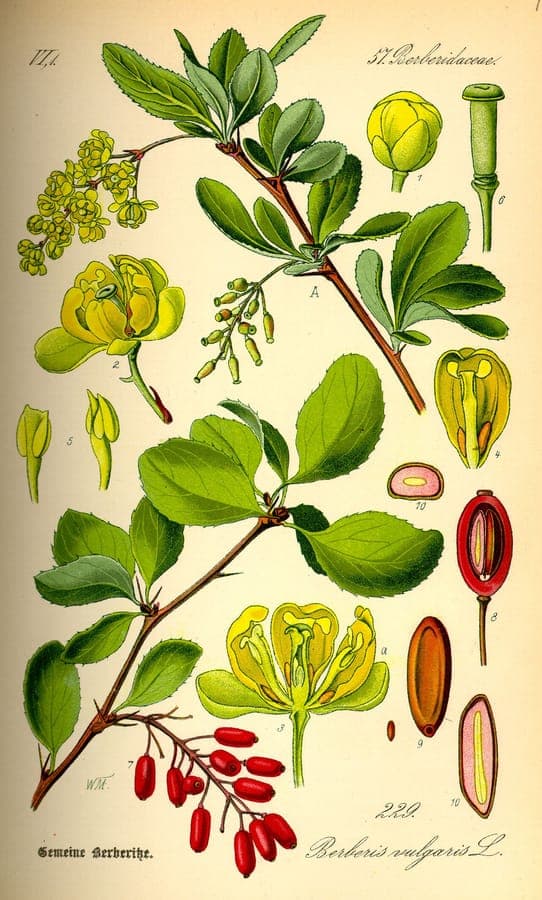
Wikimedia Commons / Public domain, via Wikimedia Commons
European barberry: complete guide
Berberis vulgaris
Want to see European barberry: complete guide in your garden?
1 minute, no credit card
Overview
Berberis vulgaris, commonly known as European barberry, is a tough, deciduous shrub that thrives in a wide range of garden conditions. Native to central and southern Europe, it's naturalised across much of the continent and has become a staple in both ornamental and functional landscaping. Reaching 5 to 8 feet (1.5–2.5 m) in height and spread, it forms a dense, upright thicket perfect for hedges, borders, or standalone specimens. Its bold foliage, vibrant berries, and early spring flowers make it a year-round performer.
One of the standout traits of this shrub is its resilience. It tolerates poor soils, drought, and urban pollution, making it ideal for city gardens or low-maintenance plots. Whether you're designing a wildlife-friendly space or need a thorny deterrent, European barberry delivers.
On gardenworld.app, you can visualise how this shrub fits into your garden plan, whether as a security hedge or a seasonal focal point.
Appearance & bloom cycle
The plant features small, oval-shaped leaves with a glossy green surface that turns brilliant shades of red, orange, and purple in autumn. Each leaf springs from a three-pronged spine at the base, so always wear thick gloves when handling. The stems are ridged and brownish, adding winter texture.
From April to May, clusters of bright yellow, pendulous flowers dangle from the branches. These are highly attractive to bees and other pollinators. By late summer, they develop into elongated, bright orange berries that persist well into autumn. The berries are tart-edible but not typically eaten raw-often used in jams, teas, or Middle Eastern cuisine.
Berries usually appear on two-year-old wood, so avoid cutting back too hard if you want fruit. Birds like thrushes and pheasants will feast on them in November and December, especially after a few frosts soften the acidity.
Ideal location
European barberry grows best in full sun but tolerates partial shade. In full sun, you'll get denser growth, more flowers, and better berry production. In heavy shade, the plant becomes leggy and sparse, losing its ornamental impact.
Choose a spot with good air circulation to minimise fungal issues like powdery mildew. Allow at least 5 feet (1.5 m) between plants if planting a hedge. It's excellent for mixed borders, cottage gardens, and low-maintenance landscapes. Its thorny nature makes it a smart choice for deterring intruders under windows or along fence lines.
Avoid planting near wheat fields or cereal crops-this species can host wheat rust, a serious agricultural disease. Many regions have restrictions on planting it for this reason.
Soil requirements
This shrub is not fussy about soil type. It grows well in sandy, loamy, or clay soils as long as drainage is adequate. It prefers a pH between 5.5 and 7.5 but adapts to slightly more acidic or alkaline conditions.
If your soil is heavy clay, amend it with grit or compost to improve drainage. For very poor soils, mix in a bucket of well-rotted compost at planting time. After that, feeding is rarely needed. Over-fertilising can lead to excessive soft growth, which is more vulnerable to pests and winter damage.
Free design
Want to see European barberry: complete guide in your garden? Make a free design now.
Watering
Once established, European barberry is highly drought-tolerant. Young plants, however, need regular watering during their first growing season-about 10 litres per week during dry spells. Water deeply but infrequently to encourage strong root development.
Avoid frequent shallow watering, which promotes weak roots. In prolonged dry summers, give mature plants a deep soak every few weeks. Use rainwater when possible, as tap water high in lime can affect long-term soil pH.
Pruning
Pruning is minimal. The best time is late winter or early spring (February to March) before new growth begins. Remove dead, damaged, or crossing branches. For hedges, trim lightly to shape, but avoid cutting into old wood-this plant doesn't regenerate well from it.
If rejuvenation is needed, cut one-third of the oldest stems to ground level each year over three years. Never remove more than a third at once. Use sharp bypass secateurs and wear thick leather gloves-the spines are no joke.
Maintenance calendar
- January: Check for winter damage and rabbit gnawing.
- February: Begin light pruning; remove dead wood.
- March: Plant new barberries; add compost to poor soils.
- April: Flowers begin to form; monitor young plants for moisture.
- May: Full bloom; watch for aphids on new growth.
- June: No major care needed.
- July: Check for water stress in young plants.
- August: Berries start developing; protect from birds if needed.
- September: Autumn colour begins; leave leaf litter for insects.
- October: Berries ripen; foliage turns vivid.
- November: Birds feed on berries; avoid disturbing nests.
- December: Inspect for pests; mulch base lightly.
Winter hardiness
European barberry is hardy in USDA zones 5 to 8, surviving temperatures down to -25°C (-13°F). It handles cold winters well, though young plants in exposed sites may benefit from a light mulch of compost or leaf mould around the base to protect roots.
In milder autumns, it may produce a second flush of flowers in October, which won't set fruit but can weaken the plant slightly. Avoid autumn pruning, as it can trigger new growth vulnerable to frost.
Companion plants
Pair barberry with other drought-tolerant shrubs like lavender, potentilla, or spirea. It contrasts beautifully with fine-textured grasses like miscanthus or carex. In borders, combine with sedum, echinacea, or rudbeckia for late-season colour.
Avoid moisture-loving plants like hostas or ferns. Instead, opt for companions that thrive in similar conditions-well-drained soil and sun.
Wildlife loves it: bees visit the flowers, birds eat the berries, and the dense thicket offers shelter.
Closing
European barberry is a reliable, hard-working shrub that brings structure, colour, and function to the garden. With minimal care and high ornamental value, it's a smart choice for beginner and experienced gardeners alike.
On gardenworld.app, you can explore planting schemes that feature Berberis vulgaris alongside complementary plants and get layout tips tailored to your garden's size and style. Look for European barberry at garden centres like B&Q, Wyevale, or local independents in spring.
Want to see European barberry: complete guide in your garden? Make a free design now.
Upload a photo, pick a style, and get a photorealistic design with plant list in under a minute.
No credit card required


Similar plants
Heavenly bamboo: complete guide
Nandina domestica
Everything about heavenly bamboo (Nandina domestica): planting, pruning, hardiness, and colour impact. Note: berries are toxic to birds and pets.
Colorado barberry: complete guide
Berberis fendleri
Everything about Berberis fendleri, the Colorado barberry with yellow flowers and red berries. Perfect as a thorny hedge or specimen shrub in dry gardens.
Jeffersonia diphylla: complete guide
Jeffersonia diphylla
Discover Twinleaf, a charming woodland plant from North America. White flowers, unique foliage, perfect for shady borders.