
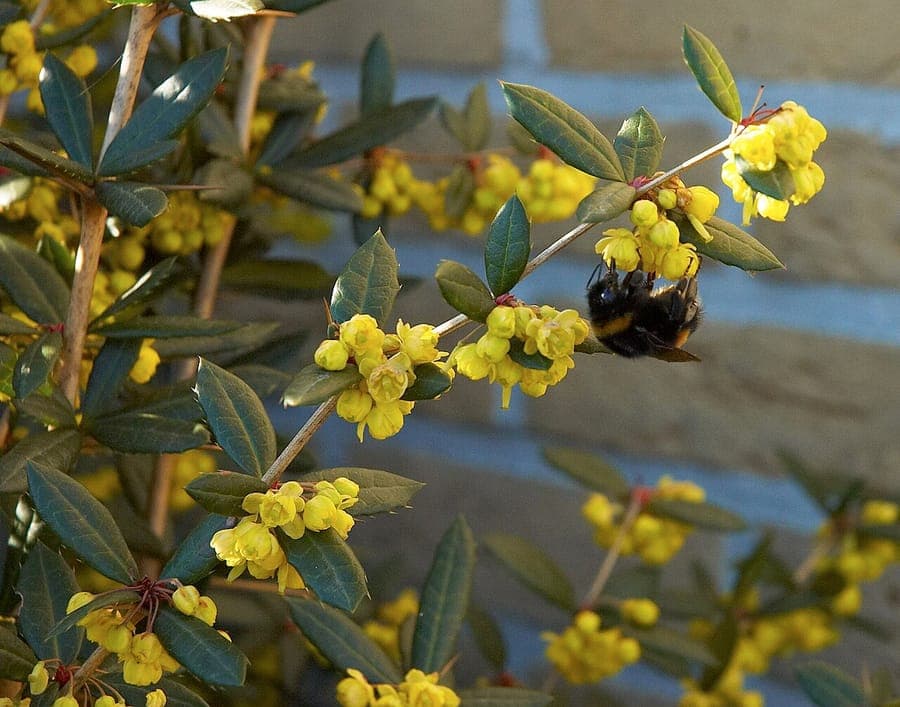
Wouter Hagens / Public domain, via Wikimedia Commons
Chinese barberry: complete guide
Berberis julianae
Want to see Chinese barberry: complete guide in your garden?
1 minute, no credit card
Overview
Berberis julianae, commonly known as Chinese barberry, is a bold evergreen shrub native to central and south-central China. It's gaining popularity in temperate gardens across Europe and North America thanks to its architectural form, resilience, and year-round visual interest. Growing up to 3 meters tall and 2.5 meters wide, it forms a dense, upright thicket that's ideal for screening or security planting. As a member of the Berberidaceae family, it shares traits with other barberries but stands out for its large, glossy foliage and impressive spine coverage. With gardenworld.app, you can design a garden layout that highlights its strong silhouette and integrates it seamlessly into your overall plan.
Appearance & bloom cycle
The plant develops leathery, lance-shaped leaves 5–10 cm long, deep green and highly reflective, giving the shrub a polished look. Each leaf ends in a sharp spine, and the margins are lined with smaller thorns-making it one of the most formidable barberries for deterrence. These evergreen leaves persist through winter, though occasional bronzing may occur in harsh conditions.
From late March to mid-April, dense clusters of bright yellow flowers dangle along the stems. Though small, they bloom in such numbers that the shrub appears golden from a distance. These nectar-rich blooms attract early pollinators like bumblebees and hoverflies. After flowering, cylindrical red berries form, reaching about 1 cm in length. These persist into winter, offering food for birds such as thrushes and waxwings. Note: the berries are mildly toxic to humans and should not be eaten.
Ideal location
Chinese barberry thrives in full sun to partial shade. In full sun, it develops the densest growth and most abundant flowering. In light shade, it still performs well but may stretch slightly and bloom less. Due to its spiny nature, it's best placed at the back of borders, along fence lines, or as a standalone specimen where accidental contact is unlikely.
Avoid planting near footpaths, children's play areas, or seating zones. If you're considering it for a security hedge, ensure it's positioned where its deterrent effect is maximized without creating hazards. Use gardenworld.app to visualize spacing and placement before planting.
Soil requirements
This shrub is adaptable to a range of soil types but prefers well-drained loam or sandy clay. It tolerates pH levels from slightly acidic to slightly alkaline (5.5–7.5). Heavy, waterlogged soils should be improved with grit or compost to prevent root rot. When planting, mix in a generous amount of organic matter like compost or well-rotted manure to help establish strong roots.
Avoid overly rich soils, which can lead to excessive leafy growth at the expense of flowering and structural integrity.
Free design
Want to see Chinese barberry: complete guide in your garden? Make a free design now.
Watering
During the first growing season, water deeply once or twice a week, depending on weather. Keep the root zone consistently moist but never soggy. After the first year, the plant becomes drought-tolerant and requires little supplemental watering, except during prolonged dry spells in summer.
Mulch with 5–7 cm of bark chips or compost to conserve moisture and suppress weeds. Avoid piling mulch against the stem to prevent rot.
Pruning
Pruning is rarely needed for shape, but light trimming can be done to maintain a formal hedge or control size. The best time is right after flowering, from late April to early May. Avoid pruning in late summer, autumn, or winter, as this removes the flower buds and berries that provide winter interest.
Always wear thick gloves and use sharp secateurs or loppers-those spines are no joke. Remove any dead, damaged, or crossing branches to improve airflow and reduce disease risk.
Maintenance calendar
- January: Check for winter damage. No pruning.
- February: Inspect for pests. Light clean-up if weather permits.
- March: New buds swelling. No feeding required.
- April: Main flowering period. Protect from late frosts.
- May: Light pruning after bloom. Replenish mulch.
- June: Monitor for aphids or powdery mildew. Water during dry spells.
- July: Continue observation. Avoid fertilizing in heat.
- August: Water deeply during droughts.
- September: Berries ripening. No pruning.
- October: Let fallen leaves accumulate around base for natural insulation.
- November: Watch for birds feeding on berries. No major tasks.
- December: Enjoy winter structure and persistent fruit.
Winter hardiness
Berberis julianae is hardy in USDA zones 7 to 9, tolerating temperatures down to -15°C. In zone 6b, it may survive with winter protection such as mulching and windbreaks. In exposed sites, foliage may bronze but usually recovers in spring. It holds its leaves well through winter, shedding only under extreme cold.
The red berries often last until February, adding valuable color to the winter garden. Snow-covered branches with bright berries create a striking scene.
Companion plants
Pair Chinese barberry with other structural evergreens like holly (Ilex), yew (Taxus), or boxwood (Buxus). Use lower-growing perennials like Heuchera, Helleborus, or Carex to soften the base. For contrast, plant fine-textured ferns such as Dryopteris or Matteuccia nearby.
Avoid moisture-loving plants that can't tolerate dry root zones-this shrub creates a dry microclimate. Drought-tolerant companions like Lavender, Sedum, or Nepeta work well.
Closing
Berberis julianae is a tough, attractive, and functional shrub that earns its place in any well-planned garden. It's low-maintenance, long-lived, and provides year-round interest with minimal care. Whether you're building a secure boundary, adding winter structure, or simply want a bold evergreen statement, this barberry delivers. Find it at local garden centres or online retailers, and use gardenworld.app to test how it fits into your garden design before you plant.
Want to see Chinese barberry: complete guide in your garden? Make a free design now.
Upload a photo, pick a style, and get a photorealistic design with plant list in under a minute.
No credit card required


Similar plants
Heavenly bamboo: complete guide
Nandina domestica
Everything about heavenly bamboo (Nandina domestica): planting, pruning, hardiness, and colour impact. Note: berries are toxic to birds and pets.
Colorado barberry: complete guide
Berberis fendleri
Everything about Berberis fendleri, the Colorado barberry with yellow flowers and red berries. Perfect as a thorny hedge or specimen shrub in dry gardens.
Jeffersonia diphylla: complete guide
Jeffersonia diphylla
Discover Twinleaf, a charming woodland plant from North America. White flowers, unique foliage, perfect for shady borders.