
Sten Porse / CC BY-SA 3.0, via Wikimedia Commons
Clustered barberry: complete guide
Berberis aggregata
Want to see Clustered barberry: complete guide in your garden?
1 minute, no credit card
Overview
Berberis aggregata, commonly known as clustered barberry, is a refined, arching shrub that brings subtle charm to mixed borders and woodland gardens. Native to the mountainous regions of central China - including Qinghai - it's adapted to cool, dry summers and cold winters, making it a resilient choice for temperate climates. Unlike many barberries, this species is only lightly spiny, which makes it safer around kids and pets while still offering structural interest.
It grows slowly to about 1.2 meters tall and spreads up to 1.5 meters wide, forming a loose, mounding shape. The foliage is semi-evergreen in milder zones (USDA 7 and above), retaining its color through winter, while in colder areas it may drop some leaves but still keeps a woody framework. Its compact size makes it ideal for small gardens, foundation plantings, or as a low hedge.
On gardenworld.app, you can design a planting scheme that accounts for the mature spread of clustered barberry, ensuring it doesn't overcrowd neighboring plants.
Appearance & bloom cycle
The leaves are small, elliptical, and bright green, measuring 2–4 cm long. They grow in clusters along the stems and may take on bronze or purplish tones in autumn, especially in cooler areas. In mid to late spring - typically April to May - it produces hanging clusters of soft pink to pale red flowers. Each truss holds 5–10 delicate blooms, which attract early pollinators like bumblebees.
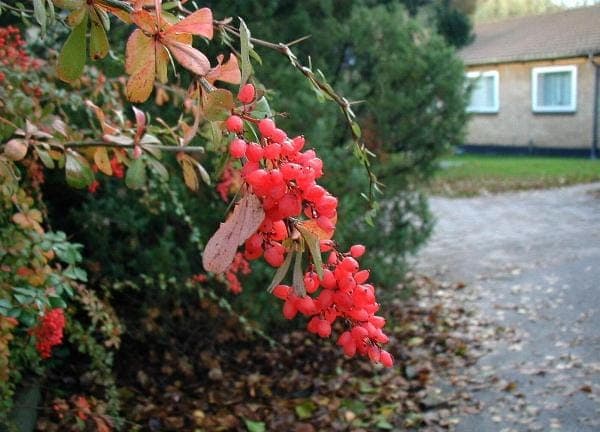
After flowering, small blue-black berries form, about 6 mm in diameter. These persist into winter and are a food source for birds such as thrushes and waxwings. While edible for humans, they're quite tart and rarely eaten fresh. The berries add seasonal interest and complement the plant's architectural form.
Ideal location
Clustered barberry thrives in full sun to partial shade. For the best flowering and densest growth, plant it in a spot with at least 6 hours of direct sunlight. It tolerates light shade, especially in hotter climates, but too much shade leads to leggy growth and fewer blooms.
A south- or east-facing border works well. It's also effective as a groundcover on dry slopes or tucked into mixed shrub borders. Avoid planting under dense tree canopies where root competition and shade are high. In containers, use a pot at least 40 cm deep with good drainage holes.
Soil requirements
This barberry isn't fussy about soil type, as long as it's well-drained. It handles sandy soils, loam, and even rocky conditions. Heavy clay needs amending with grit or compost to improve drainage. The ideal pH range is 5.5 to 7.5 - slightly acidic to neutral.
When planting, dig a hole twice as wide as the root ball but no deeper. Backfill with native soil mixed with a small amount of compost. Do not add fertilizer at planting time - it can burn young roots. Keep mulch away from the base to prevent rot.
Free design
Want to see Clustered barberry: complete guide in your garden? Make a free design now.
Watering
During the first growing season, water weekly with 5–7 liters per plant, especially during dry spells. Once established, Berberis aggregata is highly drought-tolerant and only needs supplemental water during prolonged droughts (over 4 weeks without rain).
Use a soaker hose or watering can with a rose to avoid wetting the foliage, which reduces the risk of fungal issues. Water early in the morning or in the evening to minimize evaporation.
Pruning
Pruning is rarely necessary, but if the plant becomes too wide or leggy, trim it in late winter to early spring (March to early April). Focus on removing old, crossing, or damaged stems at the base. Wear gloves - while not as spiny as other barberries, it still has small thorns.
For shaping, cut back to just above a healthy bud or side shoot. Avoid cutting into old wood without buds, as it may not regenerate. Don't prune after July, as it could remove next year's flower buds.
Maintenance calendar
- February: Check for winter damage; remove broken stems.
- March: Light pruning; tidy up old growth.
- April – May: Flowering period; apply a thin layer of compost around the base.
- June: Light shaping if needed; no fertilizing.
- July – August: Monitor during drought; water only if essential.
- September: No maintenance required.
- October: Rake fallen leaves if necessary.
- November – January: Protect container plants from freezing; ensure soil doesn't stay waterlogged.
Winter hardiness
Berberis aggregata is hardy in USDA zones 6b to 8. It can survive temperatures down to -20.5°C (zone 6b), though top growth may die back in harsh winters. It reliably re-sprouts from the base in spring. In zone 7 and above, it remains semi-evergreen with minimal dieback.
For potted plants, elevate containers on feet to prevent frozen soil. Wrap the pot in burlap or bubble wrap when temperatures drop below -10°C. Avoid heavy winter mulching around the crown - it can trap moisture.
Companion plants
Pair clustered barberry with late-spring perennials like Allium karataviense or Geranium macrorrhizum. It works well in mixed borders with boxwood (Buxus sempervirens) or dwarf hollies (Ilex crenata). For winter texture, plant near Viburnum tinus or Euonymus fortunei.
On dry slopes, combine with drought-tolerant plants like Sedum telephium, Thymus vulgaris, or Dianthus. The contrast in form and bloom time creates visual depth and year-round appeal.
On gardenworld.app, you can preview how clustered barberry fits into your garden's seasonal flow, helping you plan for color and structure across all months.
Closing
Berberis aggregata is a low-maintenance, reliable shrub that delivers interest in multiple seasons - spring flowers, summer foliage, fall tones, and winter berries. It's adaptable, tough, and blends well into both formal and naturalistic designs.
You'll find it at garden centres across the UK and US, typically available from March to May. Look for healthy plants with moist (not soggy) root balls and no signs of mildew or dieback. Plant within 24 hours of purchase for best results.
With the right start, clustered barberry becomes a quiet workhorse in your garden - not flashy, but always dependable.
Want to see Clustered barberry: complete guide in your garden? Make a free design now.
Upload a photo, pick a style, and get a photorealistic design with plant list in under a minute.
No credit card required


Similar plants
Heavenly bamboo: complete guide
Nandina domestica
Everything about heavenly bamboo (Nandina domestica): planting, pruning, hardiness, and colour impact. Note: berries are toxic to birds and pets.
Colorado barberry: complete guide
Berberis fendleri
Everything about Berberis fendleri, the Colorado barberry with yellow flowers and red berries. Perfect as a thorny hedge or specimen shrub in dry gardens.
Jeffersonia diphylla: complete guide
Jeffersonia diphylla
Discover Twinleaf, a charming woodland plant from North America. White flowers, unique foliage, perfect for shady borders.