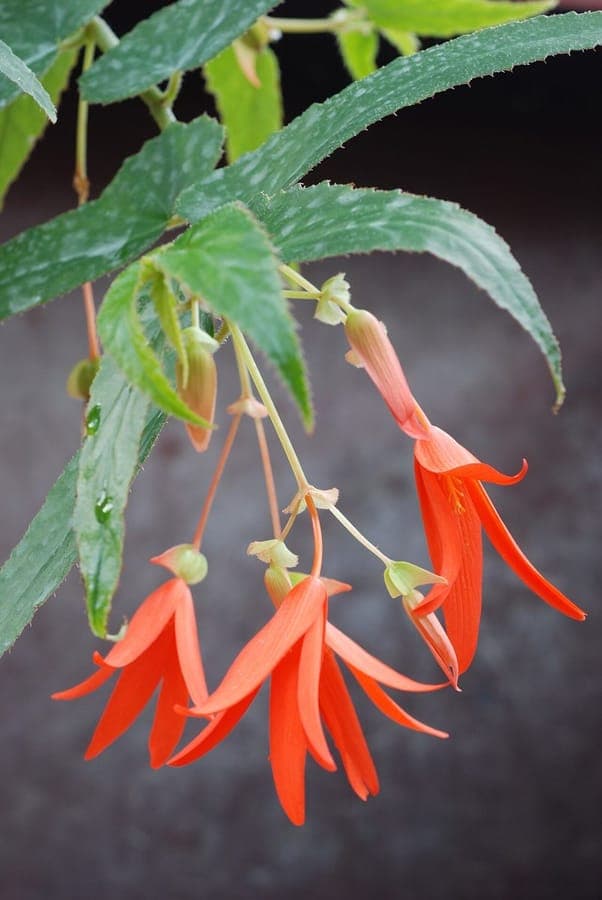
GCornelis / CC BY-SA 3.0, via Wikimedia Commons
Bolivian begonia: complete guide
Begonia boliviensis
Want to see Bolivian begonia: complete guide in your garden?
Full design in HD: €7.99
Look after your Bolivian begonia with the GardenWorld app
Identify plants with your camera and get a care calendar with reminders for this plant.


Overview
Bolivian begonia (Begonia boliviensis) is a begonia you might not recognise as one at first glance. Instead of round, double blooms it carries slender, dangling bells in vivid orange-red that are more reminiscent of a fuchsia. Garden centres often sell it simply as a trailing or hanging begonia, a label also used for trailing tuberous begonias, so check the botanical or cultivar name on the tag.
The species grows wild in the cloud forests on the eastern slopes of the Andes in Bolivia and north-western Argentina. There it often grows in rock crevices along streams, its stems hanging down over the stones. The Swiss botanist Alphonse de Candolle described it in 1859, and in 1864 the plant hunter Richard Pearce brought it to England, where it was promptly used to raise the first tuberous begonia hybrids. Begonia boliviensis is therefore one of the ancestors of the tuberous begonia (Begonia × tuberhybrida).
Only since the early 2000s has the species itself become popular as a container plant, thanks to selections such as 'Santa Cruz Sunset' and related hybrids such as 'Bonfire', 'Million Kisses' and 'Waterfall Encanto'. These flower more freely and tolerate more sun than the classic tuberous begonia. Want to see where this exuberant trailing plant would look best in your garden or on your patio? On gardenworld.app you can have a garden design made that includes pots and containers too.
Like the tuberous begonia, it grows from a tuber that goes dormant in winter. In our climate you can treat it as a summer plant to overwinter, or as an annual that you replace each spring.
Appearance and bloom cycle
The plant forms arching, cascading stems 40 to 60 cm long, sometimes longer on older tubers. The stems are succulent, green to reddish and branch well. The leaves are narrowly lance-shaped and lopsided, 8 to 15 cm long, with sharply toothed edges. They are fresh green, or bronze-tinted in some selections.
The flowers hang in loose clusters on long, slender stalks. They are 3 to 5 cm long, tubular with pointed, flaring petals and usually scarlet to orange. Selections in salmon, pink, white and yellow also exist. Their shape and vivid colour suit pollination by hummingbirds in the wild. The photo shows the typical dangling orange-red flowers with their long, pointed tips, with the narrow, toothed leaves above.
Flowering starts in June and continues without a break until the first frost in October. Spent flowers usually drop by themselves, so the plant stays tidy.
Ideal location
Begonia boliviensis tolerates more light than most begonias. Partial shade with morning or evening sun is ideal, but in our climate it also does well in full sun, provided the compost never dries out. On a hot south wall or during long heatwaves the foliage may pale and flowering slows. In deep shade the plant grows but flowers sparsely.
Because of its trailing habit it is at its best in hanging baskets, tall pots, window boxes on a railing or wall planters, where the stems can hang freely. Choose a spot with some shelter from wind, as the long stems can snap in a gale. Allow one plant per 30 cm hanging basket or three plants per metre of window box.
Soil requirements
Use an open, well-drained compost. A good-quality container compost with about 20% perlite works well. The pH can be slightly acidic to neutral, around 5.5 to 6.5. The tuber cannot stand waterlogging, so drainage holes are essential.
In the ground you can use the plant along a raised edge or in a rockery, where the stems can spill over. The soil there should be humus-rich and open. Heavy, wet clay is unsuitable.
Free preview
Want to see Bolivian begonia: complete guide in your garden? Make a free preview of your design.
Watering and feeding
Keep the compost lightly moist in summer, letting the top few centimetres dry between waterings. The tuber stores some water, so the plant copes with a short dry spell better than the tuberous begonia, but prolonged drought costs flowers. Check sunny hanging baskets every day in warm weather.
Water onto the compost, not into the centre of the plant, and avoid soggy roots. From June to the end of August give a liquid feed for flowering plants every 10 to 14 days. Stop after that so the tuber can ripen.
Pruning
Pruning is hardly needed. If a plant becomes too long or bare at the base, cut a few stems back by a third in July; they regrow quickly. Remove yellow leaves and any faded flowers that cling on, so grey mould gets no chance.
Stem cuttings of 8 to 10 cm root readily in moist cutting compost in summer. That way you can raise extra plants or keep a favourite colour without lifting the tuber.
Maintenance calendar
March–April: Start tubers at 15 to 20 °C in a bright spot, hollow side up and barely covered.
May: Harden plants off. After mid-May, once frost is over, move them outdoors.
June–August: Water regularly and feed every two weeks. Check hanging baskets daily in hot weather.
September: Stop feeding. Take cuttings if you like.
October: After the first light frost, or when the leaves turn yellow, lift the tubers or bring the pot indoors.
November–February: Store tubers dry and frost-proof at 5 to 10 °C.
Winter hardiness
Begonia boliviensis cannot take frost, and the foliage dies at the first frosty night. In very mild, sheltered gardens a deeply planted tuber may sometimes survive a soft winter under a thick mulch, but in most of Britain and the Low Countries you should not count on it.
Overwintering works just as for the tuberous begonia. Let the pot dry out in October, cut off the stems and keep the tuber in the dry compost or in dry sand somewhere frost-proof at 5 to 10 °C. Check now and then for rot. In March the cycle starts again. In containers, watch out for vine weevil grubs (Otiorhynchus sulcatus), which can hollow out the tuber.
Toxicity to pets
Like all begonias, Begonia boliviensis is toxic to dogs, cats and horses. The ASPCA lists soluble calcium oxalates as the toxic principle for the genus Begonia and names the underground parts, meaning the tuber, as the most toxic. Eating the plant mainly causes drooling, vomiting and irritation of the mouth and throat in dogs and cats. In grazing animals such as horses, larger amounts can harm the kidneys.
Hanging baskets keep the plant out of reach of most pets, which is a bonus. Do store overwintering tubers where your dog or cat cannot get at them. The plant is not edible for people either. If your pet has eaten some, contact your vet.
Companion plants
In a hanging basket or window box, combine Begonia boliviensis with plants that enjoy the same light to partial shade. Blue trailing lobelia (Lobelia erinus) makes a strong contrast with the orange-red flowers. The silvery foliage of Helichrysum petiolare adds calm among the bright colours.
In a sunnier spot it pairs well with ivy-leaved pelargoniums (Pelargonium peltatum) and the fine white flowers of sweet alyssum (Lobularia maritima), which fill the base of the container. To know when to start tubers and when the containers can go outside, check the plant calendar on gardenworld.app.
Final thoughts
Begonia boliviensis is an ancestor of the tuberous begonia and an excellent trailing plant with a character all its own. It flowers from June to October, takes more sun than its cultivated descendants and needs little upkeep. Give it a hanging basket, regular watering and dry, frost-proof winter storage, and keep the tubers out of reach of pets.
Frequently asked questions about Bolivian begonia
Is Bolivian begonia winter hardy?
Begonia boliviensis cannot take frost, and the foliage dies at the first frosty night. In very mild, sheltered gardens a deeply planted tuber may sometimes survive a soft winter under a thick mulch, but in most of Britain and the Low Countries you should not count on it.
When and how do you prune Bolivian begonia?
Pruning is hardly needed. If a plant becomes too long or bare at the base, cut a few stems back by a third in July; they regrow quickly.
How much water does Bolivian begonia need?
Keep the compost lightly moist in summer, letting the top few centimetres dry between waterings. The tuber stores some water, so the plant copes with a short dry spell better than the tuberous begonia, but prolonged drought costs flowers.
Where does Bolivian begonia grow best?
Begonia boliviensis tolerates more light than most begonias. Partial shade with morning or evening sun is ideal, but in our climate it also does well in full sun, provided the compost never dries out.
What soil does Bolivian begonia need?
Use an open, well-drained compost. A good-quality container compost with about 20% perlite works well.

See it in your garden
See Bolivian begonia in your garden
One photo of your garden and a few questions. You see the result in about a minute.
Try it with a photoIdentify this plant in your own garden. Identify a plant
Similar plants
Lobelia erinus: complete guide
Lobelia erinus L.
Lobelia erinus is popular trailing plant with blue or red flowers, perfect for hanging baskets and containers. Flowers continuously all summer long.
Helichrysum petiolare: complete guide
Helichrysum petiolare
Helichrysum petiolare, the licorice plant, is a graceful trailing plant with silvery-gray foliage perfect for containers and hanging baskets.
Ivyleaf geranium: complete guide
Pelargonium peltatum
Discover ivyleaf geranium, a practical hanging plant with purple and pink flowers. Learn about cultivation, pruning and winter storage in this guide.
